

How To Safely Prune Lavender In November (If You Didn't Get To It Earlier)
We may receive a commission on purchases made from links.
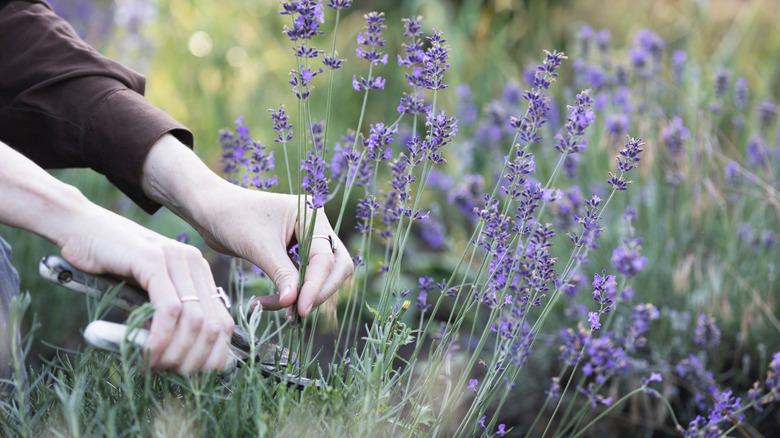
Lavender (Lavandula spp.) is a popular plant in lawns and gardens throughout much of the U.S. A colorful plant that adds depth to yards and attracts butterflies and other pollinators, lavender is also renowned for its pest-repelling properties. It's often used to help keep pesky insects such as mosquitoes away from patios and other outdoor living spaces. While lavender is often thought of as a fuss-free plant that is ideal for beginners, it does require a bit of maintenance. Among the routine tasks which need to be performed is pruning. While this is ideally done earlier in the year, you can safely prune lavender in November if you didn't get to it earlier.
While pruning during spring (post-frost) can be done to shape the plant, remove dead portions, and/or prevent a second flush, or blooming, it is the summer pruning which is most critical. It is at this time that most of the shaping, trimming, and removal of woody growth takes place. If you performed a thorough pruning after your plants bloomed in the summer, you typically don't have to do it again in autumn. This holds generally true for English, French, and Spanish species of lavender. However, if for whatever reason you haven't gotten around to it, it is a good idea to prune before winter to help breakage and damage from snow, ice, and wind. Although this pruning can wait until November, it should be completed a month or so before the first frost if possible. This fall clean-up is especially important for English lavender (Lavendula angustifolia) which is a cold-hardy, overwintering variety (down to zone 5), so it'll be the more prominent option in the northern parts of the U.S.
Best practices for pruning your lavender plants
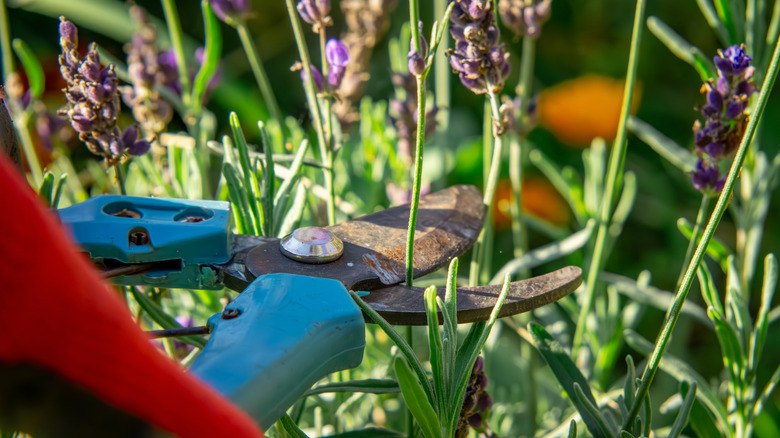
To prune your lavender, all you'll really need is a pair of clean, sharp pruning shears, such as the Fiskar's Bypass pruning shears, and a pair of gardening gloves to protect your hands from this abrasive plant. Before you launch into snipping and cutting, assess your plants and determine where you should cut. A good rule of thumb is to cut back a third of the plant. However, this can vary. What you should focus on is where the woody section ends and the soft, green growth begins. Unless it is dead or damaged, you shouldn't cut into the woody part, as lavender won't grow on old wood. Make sure your shears are clean and sanitized, to avoid spreading mildew or disease to healthy plants. Bleach-free Clorox wipes is one option as they make disinfecting gardening tools a breeze.
As you begin cutting, try to lop each stem a couple inches above the woody section. Cutting stems individually is the most precise way to do this, although if your stem are fairly uniformed you can cut several at a time. Any dead, dying, or damaged stems you come across should be cut off at the base. Shape the plant as you prune, with the idea being to preserve the natural rounded dome shape of the plant. This curvature isn't just about style, it also actually helps protect the plant during severe winter weather. However, while maintaining the shape is important, be careful not to cut too much at once.