

A Beautiful Hydrangea Variety That'll Fill Your Garden With Stunning Fall Foliage

We may receive a commission on purchases made from links.
As the air starts to get crisp during autumn, people make countless trips across the U.S. and Canada to watch trees change colors from greens to oranges, reds, browns, and yellows. It's certainly worth visiting the most scenic rivers and lakes in America to experience fall foliage — or perhaps you could plan a trip to see the must-drive New Mexico route for autumn views, known as the Enchanted Circle Scenic Byway. However, you can actually add some stunning autumnal foliage to your garden by planting oakleaf hydrangea. That way, you can enjoy the changing colors every day of leaf peeping season.
Oakleaf hydrangea (Hydrangea quercifolia) grows well in USDA Hardiness Zones 5 through 9. Luckily, that's the vast majority of the continental United States. It typically grows 4 to 8 feet tall and equally as wide. As the name suggests, this shrub features foliage that is reminiscent of the leaves of an oak tree. During summer, these leaves are vivid green, accented by pyramid-shaped clusters of small white flowers. However, as temperatures cool in the fall, the flowers fade away and the leaves turn an array of autumnal colors, ranging from purple and red to bronze and brown.
How to plant an oakleaf hydrangea to add fall color to your garden
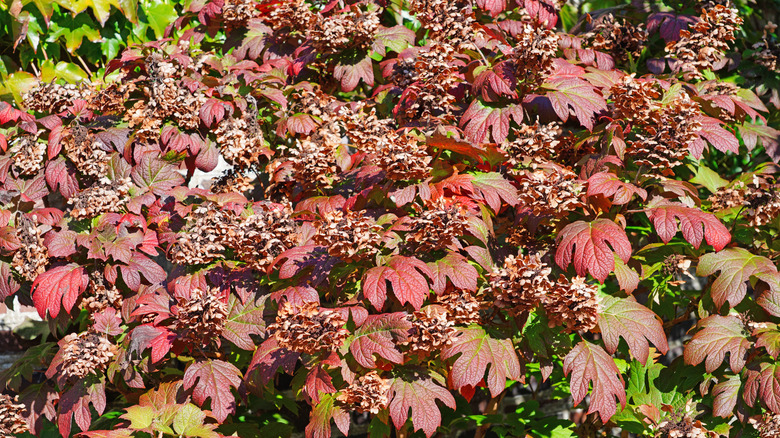
Fall is a great time to plant an oakleaf hydrangea, as is spring. When it comes to selecting a site for your plant, pick an area that has acidic, well-draining soil, and receives a good amount of sunlight. The area should also have plenty of open space to allow the plant to mature to its maximum width of 6 to 8 feet.
Once you have selected a site and purchased plants, use a Spear Head Spade or similar gardening shovel to dig a hole about twice as wide and a little deeper than the root ball. Next, take the plant out of its container and loosen its roots before planting. Then, put the plant in the center of the hole with the root ball sticking up just a bit above the surface of the soil. Backfill the hole, tamping down the area to remove air pockets, and cover the base of the plant with 2 or 3 inches of mulch.
Although oakleaf hydrangeas are not exactly maintenance-free plants, they're not too difficult to manage. Regularly check and amend the soil to maintain an acidic pH, and don't forget to water regularly. Fertilizing typically isn't necessary. Caring for hydrangeas during fall months involves little more than just watching their leaves change colors. Although some varieties require a light pruning at this time of year, oakleaf hydrangeas do not. If you want to remove the dead flowers, you can. But don't prune anything beyond deadheading and dead branches, as the following season's blooms will emerge from old wood — not new growth.