

A Perennial Member Of The Sunflower Family You Should Prune During Fall
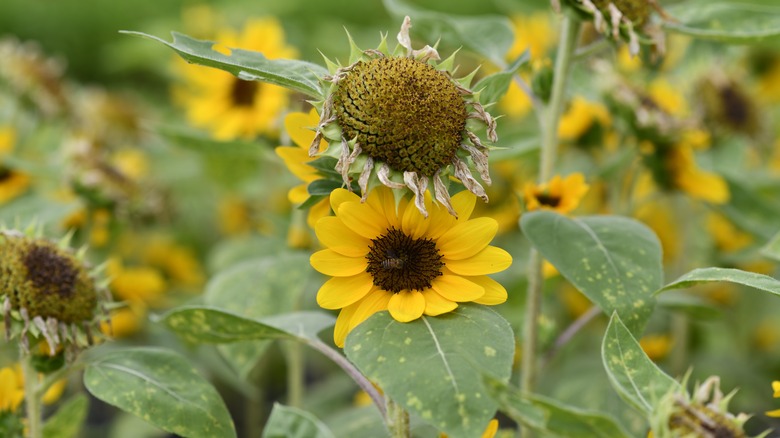
Carefully sowing sunflowers in your garden is a great way to add color and life, without much care and maintenance. However, there are certain species of perennial sunflower, like H. laetiflorus and H. salicifolius that should be pruned down to the ground in the fall once they are past their peak. Plus, your garden and compost pile will appreciate it.
Sunflowers are indeed quite the crowd pleasers. With over 150 species in the sunflower family (Helianthus spp.), it might be hard to tell which sunflowers are annuals or perennials. Annual varieties are often grown for their seeds and oil and usually have one main stem. They are the classic, larger-than-your-face blackish-brown disk in the center with yellow outer rays. These you can just pull out in the fall.
Perennials are a little more understated. For the most part, they don't grow as tall, and their flower heads and seeds are much smaller. They also produce more branches and flowers and fewer seeds. Because the vast majority of perennial sunflowers are native to North and Central America, they can be found along the road, as well as in undisturbed prairies and woodlands. And while some are small enough you don't need to do much as they go dormant for winter, the larger varieties mentioned above are better off pruned as those blooms die and the long stalks become fragile.
Deadhead the annuals all summer, prune the perennials in the fall
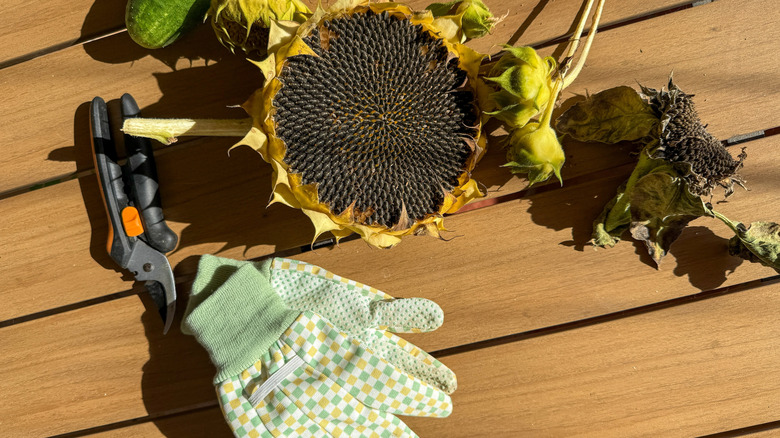
Deadheading annual sunflowers in the summer discourages the plant from going to seed and encourages more flowering. However, this is not the case for perennial long-stemmed sunflower varietals like the cheerful sunflower (Helianthus laetiflorus) or the willow-leaved sunflower (Helianthus salicifolius). Let them do their thing until their blooms naturally slow down as they start to focus energy on seeding and storing energy in their rhizomes for next spring. Once you notice the plant is brown, crispy, and a bit of an eyesore, then you can step in.
Pruning cheerful and willow-leaved sunflowers almost to the ground has numerous benefits. First, it encourages more bushiness, discourages diseases that proliferate on dead leaves/stems, and encourages more flowering for the following season. Plus, leaving the plant in place can lead to self-seeding more sunflowers in your garden, potentially crowding other species in your garden. Finally, if you want to save the seeds and sow them elsewhere, pruning will be your first step.
First, clean your pruning shears with a disinfectant. This helps prevent any fungal diseases from spreading. With sharp, clean pruners, clip the sunflower down to the ground. It's a good idea to remove the clippings because letting them decompose on the ground can encourage diseases in your garden. Pruning in late fall keeps your garden looking tidy and provides space for late-blooming plants and winter ground covers to receive more sunlight. Sunflower stems and stalks are a great source of carbon for your compost and provide structure to allow for air flow. If you want to save seeds and sow them in other areas, hang the clippings or spread them out on wire racks so they can dry. Once dry, shake/rub off the seeds, and sift out any debris.