

The Beautiful Maple Tree Variety That'll Thrive In Your Small Yard
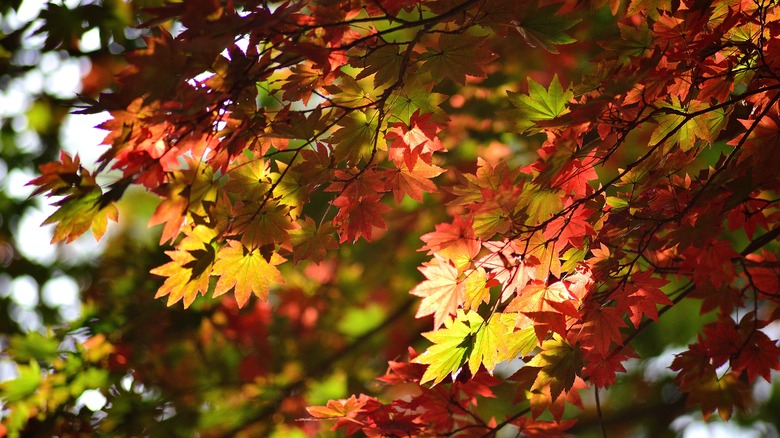
Maple trees are hard to beat when it comes to colorful displays. The sugar maple (Acer saccharum) is so well-loved for its vibrant hues that it's considered the state tree for more states than any other tree species. Red maple (Acer rubrum) is also a colorful variety, with various parts of the plant exhibiting hints of red at different times of the year. Both of these trees can be quite large when they mature, though. The red maple grows 40-60 feet high with a canopy up to 50 feet wide, while the sugar maple clocks in at 60 to 75 feet tall and up to 50 feet wide. Needless to say, these aren't ideal choices when shopping for a colorful tree to plant in a small yard. There's a vibrant maple tree that thrives in small areas, though — the red laceleaf Japanese maple (Acer palmatum 'Orangeola').
The red laceleaf Japanese maple, winner of the Royal Horticultural Society's Award of Garden Merit, boasts an incredibly colorful display that changes continually throughout its active season. In the spring, it displays bright oranges and reds, and in the summer, the reds deepen, while greens emerge. During autumn, the leaves become a brilliant red and orange before finally falling from the tree. Unlike other maple trees, the foliage on this one has a lacey appearance, with narrow leaf segments. This showy tree grows 4 to 8 feet tall and up to 7 feet wide, making it an excellent choice for gardens with limited space. Like fruit trees that grow in pots, the laceleaf Japanese maple can also be grown in a container. It's fairly deer-resistant, as well. If plant-chomping deer are an issue in your area, there are more deer-resistant plants, such as allium, you might consider, in addition to this one.
How to grow a red laceleaf Japanese maple
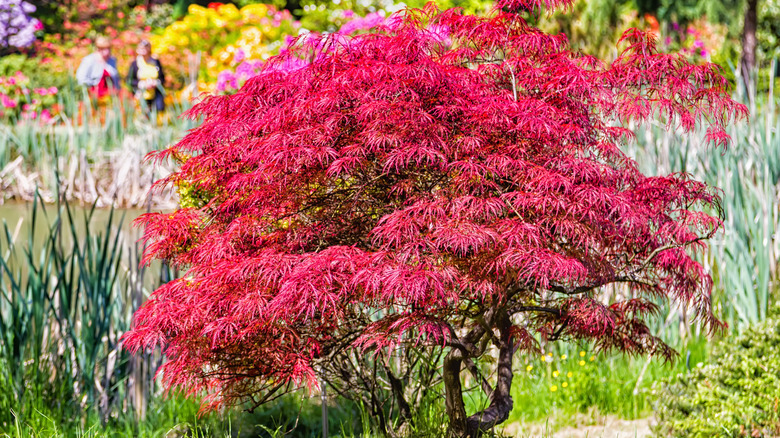
This type of Japanese maple grows well in USDA hardiness zones five through eight. If you're wondering if a laceleaf maple will grow in your yard, here's how to find out your plant hardiness zone. The laceleaf Japanese maple prefers partial shade and thrives in moist, yet well-draining, slightly acidic soil rich in organic matter. It also does best when blocked from strong winds. If you live in an area with extremely hot summers, plant the tree in a location that is not exposed to the hottest afternoon sun. In partial shade, the laceleaf Japanese maple displays its colors most vividly. This is a low-maintenance tree that typically doesn't require pruning, which is great for those looking for something easy to care for. After planting your laceleaf maple, however, you will need to ensure that you water it deeply and regularly for the first few years to help the roots establish themselves. Adding mulch around the tree also helps keep the roots cool and the soil moist.
A newly planted laceleaf maple won't outgrow your small outdoor space anytime soon, if ever. In 10 years, it will only have reached about 4 feet tall and 3 feet wide. At full maturity, which occurs around 15 years, its tops out at about 8 feet. This makes the tree an excellent choice for small yards that need a splash of color.