

A DIY Garden Cage That'll Make Use Of Your Old Hose
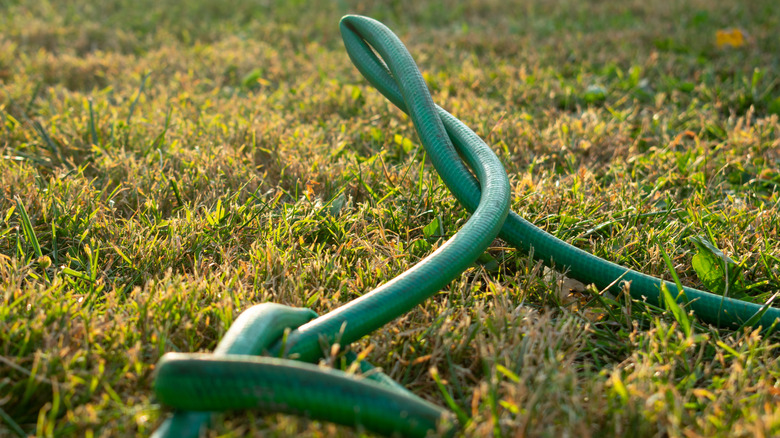
A garden hose is extremely useful around the yard and garden ... until it's not. An old hose that leaks or gets kinked all the time may seem worthless after a point, but it's actually quite useful in an entirely new way. For example, you can turn an old hose into a DIY wattle fence. You could use hoses with contrasting colors to make a stylish upcycled outdoor mat. Or the more flattened and unworthy of holding water your hose is, the easier it is to repurpose as part of a garden cage or trellis.
After all, a garden hose is a soft, pliable structure, making it suitable for use even with delicate climbing plants that need a support to cling to as they venture ever upwards. All sorts of garden staples — such as tomatoes, beans, and peas — benefit from supports to keep the plants off the ground. A tipi-style trellis or cage is a favorite for growing tomatoes (even Martha Stewart uses this special trellis for tomatoes in her garden), and with the addition of a hose, you can add strong horizontal or spiraling supports attached to the tipi frame.
How to incorporate a hose into a garden cage or trellis
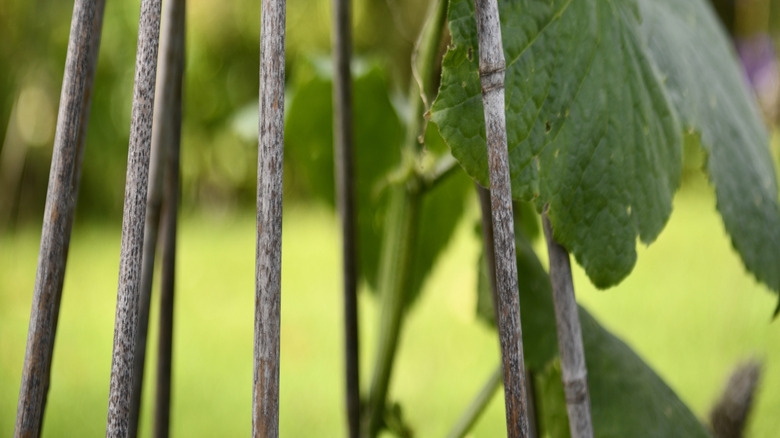
For the garden cage, you'll need three or more long poles or stakes for each plant. Bamboo works wonders in this role because it's flexible and it's a fairly renewable resource. Choose stakes that are close to an inch thick for heavy tomato varieties or other plants that need strong supports; thinner stakes are sufficient for vines that don't bear heavy produce. Push each stake into the ground about 10 inches and in a triangular formation, with each one a few inches from the plant they'll support. Press the tops of the stakes toward the center and secure them; a rubber band comes in handy to hold them as you tie them together with twine. The twine should be a few inches from the top, with the poles crossing at this point, similar to the poles in a tipi.
Once they're tied with twine and stable, they're ready for their garden hose upgrade. The hose gives the vines, stems, or lanky parts of a plant a place to rest and cling to as they grow. Cut the ends off the old hose using a utility knife. Tie one part of the hose near the top of the tipi using twine or a zip tie, then wrap the hose diagonally around the entire structure. Occasionally loop it around one of the posts for added support, then continue the spiral towards the ground. When you reach the end of the hose, secure it to the framework with twine or a zip tie. As your plants grow, gently guide them through the tipi, using the hose as supports. If necessary during the process, use a bit of twine or torn cotton cloth to loosely loop the plant tendrils to the hose or poles to guide them.