

The Invasive Tree You May Not Want To Get Rid Of If You Have A Spotted Lanternfly Problem
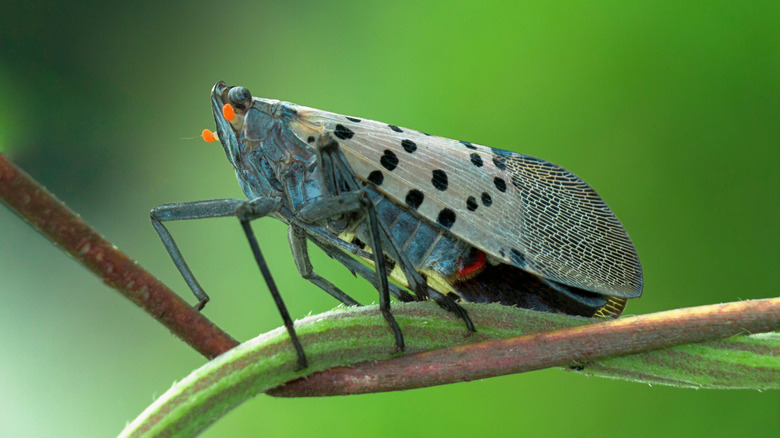
The spotted lanternfly may look harmless with its strikingly decorated wings, but since its arrival in the U.S. from Southeast Asia in 2014, this pest has been wreaking havoc. What started as a small event in Pennsylvania has spread to Delaware, Maryland, New Jersey, New York, Ohio, and Virginia. By piercing plants to feed on sap, lanternflies weaken trees and shrubs, leaving behind a sticky honeydew that fosters mold and invites other pests to the party. The result? Threats to crops, ornamental landscapes, and even local economies tied to tourism and agriculture. With no natural predators in the U.S., the invasion has been swift and relentless.
Interestingly, one of the lanternfly's preferred hosts is another invader: The tree of heaven, which is also a little-known threat to other plants in your yard. This species is widely considered a nuisance, which is why you should reconsider planting this fast-growing tree variety in your yard. But it's also highly attractive to lanternflies because the male (tree) emits a strong odor that seems irresistible to the flying pests. That creates an opportunity. Instead of immediately cutting these trees down, homeowners battling lanternflies might actually be able to strategically use them as a tool, turning the tree of heaven into a living trap for managing infestations.
How to identify the tree of heaven and use it to trap spotted lanternflies
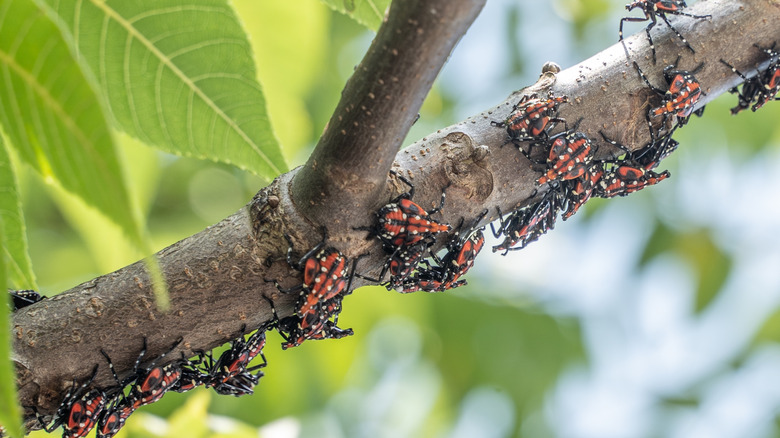
If you suspect you've got a tree of heaven (Ailanthus altissima) in your yard, here's how to be sure: First, size up those leaves. They're large — growing up to 80 feet tall and six feet in diameter. The leaf clusters are also impressive, stretching 1 to 4 feet long off the branch, with up to 40 smooth-edged leaflets. Next, crush a leaf and prepare for a whiff of rancid peanut butter or skunky gym socks, an unmistakable odor of this tree (in China, it's nicknamed "stinking chun"). The bark is another giveaway. Younger branches are smooth, while mature trunks are rougher and gray with the bumpy texture of a cantaloupe. All these features set the tree of heaven apart from look-alikes like black walnut or sumac.
One of the most effective ways to spot and remove spotted lanternflies in your yard is by turning the tree of heaven against them. Since lanternflies are drawn to this invasive tree in late summer and fall for feeding and laying eggs, experts use what's called a "trap tree" method. The approach, developed by the Pennsylvania Department of Agriculture, involves removing about 90% of the tree-of-heaven from a property (particularly the female trees) and treating the remaining few males with a systemic insecticide. When lanternflies feed on these treated trees, they ingest the insecticide and die, reducing populations over time. While this strategy can make a big difference, it comes with cautions. You must apply insecticides exactly as directed, and some (like neonicotinoids) can harm pollinators like bees that also visit tree of heaven flowers. Careful timing and application are essential to minimize unintended damage while maximizing control of this pest. If you're worried about doing this right, your best bet is to report a sighting to your state's department of agriculture, while also enlisting a licensed arborist to help properly manage the pest.