

Why You Should Skip Trying The Bug Spray Trick For Weed Control
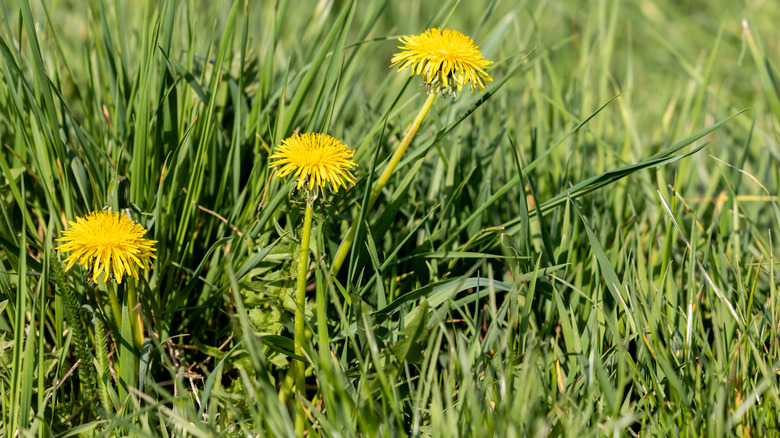
Weeds are an unfortunate reality for any homeowner or gardening enthusiast, and can certainly be a formidable foe. They've evolved to grow incredibly fast (even one to two inches overnight, in some cases!) and are capable of doing so in all kinds of conditions. It's possible to use grass alternatives if you're trying to avoid weeds in your yard. But if you have your heart set on traditional turf grass, it can be tempting to find any means necessary to get rid of unwanted weeds, including a trick you may have come across online that involves using bug spray with DEET to kill off weeds. But while the Centers for Disease Control and Prevention considers DEET a safe and effective way to prevent mosquito bites, this ingredient is far from safe for your lawn, and can do serious damage to your grass in the process. Essentially it's just not worth the risk to kill a few weeds with bug spray.
So what exactly is this stuff? DEET — an acronym for the chemical compound known as N,N-diethyl-meta-toluamide, or diethyltoluamide — is a colorless liquid that has been used in the U.S. as an ingredient in insect repellents since 1957. It is believed to repel bugs by impacting their ability to detect and locate humans, but can also have a detrimental effect on plants. Here's what you should know.
Here's what DEET does to plants

Richard Zollinger, a retired weed specialist at North Dakota State University Extension, explained to Farm Progress that DEET "will burn the foliage of most any plant." He notes that a large enough dose will completely desiccate even mature, fully established plants. In fact, traditionally that was the goal of using bug repellent as a weed killer. The weed or plant needs to be completely doused in DEET in order to prevent regrowth from occurring, but the method does appear to be effective if the weed is sufficiently covered. However, in the process of killing off weeds you'll probably end up killing off your grass and any surrounding plants, too. Research reported by Iowa State University Extension found that grass sprayed with one bug spray brand containing DEET showed signs of damage within just three hours, turning the grass's coloring from dark purple to brown and taking weeks to recover — or in some cases, not recovering at all. It turns out the risk to your lawn is present, even if you're spraying yourself. So always make sure you're not applying bug spray near any plants you love.
So if you're on a mission to eliminate weeds, it's probably safest to try something else, and there are plenty of other solutions that won't run the risk of damaging your lawn. Instead of DEET, try Martha Stewart's three-ingredient DIY weed killer, using things you probably already have in your kitchen. Or while you're doing lawn maintenance, try implementing this lawn mowing technique to control weed growth.