

How And When To Replace The Tires On Your Lawn Mower
We may receive a commission on purchases made from links.
Most everyone knows that automobile tires need to be replaced every so many miles. Letting them go too long without changing can increase the risk of a flat tire or having a blowout. And, if you have a mower with inflatable (pneumatic) tires, you run the same risk if you don't change your tires as recommended. But, how do you know when it's time to replace the tires on your lawn mower? Unlike your car, your mower most likely doesn't have an odometer to let you know how far it's traveled. However, just as there are signs you need to sharpen your mower blades, there are also indications it's time to change your tires.
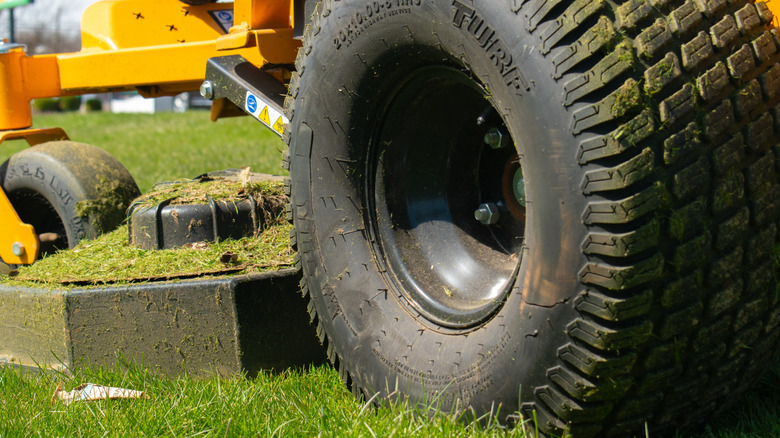
Most push and self-propelled mowers have hard rubber or plastic tires. However, essentially all riding and zero-turn mowers have pneumatic tires. As these tires age, they become more susceptible to losing air pressure, being punctured, or rupturing in blowout fashion. Often, the tread also wears down, resulting in less than ideal traction. The most common sign it may be time to change your tires is usually the evidence of dry rot. This is caused by age and sun exposure, and can easily be detected by looking for cracks on the sidewall. Other signs include your tires frequently losing air, or your ride becoming a lot bumpier.
Although it is possible to never have to change your lawn mower tires, if you bought one of the more reliable brands of lawn mowers and use it for its expected life, odds are you'll need to change them at some point. Just like replacing the tires on your car can help you have a stress-free road trip, swapping out the old tires on your mower can give you peace of mind when caring for your yard.
How to replace your lawn mower tires
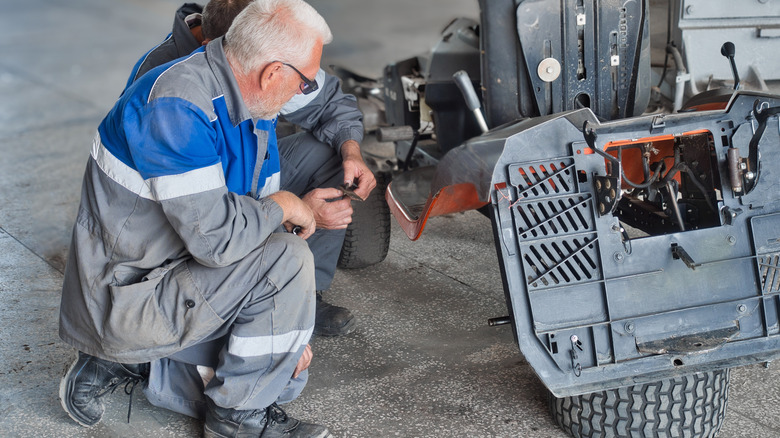
How to go about replacing your lawn mower tires depends on whether you are replacing the entire wheel and tire or just the tire. On mowers with plastic or hard rubber wheels, the tire and wheel are fused together — meaning you must replace the entire unit with something like these Antanker plastic lawn mower wheels. Regardless of what you're replacing, always ensure you get the right size for your specific mower.
To change the tires, begin by removing the old wheel. Make sure the mower is on a flat surface and that the spark plug wire is disconnected. On push mowers, you'll want to set the wheel adjustment to the highest setting. On riding mowers, use a jack to lift it before placing blocks beneath it. Next, remove the dust cap. Most push mower wheels are held in place by a bolt, which can be removed with a socket. On riding mowers, use needle-nose pliers to remove the C-clamp from the front of the wheel hub, then remove any washers and the wheel assembly.
If you're replacing the entire wheel and tire, simply reverse the steps you followed to remove the old one and you'll be done. If you're only changing the tire, you'll first have to deflate the worn tire and remove the valve stem. With the old tire flat on the ground, push down on the sidewall to break it free from the wheel. Next, pull — and pry, if necessary — the tire from the wheel, clean the wheel, and put the new tire on it. Place a strap around the middle of the tire to ensure the tire maintains contact with the wheel. Finally, replace the valve stem, inflate the new tire, and reverse the removal steps to reinstall the wheel.