

Why You May Want To Think Twice Before Using A Squirrel-Proof Bird Feeder
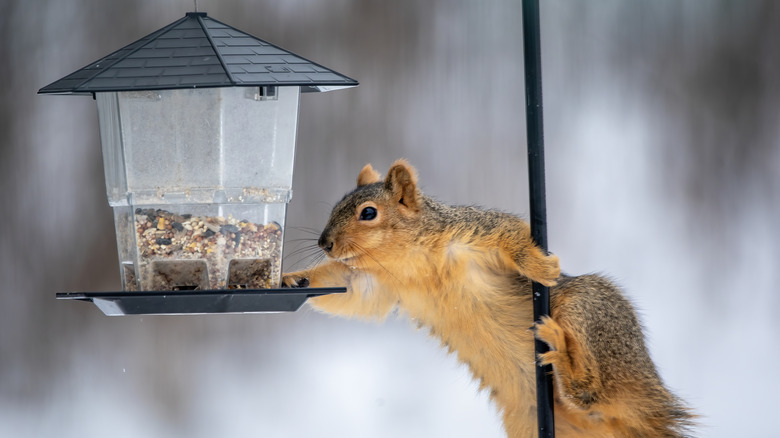
The thing about squirrel-proof bird feeders is that generally, they're not. The motto for squirrels as a species seems to be, where there's a will, there's a way. They tend to approach anything labeled as "squirrel-proof" as a challenge — search for "squirrel maze" online and you'll find multiple examples of the hungry rodent's tenacity. While a squirrel-proof feeder may be worth a try if squirrels are eating more of the seed than birds are, sooner or later, squirrels will likely defeat the barrier. In other cases, they could damage property trying to access that tasty food source. Some squirrel-proof feeders with moving parts could even harm birds, squirrels, and other wildlife, or the squirrels may damage the feeder to the point it no longer holds food.
So what does squirrel-proof mean, anyway? Any bird feeder that has built-in features to make it harder for squirrels to access could be considered an attempt at a squirrel-proof feeder. A tube feeder within a cage is one style, as it keeps out both large birds and squirrel-sized (and larger) mammals. Another style feature weight-activated feeders that close sliding metal doors over the food ports, rendering them inaccessible when a certain amount of weight is applied to the perching ring around it. Some are designed to spin a squirrel that lands on the perch, whipping them off like a kid on an old-school playground merry-go-round.
The drawbacks of squirrel-proof bird feeders
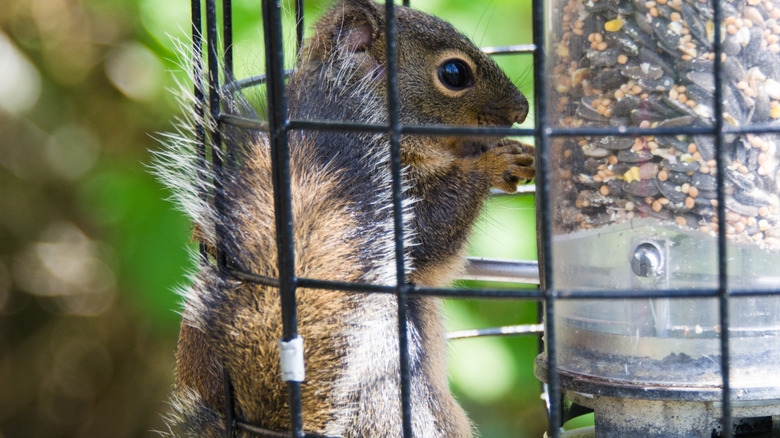
Some feeders, like tube feeders and some suet holders, have a surrounding cage, intended to make them squirrel proof. The caging grid is spaced so smaller birds can get in, but squirrels and larger animals cannot. The drawback of this feeder style is that some slightly larger birds, such as cardinals or blue jays, might not be able to squeeze through the holes. Another downside: Many cage feeders protect against large flying birds but not climbing mammals. A squirrel may also chew its way in or maneuver the hanger that holds the feeder so it falls off, spilling the seed so it can eat it. Squirrel goals.
Spring-activated perches that close the feeding ports on a feeder also work well, to a degree, but squirrels have been known to outsmart the springs. Other squirrel-proof feeders such as plastic tube-style feeders, may seem too slick for a squirrel to climb, but they do (PVC and copper are toughest for them). They'll even chew the ports to make them wider, which makes all the food spill out.
For an alternative that works with all sorts of feeders, a baffle keeps animals from accessing the bird feeder. A baffle, which is usually conical or dome-shaped, can be installed above or below the feeder. You can even repurpose a plastic bowl to serve as a squirrel baffle. When mounted on a pole or post beneath a feeder, either a DIY or store-bought baffle helps keep chipmunks, squirrels, and even raccoons from accessing birdseed.
For additional protection, remember to prune tree branches to deter squirrels from accessing nearby bird feeders. Squirrels can jump about 10 feet horizontally and five feet vertically, so keep this in mind when deciding the ideal squirrel-free place to hang those feeders.