

Think Twice Before Planting This Flower If Deer Are A Problem In Your Yard

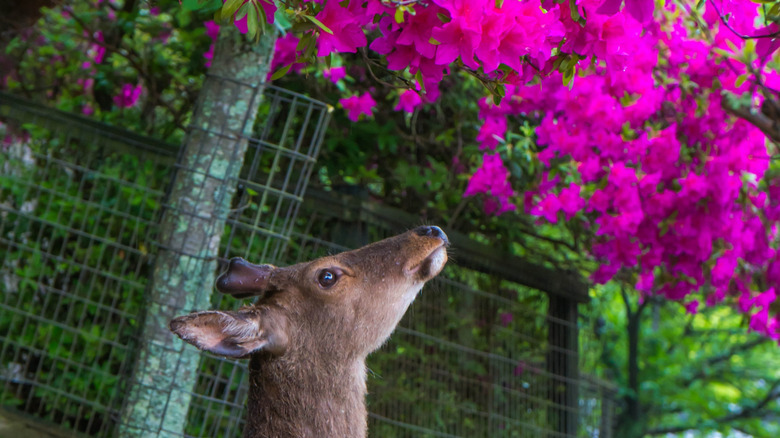
Azaleas are undeniably vibrant flowering shrubs that can thrive in U.S. Hardiness Zones 5 through 9. These popular plants typically boast beautiful pink, red, yellow, or white blooms, and love a yard with partial shade and acidic, well-draining soil. But if deer frequently roam your neighborhood, they'll likely snack on their tender leaves. Deer love azalea bushes. And once the mammals know where to find an easy meal, they'll return, significantly damaging your plants.
Deer may be beautiful to look at, but they are one of the animals responsible for most deaths in the U.S. for humans, often provoking fatal car accidents by darting into roadways. They can also bring ticks, exposing you and your pets to Lyme and other debilitating diseases. These are among the many reasons you should avoid attracting deer to your property. Even if your yard is fenced in, deer can easily leap over barriers as high as 8 feet, especially when they're hungry.
If you want to avoid attracting deer, remove existing azalea plants and avoid planting new ones. Go for deer-resistant shrubs like forsythia, hardy in zones 5 to 8, or rose of Sharon, which grows well in zones 5 through 9. You can also consider ornamental plants like boxwood (zones 5 to 9) or barberry (zones 4 to 8). But what if you already have azaleas you want to keep? Luckily, there are several easy tactics you can employ to prevent deer from making your garden a regular dining spot.
Keeping your azaleas? Here's how to get the deer away (& keep them away)
One tactic is to try transplanting the azalea closer to your house — deer are skittish and may be less likely to approach plants near human activity. You can also consider a motion-sensor ultrasonic alarm that emits a high-pitched sound that deer can hear (but is inaudible to you) or a motion-activated sprinkler that will nourish your garden and scare them off.
Pet parents can try letting their dog enjoy extra time outdoors, especially at dawn and dusk when deer are most active. These early morning and evening hours are prime for deer foraging — and a dog's presence can be a natural and effective way to ward them off. You could also try making a gorgeous wind chime from a repurposed wine bottle or anchoring scarecrows close to your cherished plants. Just be sure to vary these methods you use since deer can become accustomed to sights and sounds, making them less effective over time.
If you have a fence that isn't doing its job, outsmart the deer with a simple fence upgrade that can create the illusion of much greater height and dissuade them from jumping. For added deer-preventing insurance, you could put up a second barrier a few feet inside your main fence, something as simple as a taut clothesline strung between T-posts. This will create a visual and spatial challenge that may make them think they won't land safely — and decide it's not worth the risk. With just a few strategic adjustments, you may be able to prevent hungry deer from frequenting your azaleas.