

Must-Have Tools That'll Make Sharpening Lawn Mower Blades A Breeze
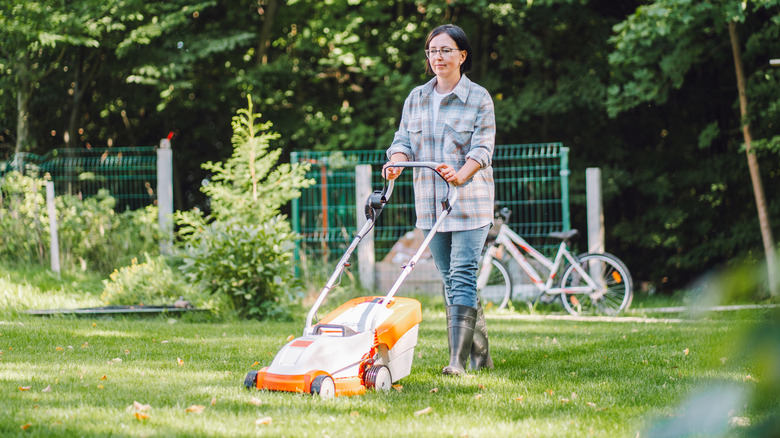
Keeping your lawn looking its best requires regular mower maintenance, meaning you'll need to sharpen your mower's blade. Sharpening it leaves the blade in good shape and promote a long, happy life for your lawn mower and your lawn. If your blade is dull, it could cut poorly and make the job of mowing the grass harder than it should be. A dull blade could also damage your grass, making it discolored and not looking so good. Worse, your grass could become susceptible to disease.
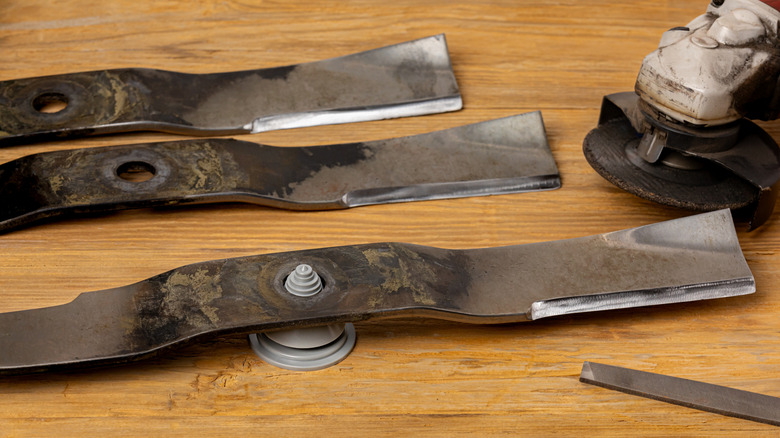
Blades typically require sharpening for every 20 to 25 hours of mowing. The upside is that sharpening your blade is an easy DIY project that doesn't take that long and is relatively inexpensive. There are many different ways to sharpen your lawn mower blades, provided you have the right equipment. You have several tools to choose from, but below is a selection of the three most common methods, starting with the least expensive and easiest to do, to the more expensive, requiring a more practiced hand.
Choosing the lawn mower blade sharpening tool that's right for you depends on a wide variety of important factors. You'll want to consider cost, of course, along with how much time each method takes, and your average mowing conditions (level? hilly? grass type?). It ultimately comes down to personal preference. Do you value precision and portability, or speed and power? Pick the one that sounds right for you, or try all three methods if you have the means.
Sharpen your blade using a file
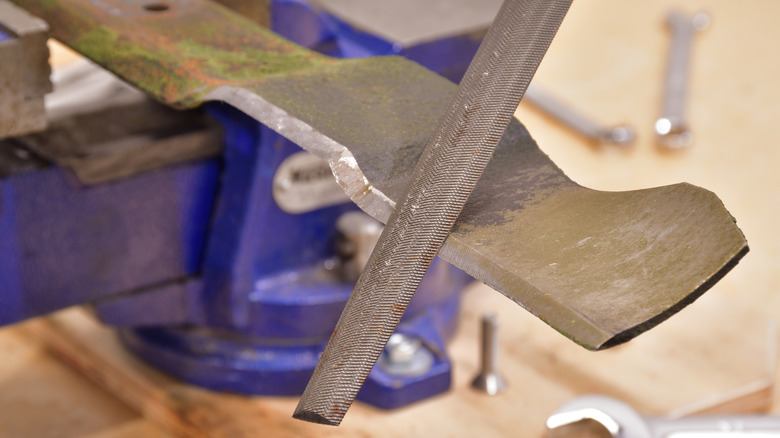
Getting your blade in tip-top condition doesn't have to be costly or time-consuming, especially if you prefer working with hand tools and all the quiet calm that can bring. The most accessible way to sharpen your mower blade is with a 10-inch or 12-inch bastard file. This metal-cutting tool features aggressive teeth that remove material quickly with little effort. Using this inexpensive, entry-level tool is easy for anyone to pick up after a couple of tries.
Don a pair of gloves, and tighten the blade securely in a vise, or clamp it to a solid work surface. Hold the file by its handle in your dominant hand, pinching the end with your other hand to guide the strokes. Place the file flat on the blade's bevel and maintain that angle as you push the file down and across the blade. The file cuts only in one direction. Continue until you get a clean edge on one side of the blade.
You'll see the edge shine up as you go, and gently feel along the edge to test for sharpness. Remember to avoid a common mistake when sharpening mower blades: They don't need to be razor sharp. Once sharpened, remove the burr on the backside of the blade's edge. Flip the blade and repeat the process on the opposite edge. You'll be able to feel the change in the blade with each stroke. It will take a few dozen strokes on each edge, and the whole process takes about 20 minutes.
Use an angle grinder to sharpen your mower blade
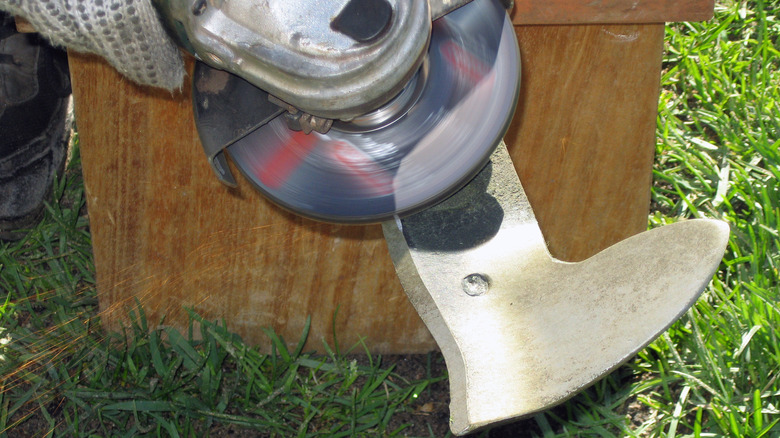
An angle grinder — named for the 90-degree angle from the motor to the grinding wheel — is a fast, easy way to sharpen your blade. This handheld power tool uses rotating abrasive discs to cut, grind, sand, and polish. You can use one to remove or shape a variety of materials. However, the angle grinder is aggressive and requires finesse when sharpening. On mower blades, an angle grinder works best when paired with a flap disc attachment.
A flap disc consists of several overlapping sandpaper "flaps" glued to a backing plate. This design provides a little more feedback than traditional grinding wheels, but since it removes material quickly, it's an imprecise way to sharpen. Spending too much time in one spot could send you back to the starting point, so stop frequently to check your work. With a little practice, this sharpening method will have your blade back in action in just a few minutes.
Secure the blade flat with the end to be sharpened cantilevered from your work surface. Wearing eye protection, install the flap disc attachment to your angle grinder and turn it on. Follow the bevel angle of the blade's edge and run the flap wheel side to side. You can instantly see your blade change and sharpen with this technique. Check your work often. Before reinstalling the blade, clean the underside of the deck, and keep grass off your lawn mower blades with a clever hack.
Sharpen your blade with a bench grinder
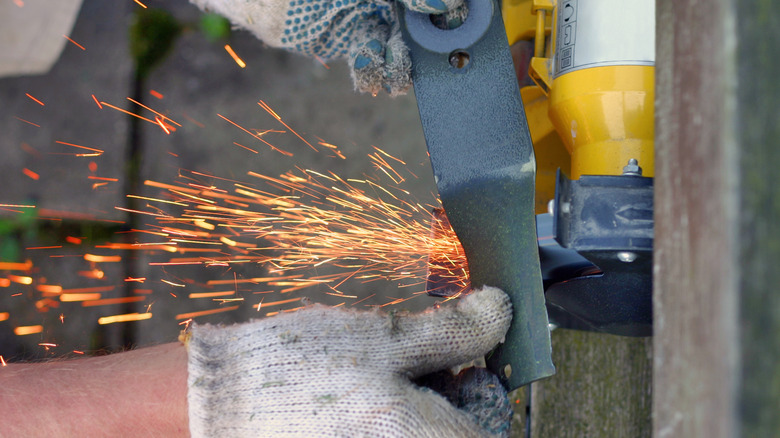
Bench grinders are pretty much what they sound like: The grinder features two abrasive, motorized grinding wheels permanently fixed to a bench or structure. They're best for grinding and shaping metal. With the file and the angle grinder methods, you take the tool to the work. In the case of the bench grinder, you take the work to the tool: You'll be holding the mower blade rather than the tool. This method is no more or less effective than the others, just different.
The bench grinder is not portable and is more expensive (anywhere from $50 to $2,500), which may deter some folks, especially if you use it only to sharpen a lawn mower blade. However, this powerful tool can be used for many other tasks, and will sharpen your blade very quickly. Another benefit is the built-in tool rest, which allows you to balance the blade at just the right angle as you sharpen.
To set the tool rest, place the blade's bevel directly on the grinding wheel (with the power off), and pull the rest under the blade to support it. Hold this position, and move the blade across the rest with the edge just kissing the grinder. Glide back and forth evenly without lifting the blade or tilting it into the grinding wheel with more pressure than other areas. Try not to take off any more material than necessary. Wear eye protection, because this method produces a lot of sparks.
When to sharpen your lawn mower blade
Sharpen your lawn mower blade before the first cut of the growing season and once or twice more, provided you don't hit any rocks. No worries if you do, just resharpen the blade. Beyond that, your grass will tell you when it's time to mow. Pluck a blade of grass from your lawn and look closely at the top. If the top edge is clean, your blade is sharp. If it has a jagged edge, it's time to pull the blade off the mower and get to sharpening.
Before sharpening the blade, you'll have to remove it. To do that, pull the wire from the spark plug for gas-powered mowers or the battery for electric mowers, eliminating the possibility of injury. For gas mowers, tilt it back so the front end points up to prevent oil or gas from spilling out, which could happen if you tilt the mower to either side. This way, you won't have to empty the machine before you start the sharpening job.
Once the mower is tilted up, you can easily access the blade. You'll likely need a socket wrench to loosen the nuts, though some electric mowers come with a specialty wrench. With that done, the blade will slide right off. You'll be able to examine the blade's edge and see if it's clean or nicked, which is another indicator you need to sharpen. Once, sharp, you'll need to know the best method for balancing your blade, and you're good to go!