

Why You Should Try Mixing Coffee Grounds In With The Soil Around Hydrangeas
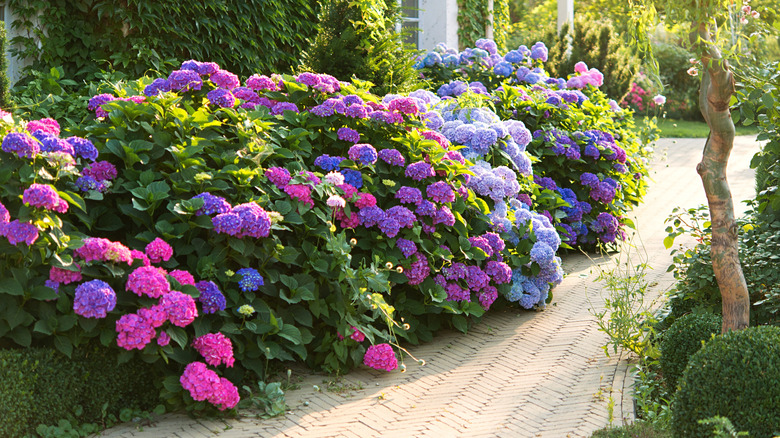
Have you ever noticed that bigleaf hydrangeas (Hydrangea macrophylla) blooming in one neighbor's yard have pink or white flowers, while in yet another, they are blue or purple? In some cases, two identical hydrangeas planted in different parts of the same yard might even bloom in different hues, making it seem as if they're not the same hydrangea varieties. If you prefer blue hydrangeas, coffee grounds may offer a little jolt to help your hydrangeas change color over time. It's not the caffeine that does the trick, however; it's the acidity. The plant has a unique ability to display a soil's pH through its flower colors. There's a bit of controversy over whether spent coffee grounds really do much for soil pH, however, since the grounds lose some of their acidity when brewed for coffee.
Not all bigleaf hydrangeas are capable of changing colors : A white variety will stay white, and red (actually a deep pink) will stay red, no matter what type of soil surrounds it. If the hydrangea variety has "blue" in the name, that means it's capable of producing blue flowers under ideal conditions, but can also offer up other colors.
How to add coffee grounds to hydrangeas
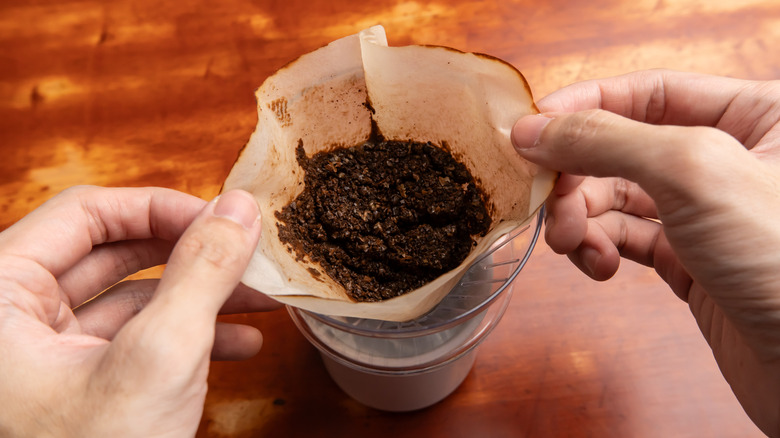
Used coffee grounds could benefit the soil around hydrangeas, but the changes won't happen overnight. It takes time for hydrangea roots to absorb nutrients from the surrounding soil, and it could take a year to achieve blue blooms, even if you've properly adjusted the soil pH. According to Oregon State University, it's a myth that coffee grounds alone can effectively lower the pH of soil. Used coffee grounds have a near-neutral pH of 6.2 to 6.8, which is just slightly acidic. Even so, coffee grounds could be used as a fertilizer when mixed into the soil around hydrangeas, since they enhance soil structure and improve drainage. Save the grounds after your morning brew each day and let them dry out so they don't get moldy. Work the used grounds 4 inches deep into the soil around the hydrangeas.
Another good way to use the grounds for hydrangeas is to compost them first. Paper coffee filters and the grounds can be added to the compost pile. A mix of 3 parts leaves and other brown matter, 1 part grass clippings and 1 part coffee grounds creates a nice compost mixture. Turn it weekly and it'll be ready to use around the hydrangeas and other plants in about six months.
How to add aluminum sulfate to hydrangeas
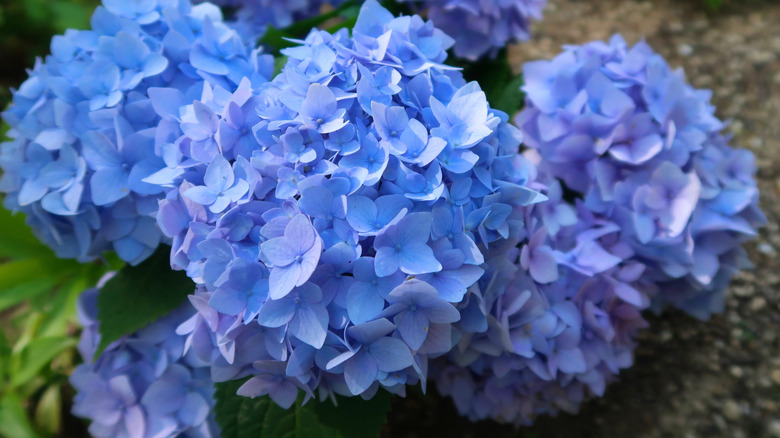
For a tried-and-true method to turn capable hydrangeas blue, add aluminum sulfate. Aluminum is one of the secret ingredients that soil needs for a hydrangea to turn blue, and adding aluminum foil is a trick that doesn't work. While it may sound like an odd metal to add, most soil naturally contains some aluminum compounds because there's more aluminum in the earth's crust than any other metal, and it's the third most common element overall in the crust. But the aluminum has to be in a form that hydrangeas can absorb. Even then, it only works when the soil pH is just right. Soil must be acidic for the hydrangeas to be able to absorb the aluminum sulfate. A soil acidity of 5 to 5.5 works well to ensure the plant absorbs the aluminum sulfate. A soil test kit from your local garden center is a good way to find out the exact pH level of the soil around hydrangeas.
To create an aluminum sulfate mixture, dissolve 1 tablespoon of aluminum sulfate in one gallon of water. Drench the soil around the plant with the solution, being careful not to get it on the plant leaves. Apply the mixture once a month in March through May for best results. Once you're happy with the color, try these fertilizing tips to keep your hydrangeas looking their best all season long.