

Create Shaped Potted Plants With The Help Of A Closet Staple
We may receive a commission on purchases made from links.
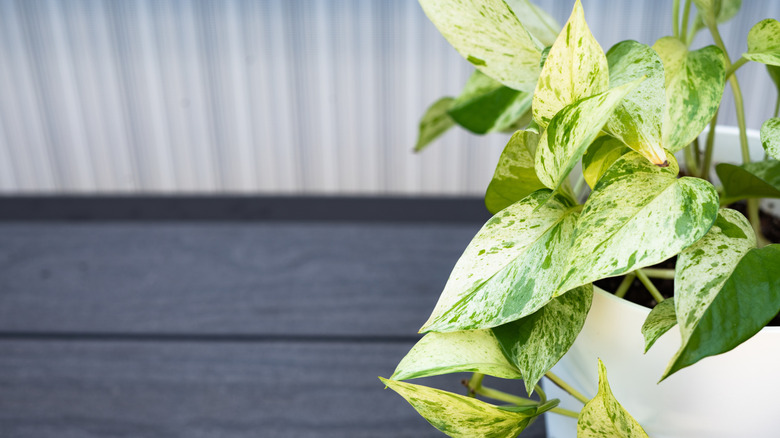
Nothing completes your patio like plants displaying long, luscious vines. However, with how quickly popular outdoor plants like pothos grow, neat vines can quickly become unmanageable without the proper care. Alternatively, you may find yourself wanting a better way to display the plants you've poured so much time into as a way to elevate your backyard space. Whatever your reasoning for wanting more shapely displays for your outdoor potted plants, topiary art is a great way to maintain and show off your plant, and it's a style that can trace its roots back to Ancient Rome. However, you don't need to be a professional gardener to pull off this look. Instead, you can shape your own potted plants with a wire hanger and a few tools.
A wire hanger is essential to this project. Because you're stretching and shaping the wire and use it as a simple trellis for your plant, wood or plastic versions won't work. Along with a wire hanger, you'll also need a wire cutter and a pair of pliers, as well as a healthy potted plant. If you're wanting to keep space free in your tool bag, you may choose to opt for a 2-in-1 tool like the Dowell lineman's pliers with wire cutter. Plus, this is just one example of a hanger DIY that's perfect for those with a green thumb. As a result, a strong pair of pliers may come in handy in the future.
Shaping your potted plants with a wire hanger
To start crafting your very own DIY trellis, begin by cutting or unwinding your wire hanger. This part can be tricky, and it may be helpful to use pliers. Once you've unwound and opened your hanger, start straightening out the wire the best you can. It likely won't be perfectly straight.
When you're satisfied with how the wire looks, you can start bending it into your desired shape. The easiest shape to create is an open-ended oval arch, designed so that both ends of the wire are at the bottom. Then, shaping with your hands or the pliers, bend the bottom three or so inches of both sides inward like the base of a lampshade harp. These are the "legs" of your wire trellis which will sit in the soil of your potted plant. If you're working with a smaller plant, you may need to cut some of the wire. You don't have to stop with an arch: Get creative and create spirals or helixes, or abstract shapes.
Once the wire trellis is securely buried in the soil of your pot, the last step is draping. Simply take the vines of the plant and wrap them around the wire to your liking. For shorter vines, you may need the help of cable ties to keep the plant in place. Patience is of the utmost importance at this step. After all, you don't want to accidentally break or snap your vines. With your vines draped, you're all finished with this project — feel free to return your pot to its home on the patio and enjoy your new eye-catching container garden.