

DIY Fishing Lures From This Common Kitchen Utensil

We may receive a commission on purchases made from links.
Over four-plus decades of fishing across the United States and beyond as both a recreational fishermen and professional fishing guide, I've learned the importance of having the right lures in your box, regardless of type of water or time of day you're fishing. I've also learned that metal spoons are among the most versatile of all lures for both fresh and saltwater fishing. With that in mind, it's a good idea to always have a variety of spoons in your tackle box, as well as in an emergency fishing kit for hiking and camping. Intrepid anglers can make their own cost-effective and customized versions of these productive artificial lures by repurposing old kitchen spoons.
Spoons are so handy to have because their flash and wobble effectively imitates wounded baitfish. This allows them to attract a wide variety of predator fish species, which includes virtually every fresh and saltwater gamefish in North American waters. Given that they are completely made of metal components, spoons are also durable. Equally important, they are very easy to use for beginner and experienced anglers alike.
While a far-flung assortment of spoons are commercially produced, anglers can DIY their own relatively easily. These versatile fishing lures can be made from any type of metal kitchen spoon, including tea, table, dessert, coffee, and soda types. Additionally, most anglers will have all the tools and components necessary to make DIY fishing spoons on-hand in their garage or workshop. Anything they're lacking will be a relatively minor expense to buy.
First steps for making a DIY fishing spoon
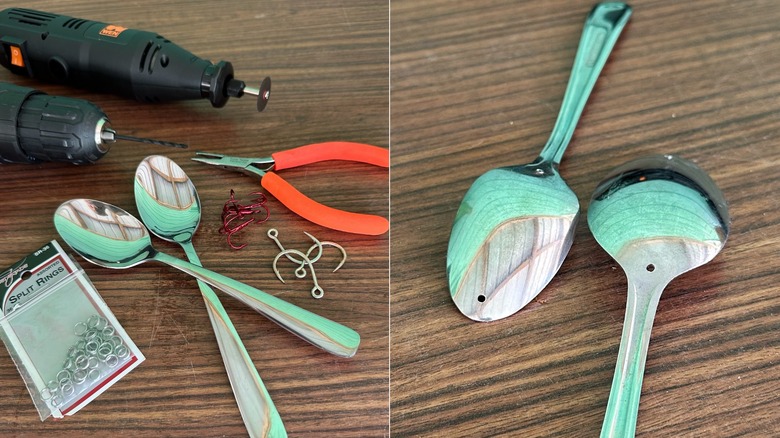
When DIYing fishing spoons, any old spoons can be repurposed, or you can buy some inexpensive ones at garage sales or dollar stores. You will also need some split rings and hooks, the sizes of which will vary depending on the size of spoon. If making various sizes, an assortment of split rings, such as the GreatFishing 200 Piece Split Ring Assortment, can be handy. You also need hooks. Treble hooks are most commonly used, but single hooks, like Dr. Fish Inline Hooks, are safer for handling and releasing fish.
If you have a band saw and drill press in your shop, those tools are ideal for cutting and drilling holes as you build your spoon. However, a handheld rotary tool with a cutting disk and/or drill bit attachment will also work. You can also use a handheld drill and manual hacksaw to do all the necessary cutting and drilling. As is the case anytime you are working with cutting tools, wear protective eyewear.
Once you have all the materials gathered, the first step is to drill holes in the front and back ends of the curved portion of the spoon. Although some prefer cutting the handle of the spoon off first, I prefer drilling the holes with the handle still attached so I can use the handle to hold the spoon in place. This is much safer, particularly if you are working with handheld tools. The hole should be about half the diameter of the split ring from the edge of the spoon and large enough to allow the split ring to pass through.
Completing your DIY fishing spoon
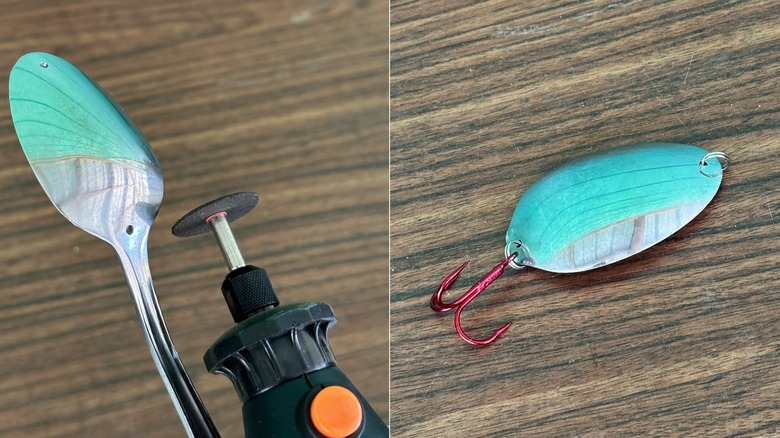
After the holes are drilled, cut the handle from the spoon. If you are using a band saw, you can typically follow the curvature of the spoon fairly easily, rounding off the new edge as you cut away the handle. This can be a bit challenging with a rotary tool or hacksaw. However, you can cut the handle straight across. Then either leave the back straight or curve it with a grinding stone attached to a your rotary tool, a hand file, or a bench grinder. As you are shaping, don't make the metal between the spoon's edge and drilled hole too thin, as this would make it too weak to handle the strain of a hooked fish.
Once you are satisfied with the shape of the spoon's back end, attach a split ring to each end of the spoon. A pair of split ring pliers, although not necessary, can make this task much easier. Finally, attach the hook of choice to the split ring on the back end of the spoon. Your spoon is now fishable, although there are a few modifications you may want to consider before declaring your project complete.
One functional modification is to attach a small barrel swivel to the split ring on the front of the spoon. This will help prevent line twist from the wobbling and spinning motion. Using a hook dressed with bucktail or mylar flash is another popular modification. Plastic tabs or bucktail trailers added to the split ring can also be used in lieu of dressed hooks. Some anglers also like to add color or eyes to their spoons, which can be done with reflective tape or spray paint.