

Fill The Space Under Your Hydrangeas With A Must-Plant Ground Cover
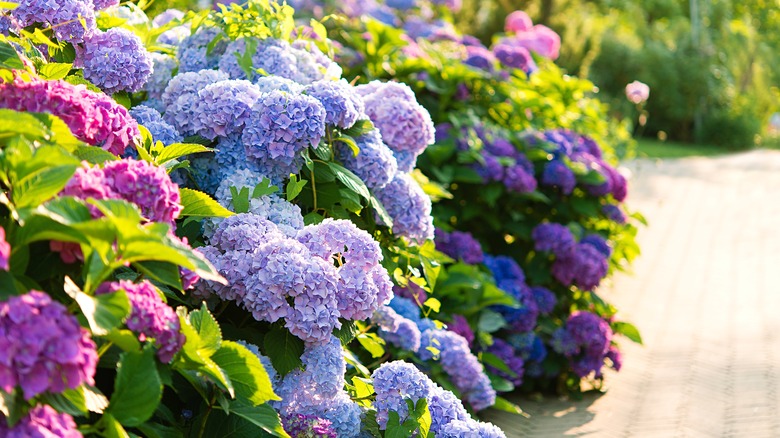
When it comes to flowers that add some power and punch to your home landscape, there's nothing that beats the versatility and variations that hydrangeas can offer. These pom-pom like beauties bring instant and long-lasting floral fire in colors ranging from crisp, clean whites to pretty pinks to bashful blues and even lingering lavenders. In fact, being relatively low-maintenance, the biggest challenge you might face is finding the optimal spot in your garden to plant hydrangeas, as well as deciding what to plant with them. A ground cover that partners well with hydrangeas and can help keep surrounding weeds down is ajuga (Ajuga reptans), also known as bugleweed.
This swift-spreading perennial can help fill in a landscape bed, delivering layers of texture and color that partner nicely with your hydrangeas. While many hydrangeas bring bright green, large leaves, and ball- or cone-shaped flowers, ajuga contrasts with a dense mat of smaller, deeper green and purple- or bronze-tinged leaves with indigo or plum bloom spires. But the ajuga cultivar you choose is important, since some can be invasive in certain U.S. regions (it's a member of the mint family, after all). 'Burgundy Glow' is a slow grower with variegated foliage in blush, lilac, emerald, and white; 'Black Scallop' boasts deep midnight amethyst leaves; and 'Bronze Beauty' delivers bronze-tinged greenery.
How to care for ajuga in your landscape beds
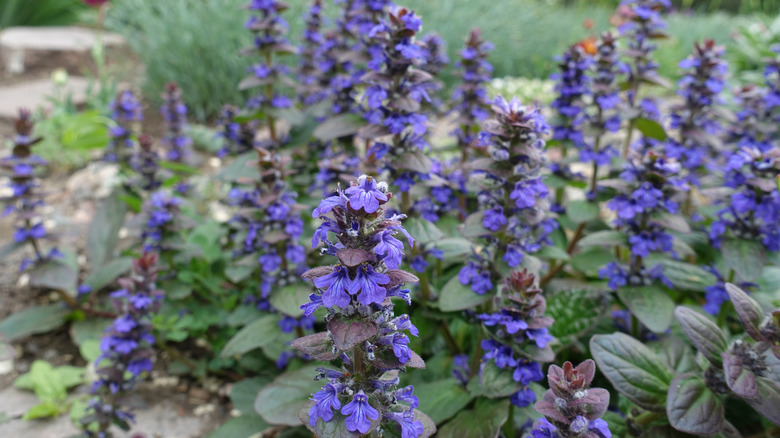
For the most dramatic foliage and the best late spring/early summer blooms, ajuga is best grown in zones 3 to 9 in partial sun and moist, well-drained soil. Since hydrangeas should be grown where sun and shade strike a balance, ajuga fits right in. And if you tend to have spots where it's tough to grow grass, ajuga is an evergreen ground cover that can thrive, providing a thick, attractive alternative with a 6-inch height and 6- to 12-inch spread. Successfully planting ground covers like this in your yard can set you up for a dense stand of ajuga that holds up well to drought, and you can manage its spread with some occasional thinning or by planting non-invasive cultivars. Unfortunately, Maryland, Oregon, and West Virginia list bugleweed as invasive, so you'll want to check with your local extension to confirm which varieties may be approved for planting.
While ajuga is low-maintenance, it also offers some additional perks, including deer-, rabbit-, and powdery mildew-resistance, as well as erosion control. And ground covers like ajuga can even keep weeds at bay better than mulch. Its nectar-rich blooms bring in butterflies, bees, and other pollinators as an extra bonus.