

The Eye-Catching Trick That'll Have Hummingbirds Flocking To Your Yard
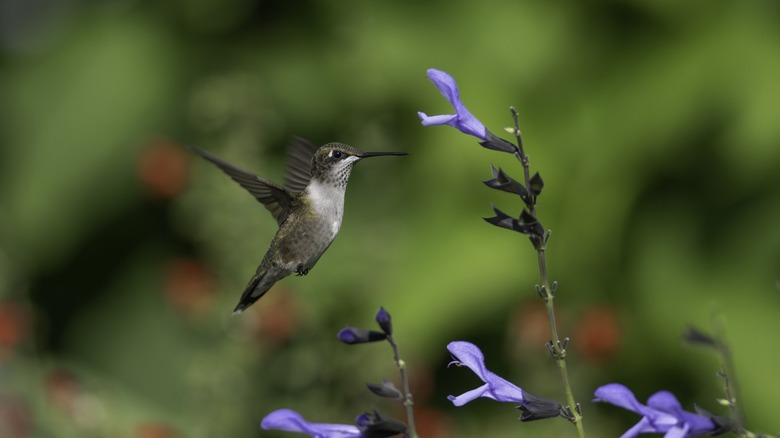
If you're disappointed that you haven't seen any hummingbirds at your feeder yet, you might want to reconsider your landscaping choices. There are so many stunning plants that will attract hummingbirds, but make sure you're planting them the right way for the biggest impact. By planting several different hummingbird-attracting plants in one area of your yard, you will easily draw the attention of delightful hummers. The birds will be happy and you will have a beautiful landscaped area filled with large quantities of bright, beautiful flowers.
The first step to creating the perfect hummingbird garden landscape is choosing the right plants. Don't just group together flowers at random. Instead, focus on the types that hummingbirds can't resist. Hummingbirds love nectar, and these migrating birds are particularly interested in bright flowers with tubular shapes, a shape associated with excellent nectar reserves. Many tubular flowers are highly specialized for certain pollinators, meaning that the long bills of hummingbirds are well-suited to fit into these flowers. Give them tubular flowers like scarlet salvia (Salvia coccinea) and columbine (Aquilegia canadensis) right next to each other for a beautiful and practical pairing. Of course, be sure to plant more than one of both, because mass plantings of bright flowers are the best beacon for hungry hummingbirds.
Types of plants to grow together for hummingbirds
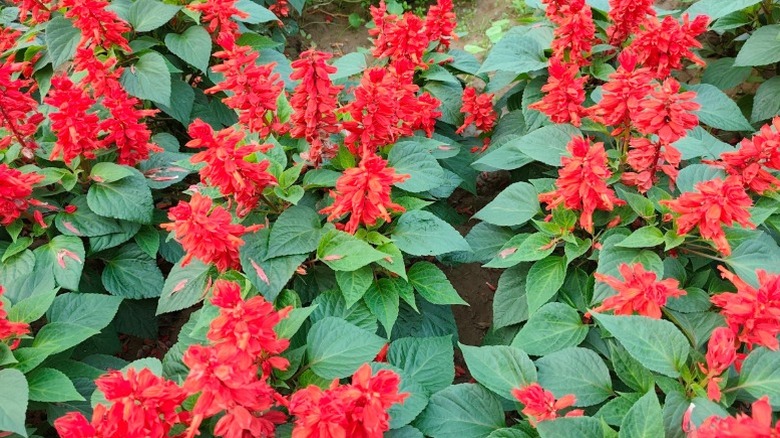
When it comes to creating large, bold groupings of flowers, think outside the box. Another must-try garden combo that will attract more hummingbirds to your yard is ideal for shady areas. Group together chocolate chip bugleweed (Ajuga reptans), cardinal flowers (Lobelia), and bleeding hearts (Dicentra spectabilis) to create a showy display of different heights and colors. Other great ways to mass plant flowers is to choose a short, clump-forming species like coral bells (Heuchera sanguinea) and a tall, showy variety like tall larkspur (Delphinium exaltatum). Both of these flowers grow well in mass plantings, plus they have the added benefit of being natives.
Also try to grow plants that have different growth rates and bloom times so that your garden always has flowers ready for hummingbirds. For summer blooms, try lion's ear (Leonotis leonurus), a fast-growing flower that will turn your yard into a hummingbird haven. For later flowering species, consider pineapple sage (Salvia elegans), which has gorgeous red, trumpet-shaped blooms lasting late into the autumn season. Just remember, when mass planting, you can focus less on red-colored flowers or other typical hummingbird-attracting species. Blue twolobe larkspur (Delphinium nuttallianum) and yellow glacier lily (Erythronium grandiflorum) are also popular. The main goal is to fill a space with a lot of nectar-rich flowers so that the birds are spoiled for choices!