

Create An Eye-Catching Lawn With This Drought-Resistant Grass Alternative

Most envision a traditional lawn as a uniform, green expanse of turfgrass — but that tradition is changing rapidly. For those willing to break from the usual and make a front yard pop, lamb's ear (Stachys byzantina) offers a dramatic alternative. This silvery plant grabs attention immediately, with its compact leaves and odd texture. It's a ground cover – which can be useful in a flower bed – but it behaves a great deal like a traditional lawn when used imaginatively. There are many different types of ground cover and grass alternatives based on your climate that you could pick from, but for the adventurous gardener, lamb's ear might be a good bet.
Lamb's ear thrives in full sun or partial shade, making it ideal for places where normal grass doesn't fare well. Deer and rabbits can't stand its thick, hairy leaves, and the plant's low-spreading habit automatically keeps weeds down. Unlike lawn grass, which must be mowed and fertilized repeatedly, lamb's ear is virtually maintenance-free once it's established. It won't require precise cutting, and overwatering is a greater danger than underwatering.
Another benefit? Lamb's ear has a gentle silver hue that catches the sun, causing yards to gleam with an otherworldly light in the proper illumination. Not the best for areas of heavy foot traffic, but a winner where form outshines function: along pathways, beneath trees, or in medians. Paired with other drought-tolerant plants, lamb's ear creates a relaxed patchwork that outrivals a solid green expanse both in beauty and practicality.
Use creative planting techniques to make lamb's ear the star of your yard
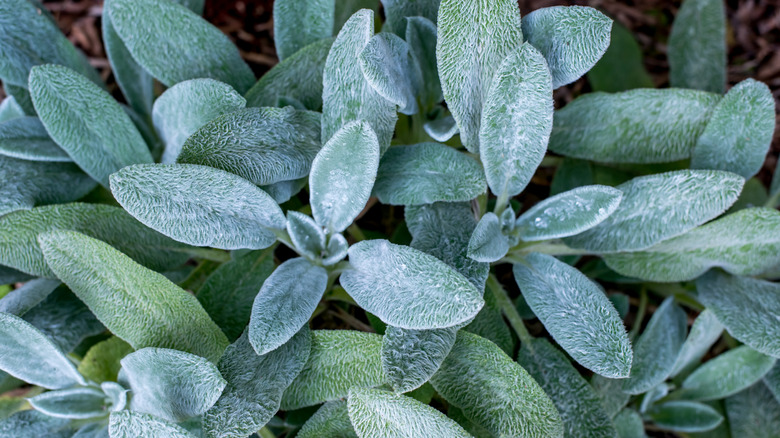
Lamb's ear grass is not just for soft borders or cottage gardens — it can be the foundation of a head-turning lawn with the right planting design. The key is to celebrate contrast and geometry. Use curved edging to separate planting beds and combine lamb's ear with stepping stones, gravel, or mulch pathways to add structure and movement. Its color could combine well with black rock, warm brick, or dark mulch, so design possibilities are almost endless.
For a truly spectacular appearance, plant in staggered, odd-numbered groups instead of in linear rows. Lamb's ear develops in tight rosettes that spread slowly outward, so providing each plant with approximately a foot of space allows them to fill in on their own without becoming crowded. This spacing continues that lush, carpet-like appearance without encouraging rot caused by retained moisture. Another clever trick is to take advantage of elevation. Lamb's ear is a low grower, typically never more than 18 inches tall, so combine it with taller companions such as ornamental grasses, coneflowers, or lavender to introduce layers. That variance in height adds depth, encouraging the eye to move around the lawn instead of stopping.
Don't overlook the season-long advantages, either. Lamb's ear produces tall, narrow flower spikes that are covered in minute purple or pink flowers in late spring. You can trim them back for a tidier look or leave them to provide food for pollinators such as bees and butterflies.