

Say Goodbye To Hand-Pulling: A Faster, Old-School Way To Remove Weeds From Your Garden
We may receive a commission on purchases made from links.
Despite your best efforts to banish weeds from your yard or garden, they sometimes take over. Whether it's a particularly wet year or you just haven't been able to keep up with maintenance, at some point you'll be on your hands and knees pulling weeds. A lesser-known weeding tool like a long-handled weeder is one alternative, but that still involves plucking plants one at a time. There's another old-fashioned tool that's even easier in terms of speed and efficiency: a wheel hoe. Looking something like a cross between a vintage reel mower and an old-fashioned horse-drawn plow, it's a manual tool with one or two large wheels that's maneuvered by pushing from behind on two long handles, dragging a variety of gardening attachments behind the wheel. Designed for multiple uses in the garden including tilling the soil, it makes quick work of weeds with a little effort.
Though wheel hoes have been around since the late 1800s, it wouldn't be surprising if you haven't heard of them: The tool was initially marketed to small-scale farmers transitioning from horse-drawn equipment to machines, with one agricultural researcher in 1893 declaring that the wheel hoe replaced "three or more men with [standard] hoes." It's still unusual to find them in big box stores. These days, modern, lightweight versions (mostly found online or in specialty stores) appeal to small market gardeners who have adopted them to cultivate rows before replanting. With the right attachment, wheel hoes are quite effective at removing young weeds, even when pushing through rock and compacted soil. If you're ready to move beyond basic beginner gardening tools and put in a little effort on your part, wheel hoes can remove weeds faster and in larger clumps than if you'd pulled them by hand.
Wheel hoes come with a variety of attachments for weeding
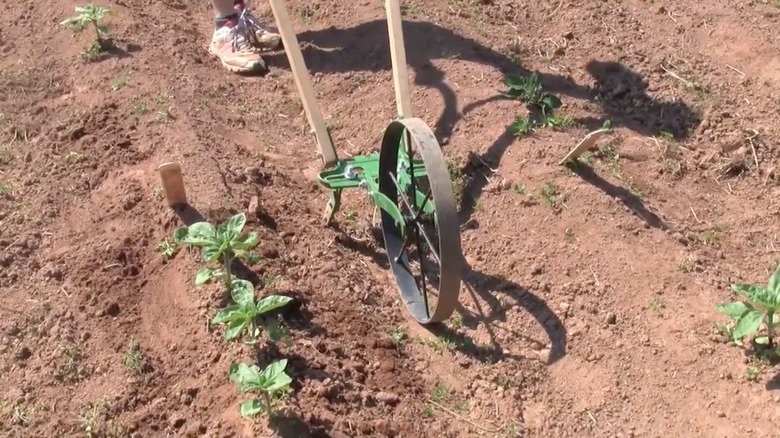
Operating a wheel hoe for weeding is pretty straightforward: Add a soil-working attachment behind the wheel, then push back and forth along your garden rows or flowerbeds, pulling up an inch or so of rock, soil, and anything growing. There are a variety of attachments, but the one that seems most effective for post-emergent weeds is the oscillating hoe. Also called a hula hoe, scuffle hoe, or stirrup hoe, it consists of a broad, flat blade on a curved, pivoting frame. Available in different lengths ranging from about 6 to 12 inches, it moves through soil quickly, clearing a swath of weeds and shallow roots in no time. With pre-emergentwhite thread-stage weeds, a collinear hoe blade might be best, as it loosens and scrapes surface soil, pulling up seedlings. Sweep attachments work well between rows for shallow cultivations, though some users find they are also effective on more established growth.
As with any tool, it doesn't work in every situation. To start, wheel hoes are not cheap: The Hoss single-wheel hoe is currently about $270 on Amazon, and an oscillating hoe attachment is another $45. In contrast, you can pick up a handheld version like the Ames 54-inch scuffle hoe for $40 or less. More significantly, wheel hoes tend to work best on small patches of young weeds and new growth. If your garden is more weed than soil, wheel hoes can involve a certain amount of elbow grease: Weeds and soil may accumulate in the attachment, meaning you're pushing a lot of material with each pass. But fans insist it is still faster and worth the effort compared with getting on your hands and knees.