

Man Uses Home Depot Finds To Fix His Bumpy Lawn

We may receive a commission on purchases made from links.
A lumpy, uneven lawn is more than unsightly, it can cause serious issues. Low spots result in a flooded lawn and standing water. This can kill your grass, attract mosquitos, and, eventually, even lead to foundation problems. Uneven lawns also make mowing difficult. Luckily, you can level your yard without heavy equipment. In fact, one YouTube content creator used only hand tools and materials he found at Home Depot to fix his bumpy lawn.
The man in the video, George from Princess Cut Lawn Care, creates a DIY lawn leveling kit with his Home Depot finds — you can do the same at your favorite lawn-and-garden retailer or online. To start, he picks materials needed to create a lawn leveling mix. This is basically the topdressing used to level a lawn. For his mix, George chooses Miracle-Gro moisture control potting mix and Quikrete medium grade sand. The advantage of potting soil over topsoil — according to this YouTuber and confirmed by Michigan State University horticulture educator Gretchen Voyle — is that topsoil can be contaminated with various weeds and random grass seed. Instead, any sterile potting soil mix can be used. The total amount of each material you need will vary depending on how much leveling you need to do. But generally, plan to use a 1:1 ratio of sand and potting soil.
For tools, George keeps it pretty simple. While a lawn leveling rake is considered a must-have tool to quickly and easily level your lawn, George goes with a 36-inch landscape rake or lift rake. The wider tool covers more ground, of course, but it's also versatile: It easily spreads and grooms gravel driveways, mulch beds, and more. A push broom and a sturdy pull cart complete this kit.
Putting your DIY lawn leveling kit to use
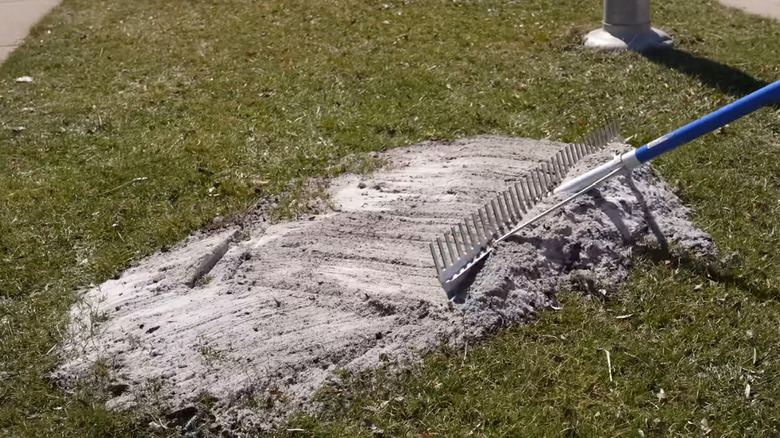
When you have your materials, it's time to put them to use. First, create a lawn leveling mix by pouring sand into the pull cart — or a wheelbarrow or wagon — then mix in an equal amount of potting soil. If you're dealing with sandy or loamy soil, you may want to use more sand and less soil. Conversely, for lawns with clay soil, adjust your mix to use a bit more soil than sand.
The best approach is to first mow your lawn close so you can see the trouble spots more easily. Then begin dumping piles of the mix into low spots. George at Princess Cut Lawn Care's YouTube channel uses the flat edge of the landscape rake to spread and level the soil mix, before gently working it into the grass using the push broom. You may need to add more mix to fill the low spot. With larger depressions, it's better to work in a few layers of soil rather than drop one large pile. Excess material can either be removed or spread into the surrounding lawn. If you want to get really accurate, set a bubble level atop a broad board to check your work.
Leveling your lawn can be done whenever grass is actively growing, but for best results, lawn care experts recommend doing so in spring for warm-season grasses and late summer or fall for cool-season grasses. Avoid adding leveling soil when the grass is dormant or overly stressed, as you can bury crowns and rhizomes, inhibiting new growth. Should you find yourself with bare patches, you can also pick up some grass seed at Home Depot to sprinkle over those areas. This will hasten your lawn's recovery time.