

Say Goodbye To Wasps & Hornets With A Natural Solution They Can't Survive
We may receive a commission on purchases made from links.
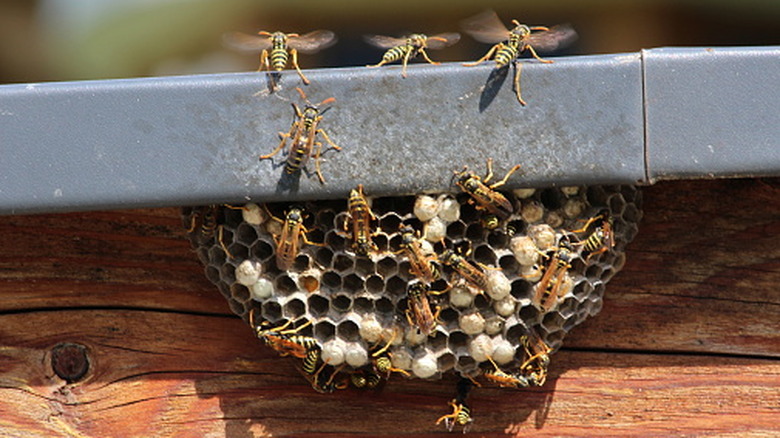
Wasps and hornets are common nuisances around homes and outdoor living spaces. Not only can these insects be agitating, they are also capable of delivering a painful sting. As a result, homeowners are usually quick to want to get rid of any nests they find. But using chemical insecticides is off the table for many people. Luckily, you can say goodbye to wasps and hornets with a natural solution they can't survive — castile soap. Additionally, when applied in the proper manner, you can take care of the wasps and hornets without exposing yourself to harm.
When mixed with water, castile soap breaks down the epicuticle — the protective layer on the exoskeleton of wasps and hornets. The soapy water then obstructs the spiracles, which are minuscule holes these insects use to breathe. As a result, wasps and hornets coated with soapy water actually drown rather quickly. Although castile soap in water is an effective, inexpensive, and chemical-free way to rid yourself of existing wasp and hornet nests, you can add yet another natural ingredient in order to ensure they don't come back: peppermint oil.
Peppermint oil can be used for a wide range of repellent activities, such as banishing snakes from your yard or getting rid of fire ants. It can also be added to this castile soap spray to deter wasps and hornets from returning to an established nest. As with snakes and ants, wasps are repelled by peppermint oil due to its strong smell and the chemical compound menthol. This combination is typically more than an insect's sensory receptors can handle, so they tend to stay away. Tea oil is also often used as a repellent due to its strong scent, but it is not nearly as effective as peppermint.
Safely use a soapy mix to get rid of wasps
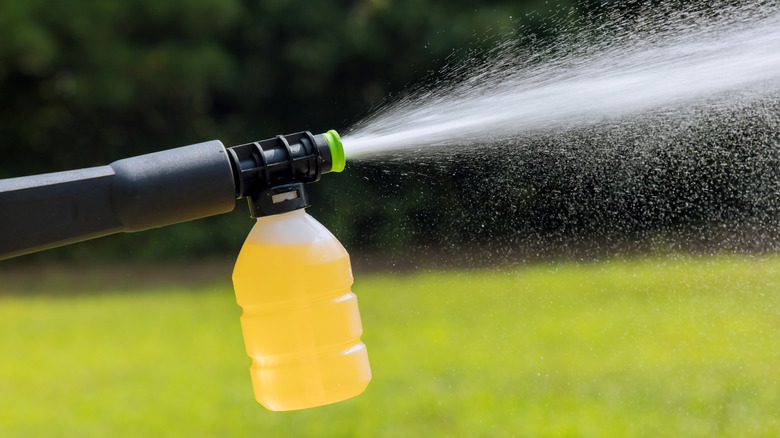
In order to use castile soap to get rid of wasps and hornets, you'll first need to gather the supplies: castile soap, peppermint essential oil, a hose, and hose-end sprayer. If you do not have a hose-end sprayer, like the Ortho Dial N Spray, you can make a soapy water mix in either a handheld sprayer or mister bottle. But keep in mind that even though it is difficult for these insects to fly once coated with soapy water and they tend to die quickly, a handheld sprayer requires being closer to the nest and you're more likely to be stung. A hose-end sprayer can project a stream up to 45 feet, allowing you to remain a safe distance away while applying the soapy mix.
Once you've gathered the supplies, do one last lap around your house and yard, looking for any additional nests, as well as in trees and bushes. Also make note of any ground nests, which is where you'll find yellow jackets. It's worth making this mental inventory so you can get rid of all the nests at once.
After identifying your targets, prepare the castile soap mix. If you are using a handheld sprayer, combine 1 teaspoon of castile soap per gallon of water and add about a dozen drops of peppermint essential oil. For use with a hose-end sprayer, the simplest method is to add a cup of Dr. Bonner's pure castile liquid soap or equivalent product to the hose end sprayer. Wait until evening, when all the wasps are back in the nest and less active, then thoroughly douse each nest. Any leftover spray can be used to banish aphids and other insects from your garden.