

Why There's Simply No Need For A Lawn Aerator Anymore
We may receive a commission on purchases made from links.
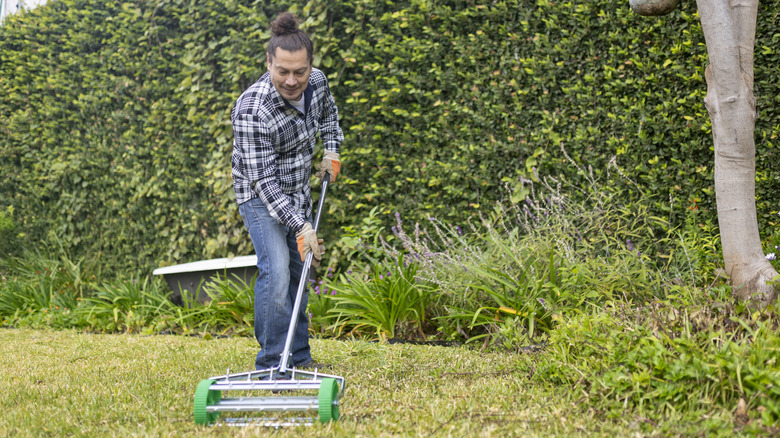
Aeration is a critical part of proper lawn maintenance. Not only does it help keep your grass healthy, it's also one of the best ways to control moss in your yard. Many homeowners neglect this task because they feel they don't have the right tool, but the reality is you don't need an actual aerator to take care of your lawn. Something as simple as a pitchfork can be used in place of a costly, dedicated aerator tool. In fact, there are a number of substitute implements that are just as capable of achieving the same result. No matter how you approach the task, your yard will thank you: Having a properly aerated lawn is one of the easiest ways to prevent or remove standing water from your lawn.
Aerating a lawn is not a complicated process. The end goal is to perforate the surface of the soil a few inches deep with multiple holes. These holes help break up compacted soil, allowing air, nutrients, and water to more efficiently reach your lawn's root system. This is often accomplished using a plug aerator, which removes a small plug of soil, or spike aerator, which punches holes into the ground. Most commercially made aerator machines feature a rotating drum with multiple spikes or core tools attached. This allows you to quickly cover a compacted lawn while punching holes.
Cost is one of the main reasons people opt out of owning an aerator. Walk-behind power aerators models cost at least $100, with most versions costing several times that. Tow-behind aerators cost about the same. While manual push aerators can often be found for under $100, all aerators have another detracting factor — they take up valuable storage space for much of the year. However, you can avoid both these issues with one of several alternatives.
Alternative ways to aerate your lawn
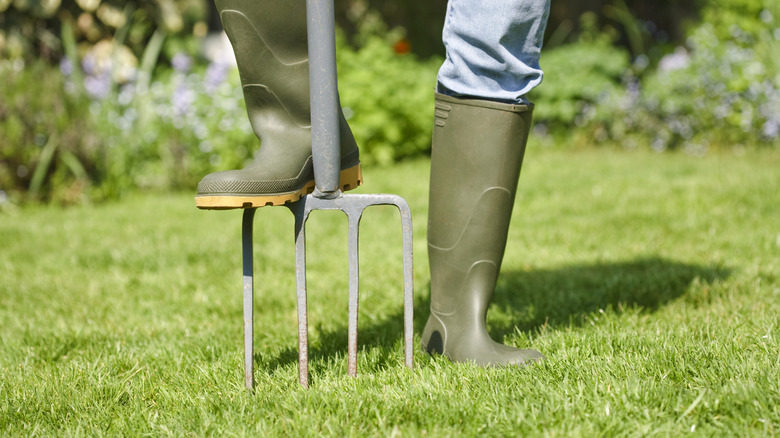
One of the best ways to aerate your lawn while saving both money and space is using a tool you already have. Essentially, anything that pokes holes in the ground will work. A garden fork or pitchfork is one such implement. Another option, for small areas such as brown patches, is a screwdriver or awl. You can even use a power drill fitted with either a garden auger bit or an SDS bit, such as those used for masonry work.
For another low-cost alternative that doesn't need a lot of storage space, you might consider lawn aerator shoes. These strap-on devices with spikes on the soles — like the Ohuhu lawn aerator shoes — typically run less than $30. They are easy to use as well. Basically, you just strap them to your shoes or boots and walk back and forth across your lawn, punching holes in it.
It is also possible to DIY lawn aeration tools with items you likely already have on hand in order to save money. One simple version involves driving nails through a board. The board is then either attached to a rake or broom handle or fitted with a strap to lift after it has been driven into the ground by stepping on it. You can also DIY an effective tow-behind drum aerator with a bucket, a length of pipe, nails, and some ready-mix concrete. While a DIY roller aerator does take up space, it will cost less than a commercially made model.