

Think Before You Burn: The Material That's Banned In Fire Pits Across America
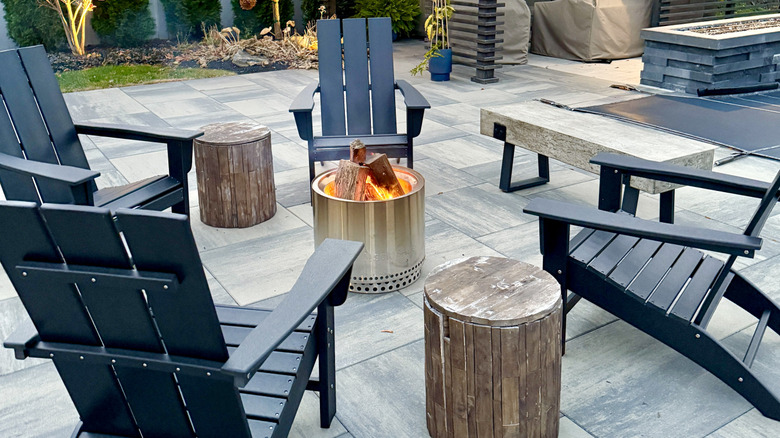
If you don't already have one, you may be considering buying or building a fire pit for the backyard. Not only can it add ambiance to an outdoor living space, the right fire pit can make your yard the talk of the neighborhood. However, so can burning the wrong materials. Turns out, you can't throw just anything that burns into a fire pit (or other open fire) and light it up. There are actually a number of items that are either prohibited by state or local ordinances or are simply a bad idea. Then there's rubber, which is illegal to burn in a fire pit throughout all 50 states.
Turns out there are several reasons why burning rubber is both illegal and a bad idea. The primary concern is that both natural and synthetic rubber release a number of toxic chemicals into the air. If you happen to be next to the fire pit at this point, you are inhaling very dangerous substances. These particles can make their way into your bloodstream and travel throughout your body. However, it doesn't stop there. The toxins released by burning rubber linger in the air, water, soil, and on plants. This can cause environmental damage for years to come. As a result, the amount and types of airborne contaminants resulting from burning rubber in open fires is in violation of the Clean Air Act.
Another big reason for banning the burning of rubber is that it burns extremely hot and is difficult to extinguish. Water from a backyard hose typically won't put the fire out. Burning rubber can also smolder for a long, long time. This makes it a risk for starting unintended fires, as well as an ongoing source of contamination.
Check local and regional ordinances before lighting a fire pit
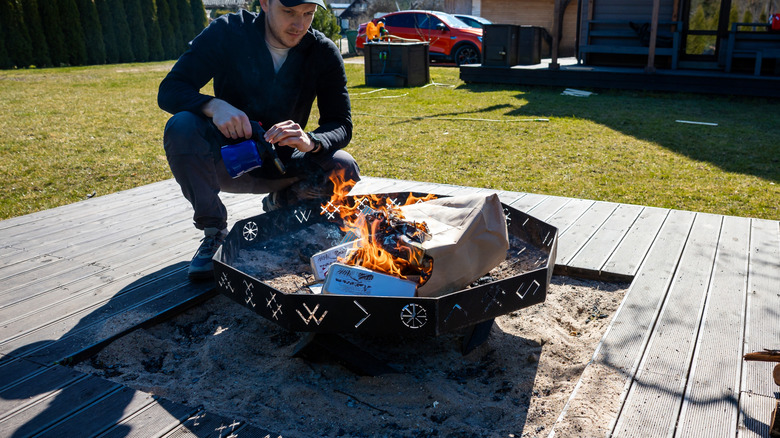
Rubber is hardly the only item that's illegal to burn in fire pits. While regulations vary by state, county, and city, generally anything that contains petroleum, chemicals, or grease is banned. Common examples include plastic, pressure treated lumber, construction materials, creosote posts, particle board, and most newspapers and magazines.
While banning rubber and plastic may make sense, the reasons for including various woods and papers may not be so obvious. It's essentially the same reason — these items produce toxins when burned. Although pressure treated wood looks similar to other woods, it releases harmful chemicals when burned. Creosote posts are coated with chemicals and petroleum products. The ink from most newspapers and glossy magazines is also toxic when burned, as is the adhesive material used to bind particle board together. Even seemingly innocuous items, such as wooden pallets, are typically a no-go, as they, too, are almost always made using chemically treated wood.
Depending on where you are, you may not even be able to burn tree limbs from your own backyard. In many instances, land-clearing waste — tree trimmings, leaves, and grass clippings —are not allowed to be burned within city limits. It seems to be a growing trend: In June 2026, the Snoqualmie Valley Record reported that the Puget Sound Clean Air Agency is considering a year-round yard waste burn ban covering four counties in Western Washington.
There are also often ordinances dictating how far your fire pit must be from structures and trees. And of course, seasonal burn bans are implemented in response to summer heat or drought. That is because, whether at home or in a campground, it is everyone's responsibility to help prevent wildfires, as Smokey Bear has reminded us for over 80 years.