

The Difference Between White And Yellow Corn Is Easily Explained By Science
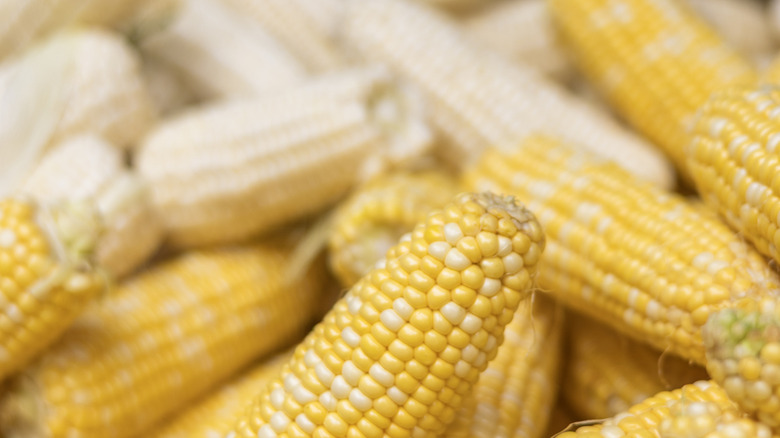
If you're planning to grow tasty sweet corn in your garden, you may be looking forward to harvesting and cooking ears covered in sweet, golden yellow corn kernels. Or, of course, you could grow white corn. There are even white sweet corn varieties like Silver Queen that are wildly popular. So, what is the difference and does it matter which you should plant? The difference between white and yellow corn is easily explained by science. Essentially, color variations — whether yellow, white, blue, or red — are simply genetic and environmental variations reflecting the presence, absence, and activation of specific secondary metabolites, or pigments. And it turns out that in most ways, those differences are largely cosmetic.
There is a common belief that yellow corn, especially yellow sweet corn, tastes better than white corn. That, in fact, is false. The color of corn does not determine its flavor or sweetness levels. Sweet corns are divided into three broad categories: standard (or normal sugar), sugar enhanced, and super-sweet. Any of these can be yellow or white — in part depending on where they're grown — and there are even bicolor varieties with uniform flavor, like Solstice. Different varieties of corn do, indeed, taste different. However, different colors of the same variety do not. Rather, the difference is the pigmentation in the kernels. Certain pigments, called carotenoids, give yellow corn kernels their color. Pigments called anthocyanins, meanwhile, lead to blue, purple, and black ears of corn. With yellow and white corn, the color affects the way the corn looks, but not how it tastes. It can, however, impact in a minor way the benefits you draw from consuming the differently colored kernels.
Corn color affects nutritional value

Given that color doesn't affect the taste, it doesn't really matter if you use yellow or white ears when cooking corn on the cob while camping or having a backyard barbecue. Or, does it? Turns out, the pigmentation that makes corn yellow actually does have some impact on nutritional value. One reason for that is because beta carotene, which is the pigment that helps turn the corn yellow, is converted into vitamin A during the digestion process.
The other slight edge held by yellow corn in the nutritional department is that it contains lutein and zeaxanthin. These two pigments work in conjunction with beta carotene to give yellow corn its color. Both are antioxidants (as is beta carotene) and very beneficial to eye health in humans. White corn does not have these same nutritional values simply because it lacks the color-causing pigments that provide these benefits. Beyond that, however, both white and yellow corn are pretty even when it comes to calories, fiber, carbohydrates, and other nutritional measures.
With all that said, just the act of growing corn and other vegetables is one reason why gardening is good for your health. In addition to the nutrients found in a tasty vegetable side dish, gardening is good exercise and helps reduce stress. You will gain those benefits whether you choose to plant white or yellow corn.