

These Mushrooms Look The Same, But One Is A Delicacy And One Is Poisonous

Mushrooms are interesting; they are fungi, yet people love to eat them. Many varieties are considered delicacies, and mushrooms grow wild in your yard as well as deep in the woods. But safely picking — or foraging — mushrooms takes a trained eye, as some mushrooms look the same as edible types, but are actually poisonous. This is why mushrooms are the last thing you should eat off the trail unless you know exactly how to identify which ones are safe to eat.
Two varieties often confused with one another are morel mushrooms and what are often referred to as false morels. Each of these mushrooms has a ruffled cap which is sometimes referred to as being brain-like in appearance. However, true morel mushrooms are considered a delicacy and are highly sought-after. False morels, on the other hand, are extremely poisonous. As a result, a case of mistaken identity when foraging for morels can have deadly consequences.
In reality, there are several different species of mushroom which may be referred to as false morels. Essentially all of the Gyromitra genus — including Gyromitra esculenta, Gyromitra caroliniana, Gyromitra brunnea, and Gyromitra korfii — might be misidentified as morels. These contain a toxin called gyromitrin which converts in your stomach to hydrazines — used in rocket fuel — impacting your central nervous system and kidneys. The potentially fatal toxin can even be inhaled when you dry these mushrooms. So don't do that.
Additionally, Verpa bohemica and Verpa conica are also considered false morels. Some of these are actually safe to eat. However, while it is fairly easy to distinguish true morels, which belong to the completely different Morchella genus, it can be quite difficult to differentiate between the various Gyromitra and Verpa species. To be safe, it's best to only eat true morels.
How to tell the difference between morels and false morels
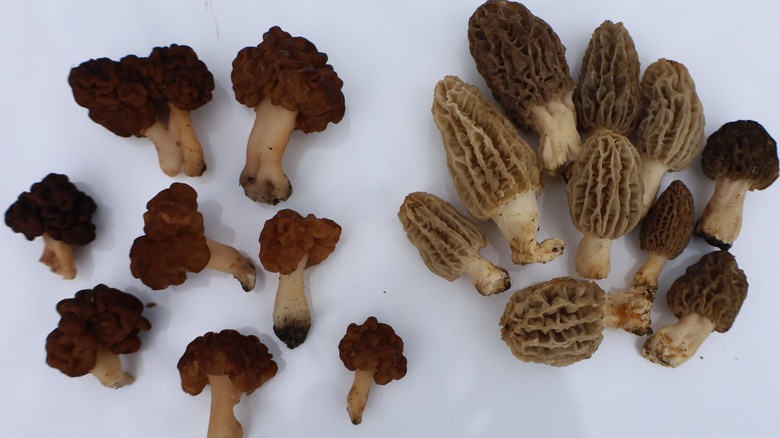
The good news is that despite their overall brainy appearance, it is typically fairly easy to distinguish true morels from the doppelgangers. You just need to know the defining characteristics of each. Aside from their brainy appearance, both true and false morels each exhibit a slight fruity scent. They are both said to have a nutty flavor. It's possible to leach out the gyromitrin from false morels that contain the toxin, though given the risks, you don't want to put that claim to the test.
In spite of those similarities, overall appearances aren't that similar. False morels tend to have a squat, ill-defined cap. True morels have a more defined, symmetrical, and oblong appearance. The coloration differs as well. False morels (both Gyromitra and Verpa) are typically red, purple, or brown, while true morels are more grey, yellow, or tan. The definitive difference, however, is inside: True morels are hollow from stem to cap. False morels, on the other hand, have fibrous tissue filling the core. When the mushrooms are cut in half longwise, it is easy to spot this disparity. Not being able to see this internal difference is one of the dangerous shortcomings of plant ID apps.