

What Are The Lines On Beach Towels For?
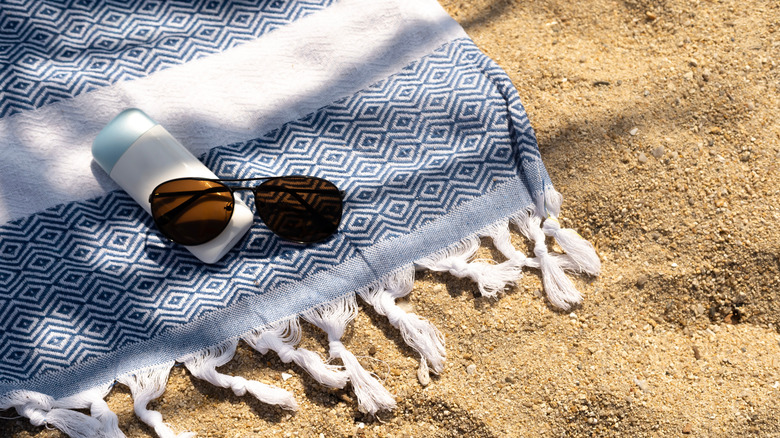
Beach towels are a staple for spending time along the seashore, whether you are just going for a relaxing day at the local sandy hangout or are looking to have the best beach camping experience possible. Have you taken a close look at your towels recently? The odds are good that your favorite one has lines either as tightly woven bands at each end or colorful lines printed on, or both. It may even have several woven bands across the length of the towel. There are both practical and aesthetic reasons these lines exist.
The primary reason beach towels, like other kinds of towels, have those woven bands — often called dobby borders or cam borders — is to increase durability. Since a beach towel is a must-have for summer camping trips and beach day adventures, you don't want to replace it every few trips. While dyed or printed lines are simply attractive, dobby borders can prevent fraying, reduce shrinking, and help avoid mold by hanging flat on a rack or line, rather than getting bunched up, so the towel dries faster.
This is done by creating one of two specific weaves — a dobby border or cam border. Each of these weaves — referred to as borders regardless of where they fall on the towels — are more tightly woven than the rest of the towel, and have the loose loops tucked flat to prevent fraying. These more rigid borders prevent the ends from shrinking faster than the middle of the towel when machine dried. While the terms are often used interchangeably, the biggest difference is that dobby borders often incorporate an intricate pattern or design (and are made on a specific dobby loom), while cam borders are typically plain and flat. True dobby borders tend to be reserved for luxury towels, the kind you might find at high-end hotel pools and spas.
Beach towel lines do more than just look good
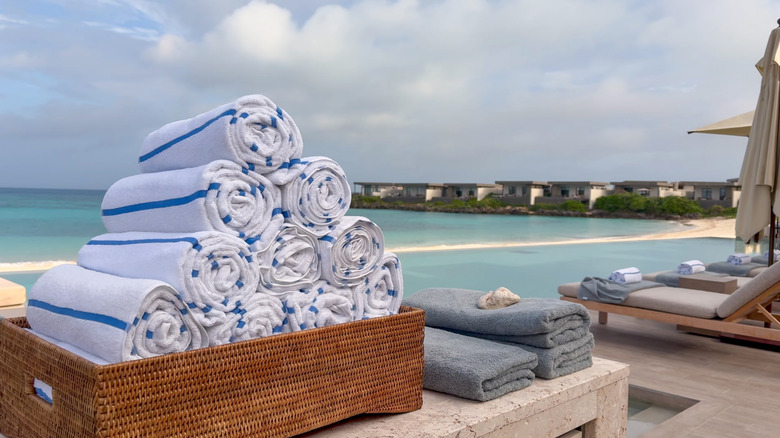
Dobby and cam borders are often placed a couple inches from either end, as is the case with many bath towels and some beach towels. However, these fray-stopping weaves can also be placed at the very edge to form a hem-like border, common on many lighter-weight beach towels. Multiple "borders" can even be placed every few inches throughout the towel, essentially creating a striped pattern. The various colored stripes on a towel may be made using a dobby weave, rather than being printed on. A dobby or cam weave can also be used to create patterns on the towel that may or may not be linear. It should be pointed out dobby or cam borders aren't strictly necessary. They are often altogether absent on lightweight, inexpensive beach towels.
That brings us to another reason beach towels have lines: aesthetic purposes. After all, if you are spending time on one of the most stunning beaches in the world, you want a good-looking towel. Decorative lines can be woven into, or printed or dyed onto, the towel. While these sorts of lines are distinctive, they will do nothing to help a towel lay flat or prevent fraying.
Even if they are just for looks, decorative lines did once serve a practical purpose. They were first used in the late 19th century to designate the type of towel — i.e. bath, pool, beach, or hand towel. This made for an efficient means of separating large loads of towels at hotels, while making sure they were returned to the proper place. By the first quarter of the 20th century, hotels, spas, and other business began using specific colors and patterns on towels to indicate ownership in an effort to reduce theft.