

The Easiest Way To Prevent Wasps From Nesting In Your Yard
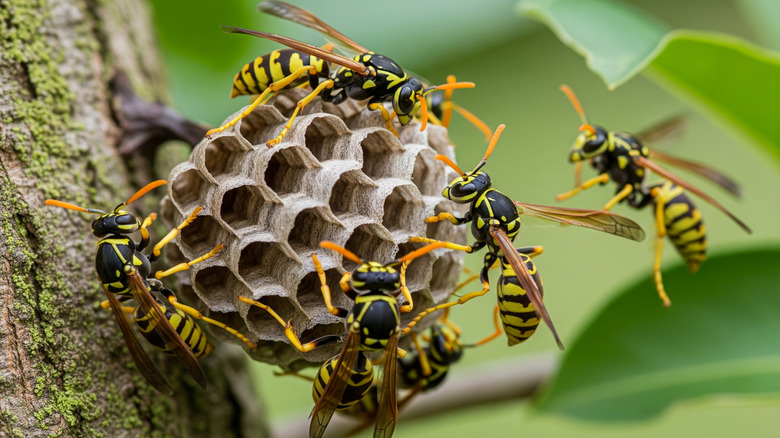
Although some wasps are beneficial for your lawn and garden, we typically prefer them not to move en masse to our yards and set up residence. As a result, people often spend a lot of time and money attempting to eradicate wasps and remove wasp nests. However, the most effective way to limit the number of wasps in your yard is to prevent them from nesting there in the first place. The easiest way to do this is to limit mistakes that attract wasps to your yard. In particular, you should make sure they don't have easy access that allows them to create nests. Simply put, that means filling in holes wherever you find them.
The reason for filling holes to prevent wasps from nesting may not be immediately evident. However, if you consider that wasps utilize holes in trees, posts, exterior walls, and even in the ground to house their nests, it begins to make much more sense. Additionally, they will use holes and cracks in houses and sheds to access indoor areas where they can build nests, such as attics and crawl spaces. They are particularly fond of these locations as the temperature drops. Filling in holes wherever you find them is essentially shutting the door on wasps attempting to take up residence in your yard and around your home.
Knowing that plugging holes is the best way to prevent wasps from nesting in your yard is one thing. Knowing which holes to fill is another. The simple answer to that is — all of them. Any place a wasp could find refuge or set up a nest is fair game, so blocking as many spots as feasible is important. How you go about filling in a potential egress depends on the type of hole and where it is found.
Make it difficult for wasps to nest in your yard
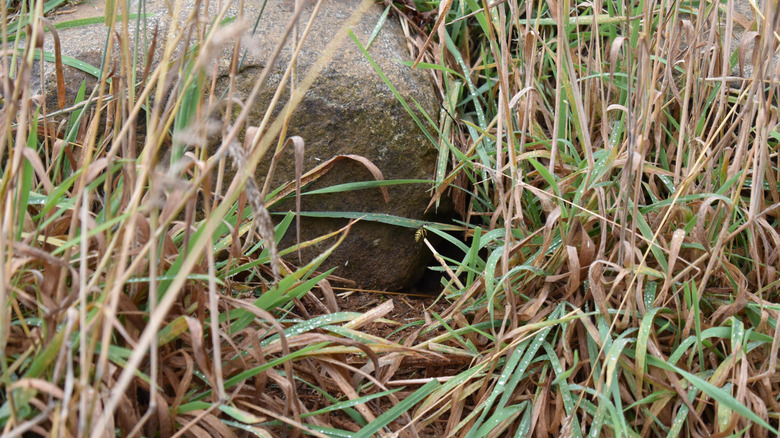
For starters, several varieties of both bees and wasps, including some dangerous types of wasps, use existing holes, like abandoned rodent burrows, to set up nests. To prevent this, scan your yard on a regular basis and fill any hole, regardless of size, with dirt. But first make sure it isn't already an active nest. If it is, you will need to clear the hole of wasps first. This can be done by either pouring soapy water on the wasp nest or spraying it with insecticide. Wait until evening for either strategy, when all the wasps have returned to the nest and are less active, and place a mesh screen across the hole before filling or spraying it to prevent them from flying out.
While you are scanning your yard for holes in the ground, inspect the roots of trees and other large vegetation. If you find any openings, fill those will dirt or sand as well. Then, move on to checking for holes in your fence and trees, as well as structures such as garages, sheds, and, of course, your house. Again, make certain any holes that are found are clear of active nests before being filled. If it looks like mason or carpenter bees are inhabiting these spaces, set them up with their own tin can bee hotels before blocking their old houses. Caulk or spray foam can be used to fill any cracks or holes in wood, brick, or concrete, including cracks or gaps around windows and doors. Spray foam can also be used to fill holes in trees, which will help prevent attracting mosquitoes as well.