

How To Clean And Store Your Kayak To Prevent Hull Damage

We may receive a commission on purchases made from links.
Kayaking has become increasingly popular in recent years. In fact, it is among the fastest growing sports in the country. While it is important to choose the right kayak for you, along with the accompanying gear, it is just as important to take care of your craft so it performs properly and provides years of good service. To that end, among the most basic tasks to complete with each outing are cleaning and storing your kayak the right way. This helps prevent hull damage and a variety of other issues. Cleaning starts by hosing down the inside and outside thoroughly.
Why wash a kayak with water? After all, it is used in water and will return to water. Simply put, not all water is the same. If the kayak navigates saltwater, it is necessary to remove any caked-on salt to protect the hull as well as any components, especially metal ones, which can quickly corrode. Secondly, organic matter, like algae, in both fresh and saltwater can lead to buildup and water stains, as well as mold and mildew growth. Among the less obvious organic matter that clings to kayaks are various microorganisms. If the kayaks are not cleaned after use, this can lead to the spread of invasive species into other water bodies. This is why many areas, including some top national parks for kayaking, mandate all watercraft and equipment (including kayaks), be washed down at cleaning stations.
Proper storage is equally important. Prolonged exposure to sunlight can prematurely degrade the integrity of your kayak's hull. Extreme temperatures can cause kayaks to become misshapen or even crack. Additionally, not distributing the weight and pressure correctly when storing your kayak can cause the hull to dent, bend, or warp.
Properly washing and storing your kayak
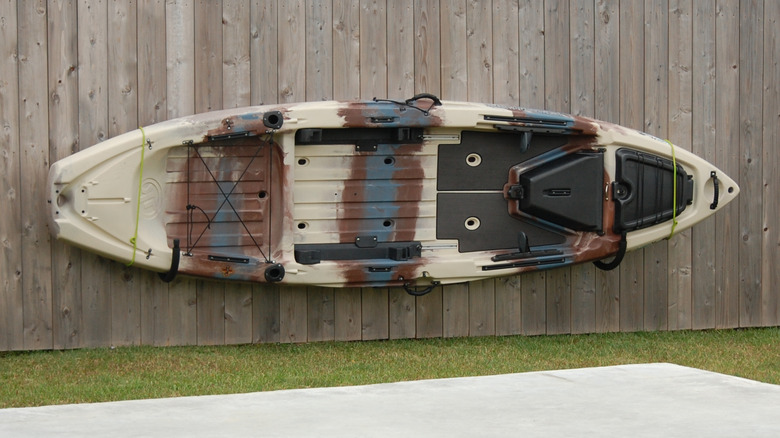
Although properly washing and storing your kayak is important, it isn't all that complicated. It more or less follows the same rules as cleaning boats to prevent the spread of invasive species. The first step is to drain all the water from your kayak as soon as you pull they kayak onto shore. Then, use the boat cleaning station at the launch site, if available, to ensure you don't transport anything beyond your location. Whether washing at the launch site cleaning station or elsewhere, use a mild soapy water and soft bristle brush to clean away mud, algae, aquatic vegetation, and small creatures, such as parasites or snails. Then rinse it thoroughly with clean freshwater. Finally, thoroughly dry the kayak and all attachments, using soft towels. Remove any soft attachments, such as seat backs and cushions for separate drying and storage.
Once your kayak is completely dry, it is time to store it. The best way to do this is to keep your kayak indoors, away from any source of sunlight or heat. It is also best to keep the kayak off the ground. A wall-mounted rack, like the Walmann lightweight storage rack or a lift that allows the kayak to be stored on its side or upside down is ideal. This distributes the kayak's weight across its strongest points — the bulkheads and near the cockpit. If you are unable to store your kayak inside, you can use these same racks outdoors, but consider covering it with a tarp or a fitted kayak cover in order to protect it from sunlight, dirt, rain, insects, and rodents.