

Must-Know Tips For Propagating Rosemary In Your Herb Garden
Rosemary is an essential culinary sprig and a medicinal plant you can grow in your garden. It's also an aromatic herb that can deter pests from your garden. But if you only have one or two rosemary plants in your herb garden, you could be over-harvesting and stressing the plant out. The best way to keep your fragrant herb in abundant supply is to start propagating it.
Propagation is the practice of breeding from a mature parent plant. You can do so by taking cuttings of a stem, young limb, or leaf, or by dividing roots, tubers, rhizomes, or bulbs. The best way to propagate rosemary is through cuttings. It's nice because you don't have to start growing the plant from seeds, which can be finicky and time-consuming (it can take years to grow a rosemary from seed large enough to harvest).
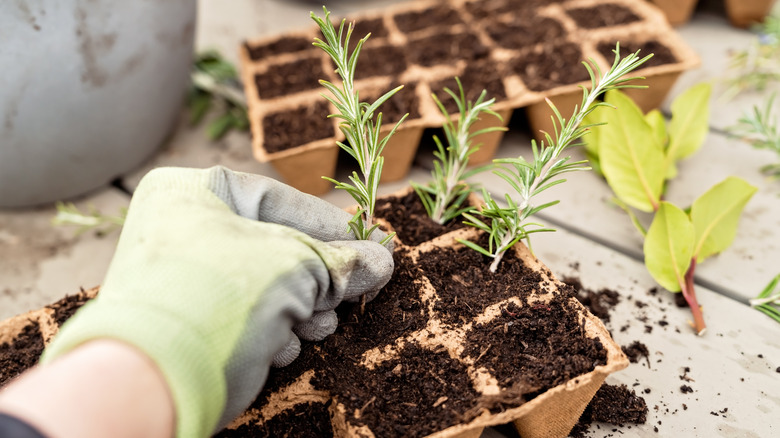
Cutting is simple. Just take several 4- to 6-inch-long, semi-hardwood rosemary stems and remove the leaves from the lower 2 inches of stem. If you want to use rooting hormone, now's the time to dip the stems. Next, insert your cuttings about 1 inch down in a moist perlite-peat mix, or other seed-starting soil conditioner. Keep the mix humid under indirect light. In two to four weeks, your cuttings will have baby roots growing! Once the roots are established, you can transfer your homegrown starts directly to your herb garden. You can also pop the stems in a jar of water instead of potting soil, just strip the leaves further up the cutting and don't let leaves touch the water.
Other ways to propogate rosemary
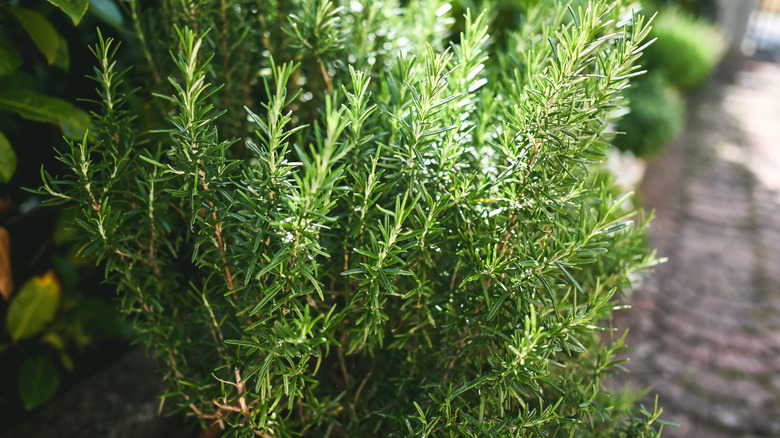
While cuttings are the most popular way to propagate rosemary, layering and seed germination are two more ways to increase your rosemary production. To try the layering technique, head over to your existing well-established parent plant. Locate a healthy, flexible (semi-woody) stem growing near the base of your rosemary plant. Don't remove it. It should ideally be a low branch that can easily bend to the soil.
Gently strip the leaves and scrape a small section of bark on the underside of the stem. Bend the stem down to the ground, and bury the wounded section a little under the soil while keeping the tip of the stem exposed above ground. With a U-shaped garden pin, a small rock, or wire, secure the stem in place. Some people pile mulch over the stem to ensure the wounded section stays covered and moist. In about two months, new roots will have formed. If they are looking robust, you can snip the newly rooted section from the original plant and transplant it.
Germinating seeds is another way to propagate this herb. However, this technique isn't for the impatient, and there are a few key steps you don't want to skip when starting seeds. Start seeds indoors about six weeks before final frost, or sow fresh, high-quality rosemary seeds on the surface of a moist, well-draining mix kept at 65 to 70 degrees Fahrenheit. Leave them uncovered, with plenty of access to light. Soaking seeds for a day before planting will help spur germination.