

Help Your Raised Garden Beds Thrive With A Hardware Store Staple

A raised garden bed offers many benefits over in-ground gardens: There's more control over soil conditions for one thing. Additionally, raised beds that are actually off the ground help keep out some unwanted garden guests, such as rabbits. But the type of garden bed that consists of a four-walled frame with no flooring between garden soil and the earth overlooks the fact that burrowing animals — like groundhogs, voles, and chipmunks — can wreak havoc in a raised bed once they find their way in. Thankfully, a little forethought prevents subterranean access. Lining the bottom of a raised bed with flexible metal mesh known as hardware cloth keeps many pests from digging into your garden. After all, if you see chipmunk holes causing lawn damage in your yard, it's only a matter of time before they discover your framed garden beds.
Hardware cloth comes in a roll like chicken wire, but is much stronger. It's typically made of stainless steel or galvanized metal, featuring smaller, square holes compared with chicken wire's large hexagonal holes. Mesh featuring quarter-inch or half-inch holes is best for lining raised garden beds: The smaller the hole size, the more animals it excludes. Hardware cloth is sold in assorted widths, so if you haven't built your garden beds yet, it's easy to size them based on the available hardware cloth. Otherwise the mesh is easy enough to cut to size using aviation snips or electric shears.
How to install hardware cloth in raised garden beds
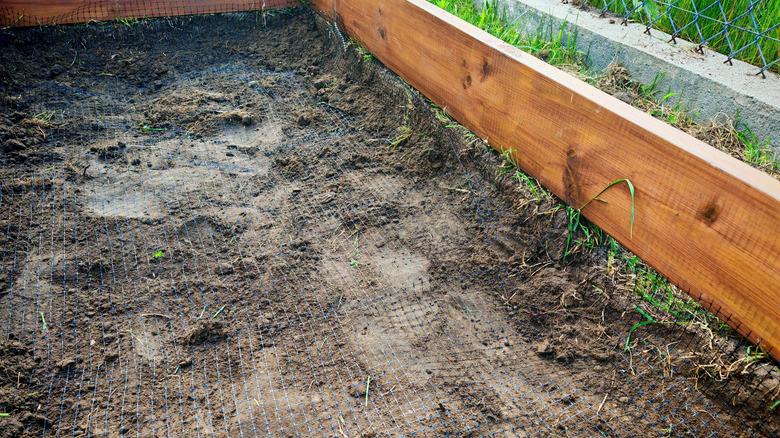
Installing hardware cloth in a raised garden bed is easiest before you've added the plant soil. Trim the cloth so it's a few inches longer and wider than the interior of the garden bed frame. You can size it and crease it down over the outside top of the box to get proper dimensions. If your cloth is too small, overlap sections by a foot, securing overlapping pieces with wire ties.
Center the cut hardware cloth over your raised garden-bed frame and gently lay it down inside the frame. Get inside the frame and stand on the cloth, pushing the material into the soil while bending the excess upward along the interior of the frame's wall. Secure the mesh along each wall with stainless steel staples every few inches, continuing along the inside perimeter of the garden bed until the hardware cloth is stapled all the way around. You can further secure it with U-shaped fencing nails, and add a layer of cardboard to weed-proof the garden bed, if you like.
If your raised-bed garden already has dirt in it but no plants, you can still add hardware cloth. It'll take more effort, but it's worth it to prevent sneaky wildlife digging their way in. Shovel all the dirt to one side of the raised bed. Roll out the hardware cloth on the exposed section, pressing it into place. Staple that end in. Roll or loosely fold the unused half of the hardware cloth so it gathers in the middle of the raised bed, then carefully scoop the piled dirt onto the side of the cloth that's already stapled. Unroll and staple down the hardware cloth on the newly exposed portion, then even the dirt out across your raised garden bed.