

The Reason You Never See Cardinals In Your Yard Is Simple

Once you've filled your bird feeder with sunflower seeds to attract cardinals, refreshed your bird bath, and patiently waited at your window with a pair of binoculars, it can be quite demoralizing if none of the bright red songbirds show up. In fact, many backyard bird lovers struggle to get cardinals to flock to their yard, even under the most ideal conditions. Luckily, there are a few easy techniques to diagnose what's causing this shortage, allowing you to take decisive action. One of the most common issues plaguing bird lovers is surprisingly simple: feeder placement. Northern cardinals are creatures of habit, demanding certain kinds of spaces for safe feeding. If you've got your bird seed in the wrong spot, it could be enough to drive them away.
In the wild, cardinals tend to forage along the edge of forests and in dense shrubbery. They also like to stay relatively close to the ground — where gorgeous berry bushes that cardinals love thrive — and where seeds and fruits fall from the surrounding trees. These birds can be jumpy, and are hyperaware of any looming predators waiting to snatch them. For this reason, cardinals are usually drawn to bird feeders that afford them a little privacy, or are close enough to trees to provide an easy escape route. Likewise, while elevating feeders reduces competition from ground-feeders like doves, these medium-sized songbirds are unlikely to stop at a bird feeder that's too high off the ground. Their bright palette makes them an easy mark for high-flying predators, so they prefer to stay low when possible.
Finding the perfect spot to place your bird feeder
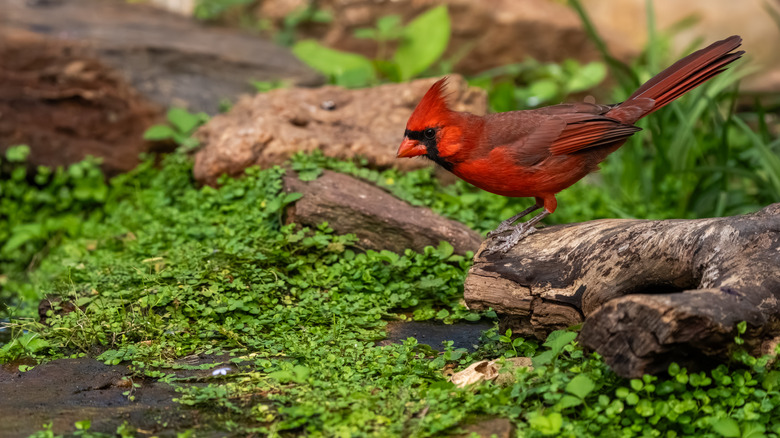
Once you have a good understanding of what cardinals want in a bird feeder, it should be easy to entice them to flock to your yard. Simply provide food, security, and comfort by thoughtfully choosing a location that mimics their real-life grazing habits. To begin, scan your yard for areas with natural cover. This can mean dense shrubbery, small trees, or overgrown fields. Placing your bird feeder roughly 5 to 10 feet from protective cover should be enough to offer some security, while still making them visible to you as you tend your garden. If you lack this kind of cover, it might be worth it to consider planting a row of bushes along your property line. You can even try attracting cardinals to your yard with easy-to-grow plants such as sunflowers, crabapple trees, and flowering dogwood.
It's also important to consider the stability and construction of your bird feeder. Cardinals tend to prefer platform feeders with wide, attached trays, where they can perch comfortably while they eat. Investing in a tray feeder or large hopper feeder might invite more of them to your yard, so long as they aren't placed high up in the trees. The ideal mounting height is roughly 5 feet off the ground. This will reduce the swing and sway of your feeder, while mimicking the preferred natural feeding environments for these finicky birds.
Even when you've positioned your feeder perfectly, patience will be a key factor. Like many wild animals, cardinals are creatures of habit, so it may take several days or weeks before they reliably relocate to your yard. Once they feel secure enough to return regularly, you should begin to see them traveling in pairs or family groups.