

Could There Be Snake Eggs In Your Yard? How To Spot Them Before It's Too Late
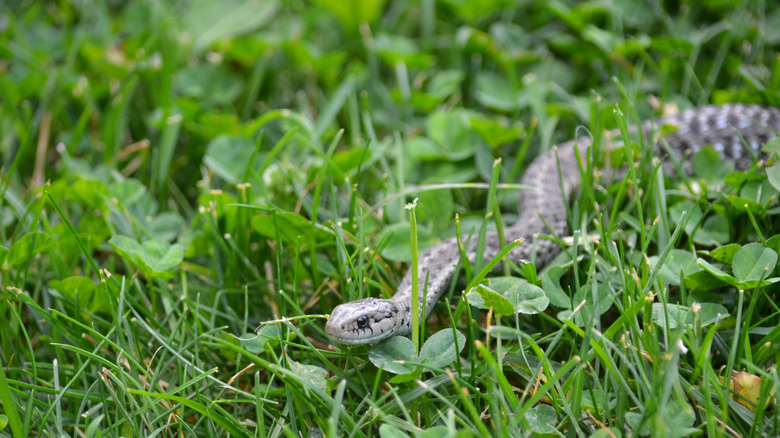
When you're trying to detect and identify snakes in your yard, a clutch of eggs in the grass or under a squash vine could be an indicator of snake activity. However, eggs on the ground aren't necessarily snake eggs. Turtles and other reptiles lay their eggs on or in the ground. Wild turkeys, pheasants, and all sorts of waterfowl nest on the ground. Smaller birds such as quail, the hermit thrush, and the horned lark do too.
The good news is that snake eggs are fairly easy to distinguish from bird eggs. Snake eggs have a little give when lightly prodded, as if they're made of a rubbery or leathery substance, while bird eggs have a harder, non-porous shell. What's more, some snakes don't lay eggs at all, which is good news if you're concerned about the potential for various venomous snakes in your yard. Rattlesnakes, water moccasins, and copperhead snakes all give live birth so you won't find any of their (non-existent) eggs on your property. Garter snakes, common in many yards and gardens, also do not lay eggs.
Many common stateside snakes do lay eggs: Milk snakes, rat snakes, gopher snakes, and coral snakes are all what's called oviparous. Coral snakes are the only egg-laying venomous snake in the United States, but they tend to lay their brood far from human settlements. They are often hidden under decaying wood. In desert environments, coral snakes lay their eggs underground or lightly buried.
How to spot snake eggs
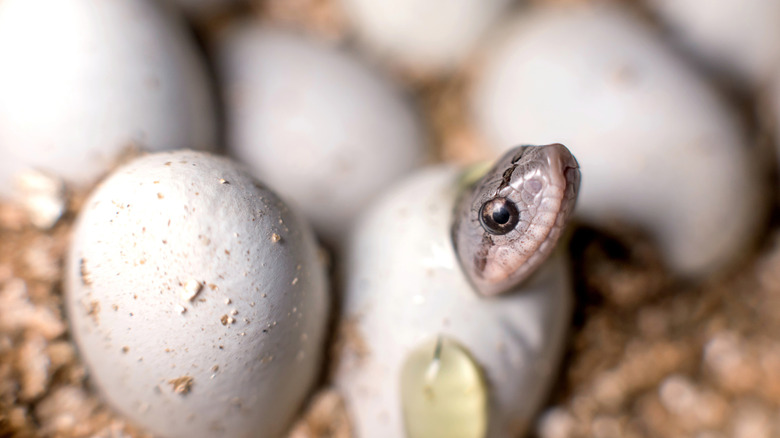
If you see eggs directly on the ground, tucked in decaying matter in your yard, or covered with soil, first look around to ensure there aren't any slithering mamas nearby. If it's a snake egg, it will seem rubbery and porous when prodded. It's more elongated than a typical bird egg, giving it a somewhat tubelike look. Most bird eggs look more or less like chicken eggs, with a wider bottom and tapered top.
Look up which snakes live in your area, and whether they lay eggs or give live birth. Compare images of those eggs to what you found in your yard. Snake eggs are often white or light in color, and typically don't have spots the way quail and some robin eggs do. Recently laid snake eggs might even look a little transparent. Many snakes also lay large clutches — perhaps more than a dozen at a time, as is the case with milk snakes and eastern rat snakes. In contrast, a robin typically lays three to five eggs at a time. This isn't a perfect detection system: Some coral snake species lay three to seven eggs at a time, while a wild turkey can lay a dozen.
Then you need to decide what to do with them. Some snakes are actually beneficial for your yard, as they are a natural form of pest control, eating rodents, slugs, snails, even termites, so you'll probably want to leave them alone. If you live in an area with invasive species like the Burmese python, contact wildlife control or the fish and wildlife commission so they can humanely get rid of them. Pythons can lay about 100 eggs at a time and the mother aggressively protects them, so it's best to get professional help.