

What You Need To Know About The Outdoor Adventure Sport That's Rapidly Rising Across The US
We may receive a commission on purchases made from links.
Via ferrata, which translates to the iron way or iron path, began as a practical means to traverse rugged terrain in the Italian Alps. While it was primarily used as a way to move troops and supplies across the Dolomites in WWI, following the war it took on a more recreational purpose. Although it has been popular among European climbers and mountaineers ever since, via ferrata didn't debut in the U.S. until 2001. Over the next two decades, there was relatively slow growth. However, in recent years this unique outdoor adventure has exploded in popularity, resulting in numerous courses being established throughout mountain regions across the country. If you are looking for your next mountain adventure, via ferrata just may be for you. First you need to know what it is, where and how it is done, and how you can get started.
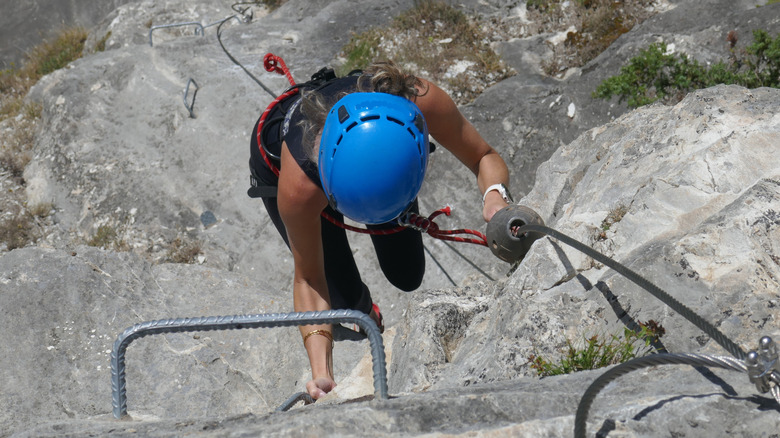
To begin with, via ferrata is, as its name implies, heavily dependent on various metal works. Essentially, it is a course with preset cables, as well as permanent hand and foot holds, and, in some instances, ladders. Beyond the common aspect of utilizing a defined path with these pre-placed safety and assistance components, via ferrata courses vary wildly. Some may be straight, vertical ascents, while others may be a somewhat casual horizontal venture along a rocky outcrop, or anything in between. It is most often described as a combination of scrambling and rock climbing, albeit a safer and quicker version. It's still important for novice rock climbers to avoid common mistakes, even with the assists.
Where you can access via ferrata courses in the U.S.
What's often considered the first via ferrata course in the United States is located at the Red River Gorge in Kentucky, opened in 2001. Today, there are a handful of via ferratas operating east of the Mississippi River, including one in West Virginia and a pair in New York state. However, the vast majority of the top courses are located out west.
Many of the top via ferratas in the western U.S. are located near popular scenic areas, such as the Above Zion Via Ferrata in Utah, situated (as its name suggests) directly across from Zion National Park. The route is renowned for providing participants breathtaking views of the park — which is on most people's national park bucket list — from high elevation. Other popular routes in the western U.S. include locations in or near Taos, New Mexico, Jackson Hole, Wyoming, Tahoe, California, and Telluride, Colorado.
Not surprisingly, via ferrata is particularly popular in the town known as the Switzerland of America — Ouray, Colorado. This small town is home to an almost disproportionate number of via ferrata courses. These include a free via ferrata route, several with guided tours offering various degrees of difficulty, and one that claims to be the longest course of its type on the continent.
What you need and how to get started
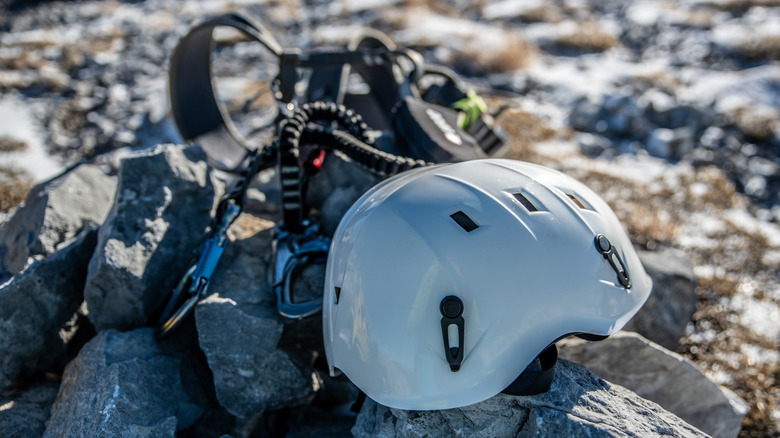
The equipment needed for via ferrata is fairly basic. You will need a proper helmet such as the Black Diamond Half Dome rock climbing helmet. You will also need a rock climbing harness and a via ferrata lanyard. This somewhat unique tool is basically a pair of carabiners attached to a Y-shaped shock absorbing lanyard. This allows you to have at least one carabiner clipped onto the cable at all times, even as you are maneuvering over obstacles or changing directions.
Typically, that equipment will be provided for you on a guided tour. So, unless you already have a harness and helmet from rock climbing, you may just want to book a tour and get a feel for it before buying equipment (a quality kit can run you over $300). You'll need to bring appropriate clothing. It's essentially the same apparel you wear for rock climbing or mountain hikes, including good hiking shoes. You don't want to be wearing the wrong hiking shoes on this journey. Additionally, you may want to bring along a pair of gloves to safely grip metal cables.
The best way to get started in via ferrata is to book a guided trip on a route that is not overly technical. This will give you a chance to become familiar with the methods and routine this climbing discipline requires before attempting it on your own. The good news is that while previous mountaineering or climbing experience can be helpful, it is not necessary to successfully take up via ferrata.