

Want To Sleep In Your Car At US National Parks? Don't Break These Rules
Perhaps you've booked the perfect campsite at your favorite national park. Or maybe you are taking a bucket list-worthy road trip and notice a U.S. national park on your route that would make a convenient overnight spot. In either instance, if you decide it's easier to spend the night in your car rather than pitch a tent, you'll want to double-check the rules and regulations. The key is knowing where you are and are not allowed to sleep in your car within a national park.
If you already have a campsite booked, in all likelihood you will be able to sleep in your car, as car camping is okay at almost every national park campground. The primary exceptions involve some primitive, walk-in sites where vehicles are not allowed. However, at areas where you are allowed to park at an assigned campsite, you can hole up in your car, just as you would an RV or tent. This includes frontcountry campsites, as well as select backcountry sites at some parks that are reachable by the appropriate vehicle. To be on the safe side, call or check a park's web page ahead of time.
You can't just pull off the side of the road to sleep
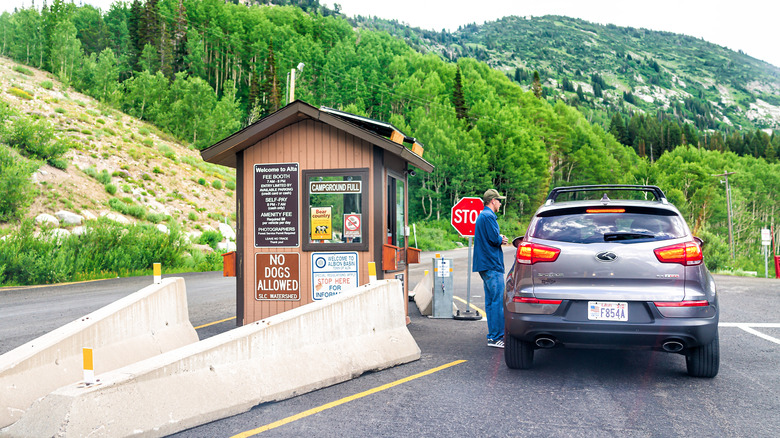
If you have not reserved a vehicle-accessible campsite within a national park, you may find yourself unable to stay the night in your car — at least legally. For starters, unlike Bureau of Land Management (BLM) dispersed camping lands, where you can simple pull over and set up camp for free, national parks are more restrictive. You are not allowed to set up camp — or sleep in your car — outside of the campsite to which you are assigned. You cannot sleep in your car along the side of the road, nor in other areas such as parking lots, lookouts, or even open spaces of land. In other words, the entry fee alone does not allow you to bivouac in your car inside a U.S. national park.
Take heart — there are still options if it's almost road trip time and you don't have a camp spot. Some national parks accept campers on a first-come, first-served basis. Depending on the park and campground, as well as the season and your arrival time, this might work. For most national parks, this tactic is most useful in the off season, as many of the more popular places are often full during summers and on weekends and holidays. You can also try to book a last-minute reservation at a national park. Check Recreation.gov for a given park: If they have a campsite available, book it. If not, set up notifications, and continue to check back, as sometimes sites open up due to last-minute cancellations.
If you end up deciding to pull to the side of the road in a national park unauthorized, you may simply be told to move along. But park rangers have the power to issue fines, and suddenly your free strategy gets a lot more expensive.