

The Best Method For Laying Artificial Grass In Your Yard
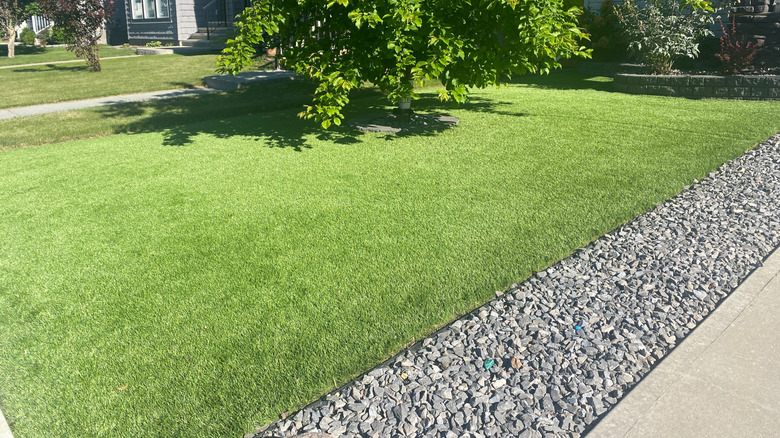
With the labor involved in caring for a lush lawn, along with health concerns surrounding the use of chemical fertilizers and pesticides, homeowners are seeking other ways to have the yard of their dreams. Although there are many clever alternatives to grass for a no-mow garden, sometimes, you still want the verdant, grassy look without all the upkeep. Installing artificial grass is a great way to have the green lawn of your dreams without the work.
While there are valid reasons for not installing artificial turf, modern versions look and feel like real grass and aren't the artificial grass of the 1960s. But it's still important to take the time to install your faux turf correctly to get the most natural-looking results. Getting the site ready properly is critical to a successful install of your artificial grass. Don't lay artificial grass over an existing grass lawn. Doing this can lead to a host of problems, including uneven surfaces, weed growth, and drainage problems that can lead to mold and mildew. Gather the tools you will need for installation — including a shovel, wheelbarrow, hammer, hand tamper, weed barrier, gravel or crushed stone aggregate, and sand — along with the artificial grass of your choice.
Getting the site ready for artificial grass
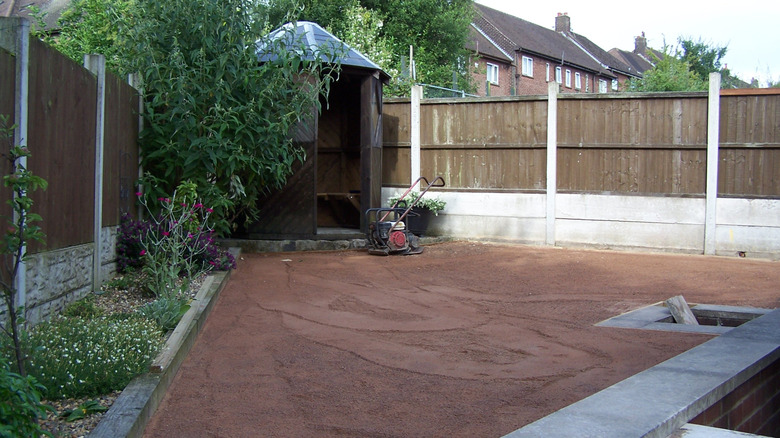
Remove all of the existing grass and weeds from the area you plant to lay down down artificial grass. To make room for a base, remove the top 3 to 4 inches of soil from the area with a shovel. This part can take a little bit of elbow grease, but this space for your base is very important. Once the soil has been removed, use your tamper and compact the loose soil. Next comes your base: Use your wheelbarrow and add a gravel base with pebbles no larger than ⅜ inch. Once you have added the gravel and spread it out evenly, add a sand layer on top of the gravel. Tamp your aggregate to compact it and create the flattest surface possible. Water the area with a hose to help gravel and sand mix and settle together.
Place landscape fabric on top of the base to prevent weeds from poking through your artificial grass. This is an important step in keeping your artificial grass in great shape. Place the weed barrier wherever you are going to place the artificial grass. Once the weed barrier is down, make sure everything is level.
Laying the artificial grass properly for best results
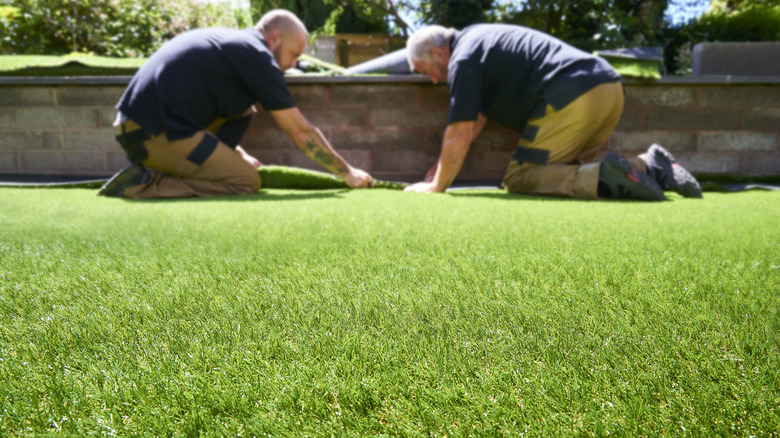
Once the base is ready, it's time to lay down artificial grass. Two or more people will help this part of installation go smoothly. Avoid dragging the turf across your base, which can both disturb the base and stretch the turf. After you have the artificial grass spread out, many installers recommend letting it settle for one to three hours. After it has settled, use a box cutter to cut the grass to the shape of your yard. Leave about ½ inch of grass beyond your yard border so you can neaten the edges properly. If you need to connect multiple pieces of turf, use adhesive and seaming cloth (artificial grass tape) on the underside. Apply the adhesive to the cloth, let it set for 10 minutes, and then lay the pieces together carefully.
Pin or nail the turf down around the perimeter and along your seams, spaced about 6 to 8 inches apart all the way around. Don't hammer too much or too hard — you can cause indentations in the base, which will be visible on the turf's surface. Once the install is complete, apply infill sand to refresh the turf and make it look its best. Make sure to apply the correct amount using a drop spreader for the maximum life span of your turf. Work the infill is deep into the grass fibers, then use a push broom to brush the turf so blades stand up properly. Now that you have that beautiful, no-mow lawn all set, you can work on creating a low-maintenance oasis in your backyard with these ideas from "The Property Brothers."