

How A Little Preemptive Paint Job Can Help Your Fruit Trees Thrive
We may receive a commission on purchases made from links.
Having fruit trees in your yard or garden can be a delight thanks to their fresh food, generous shade, and the beauty they add to your home. However, keeping your fruit trees healthy can be challenging, and not just because you might live in a bear-infested area. Fruit trees can be highly susceptible to sunscald, pests, and frost, which may be one of several reasons why your trees aren't growing fruit.
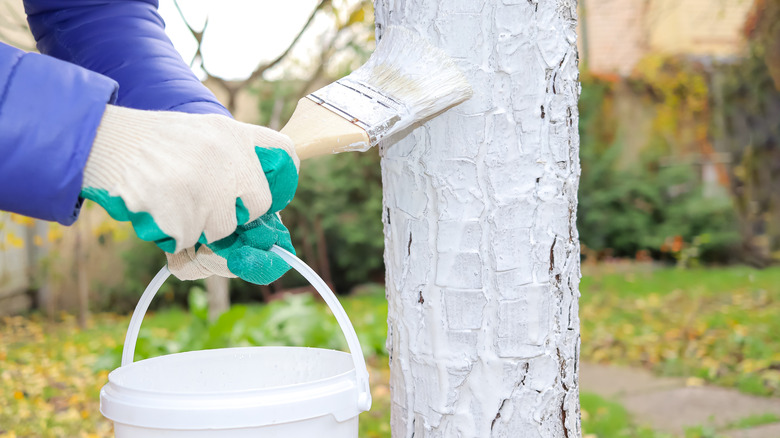
Sunscald is a condition where the bark of your fruit tree might appear burnt or cracked, and it is more common on younger trees because their bark is thinner and thus more susceptible. In the cold of winter, frost damage could also cause similar cracks. This damage to the bark might allow pests and fungi to infect your fruit tree. However, there's an unusual way you can prevent sunscald, pests, and other damage to your trees, and that's by whitewashing them.
Whitewashing trees is a process that can be traced back to ancient Greece, though it has flourished among orchards in the past few centuries. Painting your trees can protect them from cracking due to sunscald or frost, thanks to the way whitewashing works. The white paint reflects light, which will prevent the bark from overheating; the paint also serves as a barrier to prevent frost and pests from reaching and penetrating the bark.
Which paint to use for whitewashing and how to apply it
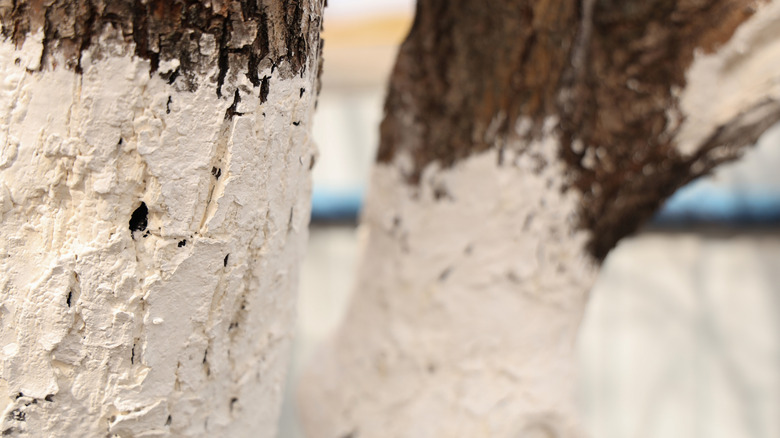
In addition to commercial tree paint, such as Go Well Brands' Tree Paint, there are two primary options for whitewashing your fruit trees. The first is a lime-based paint, which uses hydrated lime diluted in water and has a chalkier appearance. Due to the consistency of the paint, limewash will still allow your trees to breathe. To make limewash, mix one part hydrated lime with six to eight parts water. Mix the paint until it has a similar consistency to skim milk, and let it sit overnight.
The other whitewashing option is to use an interior white latex paint. This will create more of a seal on the bark, which can, on occasion, be more effective protection for your fruit trees. To use latex paint, you will want to mix one part paint and one part water, ensuring not to dilute the paint too much.
To apply your whitewash of choice, you can either spray or paint the solution onto the tree bark in late fall. Be sure to start at least 18 inches from the ground, and do not whitewash trees that are less than two years old. You will want to apply the whitewash evenly along the bark and in thin coats to not suffocate the tree. You will want to reapply the whitewash annually if you are concerned about further damage to your fruit trees. If you don't think there's enough space in your yard for this, you can even grow fruit trees in pots and whitewash them that way,