

A DIY Picnic Table That'll Take Your Backyard Space To The Next Level
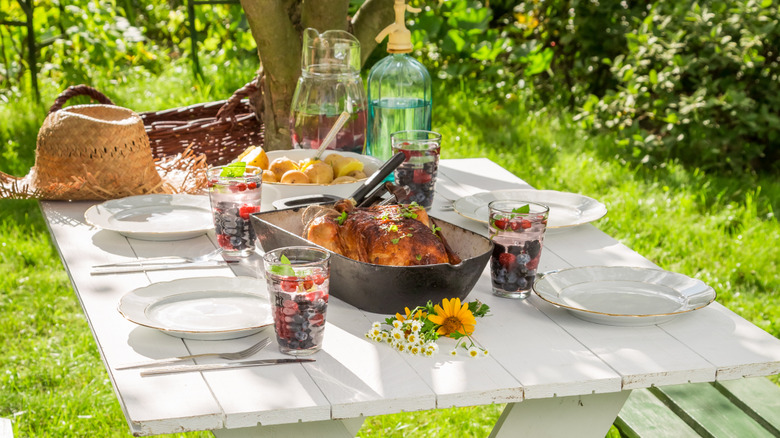
A picnic table is the hallmark of a backyard good time. If you're interested in tackling DIY outdoor furniture, a picnic table is the perfect carpentry 101 project. This freestanding bench-and-table design is a beginner-friendly option because the table and bench share the same design, with the table simply larger. Constructing a picnic table is pretty straightforward: Cut the lumber and assemble the top, benches, and legs separately. Attach the legs to each surface, then apply a weatherproof, food-safe finish. To keep your picnic table pristine for years to come, use a stylish vinyl fitted tablecloth over the top when you use it.
For this project you'll need a pencil, a measuring tape, a miter saw or circular saw, a drill with bits that fit your hardware, a sander or block sander, clamps, and a socket wrench. Always wear safety equipment during the process. If you don't have a circular or miter saw, local lumberyards or home improvement stores can cut your lumber to size for a small fee. Some public libraries and makerspaces have tool lending libraries.
For a six-foot table, you will need ten 2- by 6- by 8-inch and five 2- by 4- by 10-inch boards. The affordable lumber choice is pressure-treated pine, also one of the best choices for a deck in a rainy area. More durable, visually appealing options include cedar, Douglas fir, white oak, or other hardwoods. Though be aware your table will be much heavier than with the pine.
Screws for fastening include a ½-lb box of 1¼-inch wood screws and a box of approximately 70 heavy-duty 4-inch lag screws. You'll also want exterior-grade hardware (look for galvanized), including carriage bolts in 3½- and 4½-inch lengths, washers and nuts, 2 × 5-inch corner tie plates, and ¼-inch Phillips pan-head screws with the appropriate driver bit.
Cut and assemble the surfaces, then attach the legs
Once all your cuts are made, lay out the each bench and the tabletop, separating each board with ¼-inch spacers and clamp in place. Drill and secure the appropriate 2-by-4 underside the planks to create a solid tabletop and two benches. The 2-by-4s should be set perpendicularly about 8 inches in from each end, using lag screws. Repeat on all sides until you have three surfaces ready for legs.
The legs are an "X" design, fastened to the surface underside planks with bolts. To construct each leg set, create an X, marking where lap joints will be cut, using a miter saw. Screw each X together with the 1¼-inch screws. Before securing them to the top surfaces, trim the top and bottom edges of each set of legs so they are flush with the underside of the surfaces and rest flat on the ground. Fasten the legs to the 2x4's on the undersides of the benches and tabletop.
The final component of the assembly is diagonal bracing, which prevents the table and benches from wobbling or collapsing under load. Each brace should be centered on each X, then connected to the surface's underside with a carriage bolt, washer, and nut. Finally, add 90-degree tie plates with screws to stabilize the braces. After repeating this process for all the legs, you have a stunning homemade picnic table nearly ready to eat on. What gives this DIY project a professional-grade look is thorough sanding and an outdoor-grade wood finish, varnish, or paint. You might even have leftover waterproof sealent for your planter boxes that will work for the table, too.