

Here's How Much Snow You Should Leave On Your Pea Gravel Driveway (& Why)
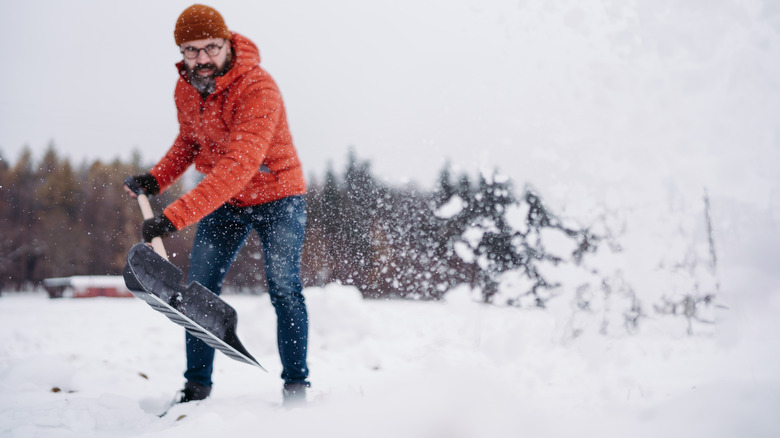
When a fair amount of snow falls, the question often arises as to whether a snow blower or shovel is the right tool for the task of clearing snow from your driveway. If you have a pea gravel driveway rather than a paved one, your snow-removal situation becomes a little more complicated. If you dig down too deep to remove snow, you'll take some of the gravel out with it, which could result in divots in your driveway. Divots that erode and grow with each rainstorm and vehicle driving over. Displaced gravel can also ends up in your yard or somewhere else it doesn't belong. If you decide not clear snow at all, of course, it could be hard for cars to enter or exit, while excessive snow melt (and freeze-thaw cycles) brings its own erosion issues to gravel driveways. As it turns out, the best way to protect your gravel driveway is to leave about an inch of snow on it, whether you're shoveling or snow blowing.
That inch-deep layer of snow is shallow enough to drive through with ease, yet deep enough to keep the gravel where it belongs. If the snow sticks around for a while, it becomes a packed base layer that protects your gravel driveway and keeps it from shifting much as you drive over it. And more good news: You're at an advantage when shoveling or blowing snow off of a pea gravel, rather than a crushed rock, driveway. The smooth, rounded pebbles settle in and compact well, making the gravel surface more even. This means even if your shovel dips below the 1-inch mark, your shovel blade will more likely skim over the rocks instead of catching on jagged edges poking up unevenly.
Take a layered approach to removing snow from gravel driveways
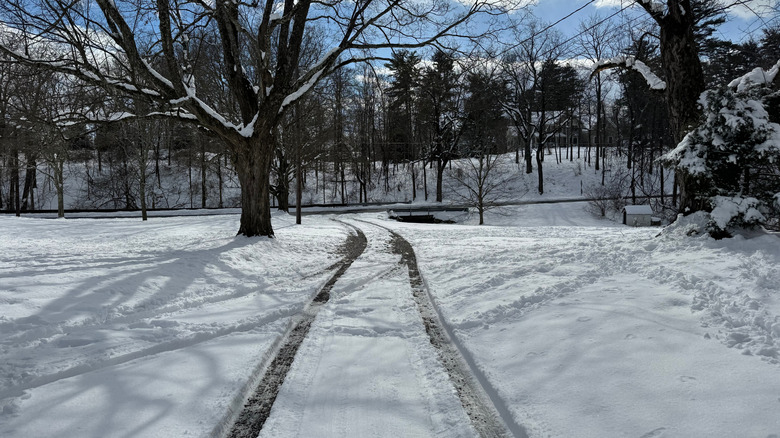
As with clearing snow from pavement, you still have multiple snow-removal methods to choose from for your pea gravel driveway. When the snow is extra light and fluffy, using a leaf blower is one of those clever hacks that'll make snow removal a breeze, yet it's not forceful enough to dislodge any of the gravel. On fairly light snow, a small tractor with a snow pusher offers you the opportunity to push the snow off to the side of the driveway without scooping it up.
For deep snow where the only option is shoveling or plowing, remove the snow in layers. It'll take some effort, but it makes it easier to properly approach the 1-inch-deep mark. Plus it means you're carrying less per shovelful, which saves you strain. If you have the opportunity, one way that makes it easier to stay on top of a heavy snowfall prediction is to clear the snow while it's still falling, shoveling after every couple inches coats the ground rather than waiting until it gets deep and unmanageable.
If you have a snow blower with an adjustable height setting, set the blade so it leaves about an inch of snow on the ground, which prevents it from hitting the driveway, sending pea gravel flying. If you aren't quite sure how low to go, set it to a rather high setting for the first pass, then go back and lower it for another round. Using a snow-pusher blade on a tractor or mower works in much the same way; choose a setting so the blade stays an inch above the driveway's surface. Where there are corners, complex edging, or other obstacles, remove the snow by hand rather than with a large machine.