

The Large-Flowered Climbing Plant That'll Add Color To Your Boring Fence
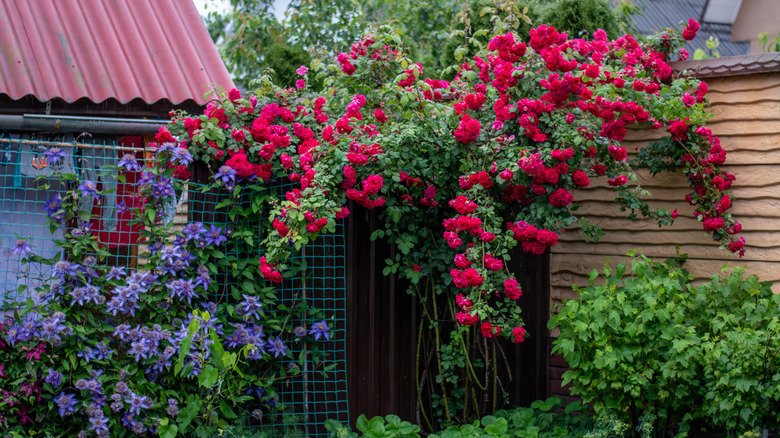
Fences are useful for privacy and keeping pets contained, but they aren't always the most attractive feature of a garden. A fresh coat of paint can add some flair, but you can also cover your fence with climbing plants. Clematis (Clematis spp.) is a gorgeous perennial flower that is perfect for adding color and life to your fence. The flowers bloom in a wide range of colors, including blue, purple, red, yellow, and white. While most of the popular clematis species and cultivars have large flowers, there are smaller options if you prefer something more delicate, like woodbine (Clematis virginiana).
When choosing your clematis plant, there are plenty of options. Native clematis species can be found in specialty nurseries or through seed exchanges with other gardeners. Some, like bellflower clematis (Clematis pitcheri), have bell-shaped flowers instead of the wide, starburst flowers that most common garden clematis species have. Others form short shrubs instead of growing into vines, like the Virginia whitehair leather flower (Clematis coactilis).
Non-native clematis plants are also beautiful and easy to grow, and some have even won awards. The popular cultivar 'Jackmanii' has won the Royal Horticultural Society's Award of Garden Merit, as has the strikingly red 'Madame Julia Correvon' clematis. The only clematis you should avoid is sweet autumn clematis (Clematis terniflora), which has become invasive due to its vigorous growth and is a poisonous species.
Caring for your clematis
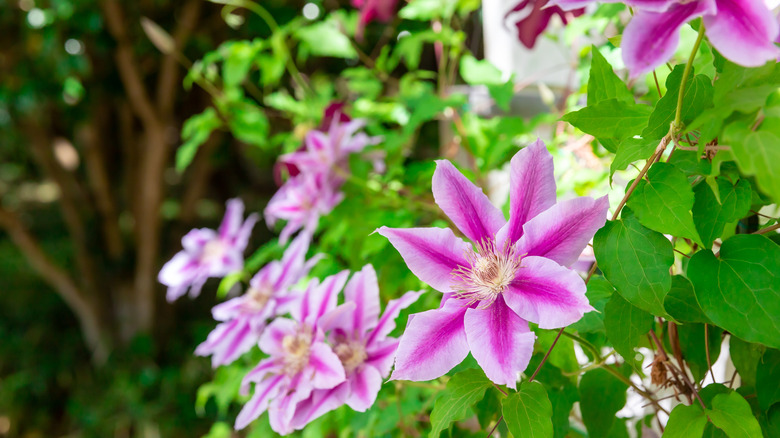
Plant your clematis in well-draining soil and full sun. In hotter climates, afternoon shade is helpful. Add compost to the soil before planting. You can easily make your own compost, but many garden stores sell bagged compost that works just as well. Once your clematis is planted, water it thoroughly. Clematis plants need regular watering and fertilizing to ensure healthy growth. Water it deeply when the soil is dry and give it balanced fertilizer during the growing season.
Pruning depends on the type of clematis you have. Clematis that bloom on old growth can be trimmed after the plant flowers in spring. Some bloom on new growth and should be cut back entirely in late winter to early spring so new stems have room to grow. Most common cultivars are hybrids, blooming on both old and new growth, and can be pruned lightly after the first buds appear.
To keep climbing clematis healthy, it's important to train it properly. You can add this DIY string trellis to your garden, or plant it near a fence. It should be planted between 1 and 1 and a half feet from the fence, so that the roots have room. Add supports, such as horizontal wire, across the surface of the fence to keep the vines upright. Position the vines so they are between the fence and the supports, then tie the wire gently to the vines to keep them there. Continue to tie new growth until the vines are able to fully support themselves against the fence.