

Avoid This Snow Shoveling Mistake To Keep Your Lawn Healthy All Winter Long
We may receive a commission on purchases made from links.
Throughout the winter months, clearing snow from driveways, roofs, sidewalks, and patios becomes a routine practice in many parts of the country. Although this task is necessary to prevent damage to your property and make these areas passable, piling that excess snow onto your lawn can cause its own problems. So, while finding hacks to make clearing snow easier seems like a priority, it is just as important to have a plan for what to do with it. Because simply creating a massive pile of snow in your yard is a snow shoveling mistake to avoid if you hope to keep your lawn healthy all winter long.
That is not to say that you need to clear your entire yard of snow. In fact, some accumulated snow can actually benefit your lawn by adding nitrogen and moisture to the soil and providing insulation during periods of sub-freezing temperatures. When it comes to your lawn, in most situations, it's best to just leave a layer of snow to melt on its own. However, if you end up with areas of snow that are uneven, it can cause problems for your grass and soil. This is true whether undulating levels were caused by wind-driven snow drifts or by you creating a small mountain with freshly shoveled snow from your driveway.
Piles of snow can damage your lawn
Snow weighs a lot (between 12 and 25 pounds per cubic foot). Too much pressure on your lawn can damage grass and compact the soil. However, a fairly uniformed layer of snow will apply even pressure across the entirety of your lawn. It will also melt at more or less the same pace. Areas with excessive amounts of snow — such as piles cleared from your driveway or deposited by snowplows — can damage your lawn. It's not just the extra pressure: These areas tend to melt unevenly and disrupt the air circulation over your grass. As a result, excessive moisture can build in your lawn and soil, leading to snow mold and other fungus and disease.
With that in mind, it's best to find other ways to dispose of snow cleared from your driveway, roof, patio, or sidewalk. Ideally, you will have an area that receives plenty of sunlight to encourage melting. It should be piled away from your house foundation and walls, and not on your lawn. However, if you do need to toss cleared snow onto your yard, spread it as evenly as possible to prevent too much accumulating in any one spot.
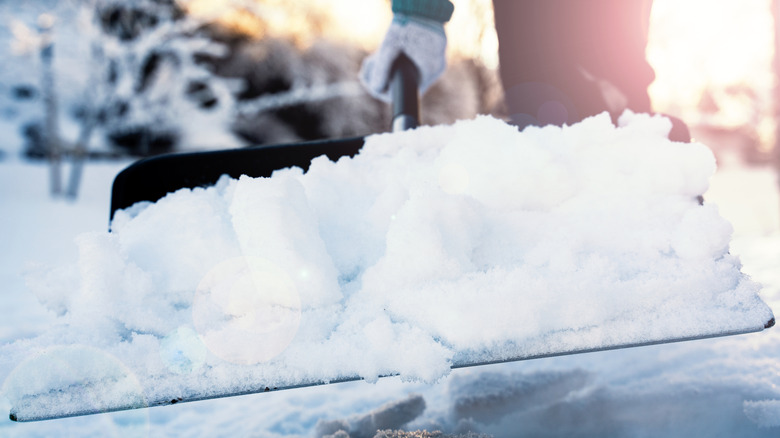
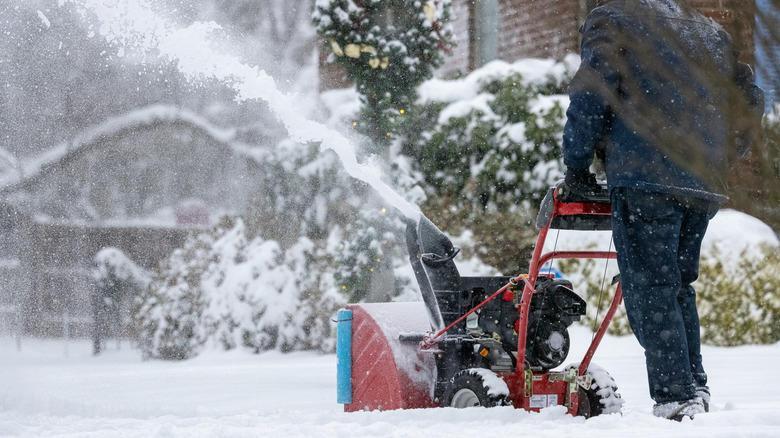
Keep in mind, this applies whether you area using a snow shovel or snow blower. If you are using a shovel, like the True Temper poly snow shovel, you can spread some of the snow in flower beds and around the base of bushes and trees (it makes an effective winter mulch). When using a snow blower, make sure it is properly adjusted to spray the snow evenly across your lawn. Start by making a pass down the middle of your drive, making successive passes on either side of the center, working progressively outward.