

The Rapidly-Spreading Moth That's Killing Your Boxwood Trees And What You Can Do
For every tree you plant, there's a pest looking to invade. Aside from termites and various beetles and borers, some moths can also be cause for concern. Not all of them are native to North America, either. Some of the latest invasive pests hails from eastern parts of Asia, including the spotted lantern fly, an invasive pest you should kill on sight.
Another such pest is the box tree moth (Cydalima perspectalis), which made its first North American appearance in 2018 in Toronto, Canada, and it's been spotted in about 10 states in the Eastern parts of the United States, with Michigan being the farthest west this pest has traveled so far. The caterpillar form of the box tree moth causes considerable damage to boxwood trees (Buxus spp.) by munching on the undersides of the leaves. Older caterpillars will eat all but the middle rib area of a leaf, and if there's an infestation of these pests, they could permanently damage the tree. If several boxwoods are planted in the same general area, these cantankerous crawlers could decimate all of them.
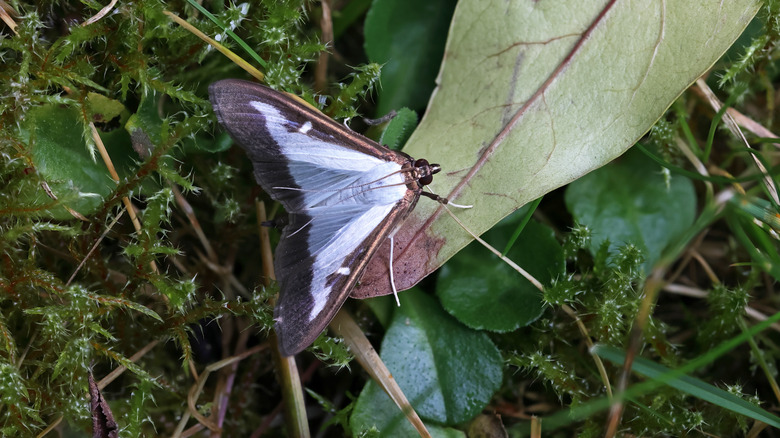
As adults, box tree moths are either brown or white with a brown border around their wings. In either instance, they have a white, comma-shaped marking on their wings. The caterpillars are green, yellow, white, and black, with black dots on their backs, ringed in white. It's fairly easy to tell if a caterpillar will grow into a box tree moth if you find it on or near your boxwoods and it matches the color description.
What to do if you find box tree moths in your yard
Early detection gives you the best shot at solving the problem. Be on the lookout for signs your yard has a pest problem. Check the boxwoods regularly for signs of adults, caterpillars, pupae, or eggs. The eggs are light yellow and overlap.
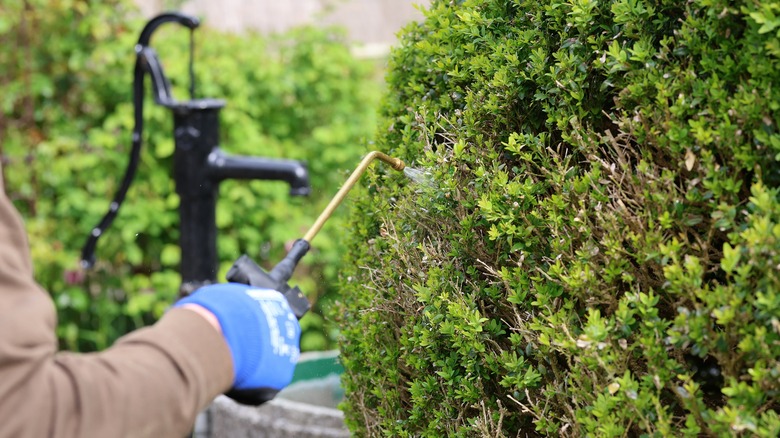
Currently, no pesticide is designed to target these moths. Pesticides designed for other moths are also indiscriminate, so it's best to try non-lethal control methods so you don't harm these beneficial insects. Instead, experts suggests hand-picking caterpillars off the boxwoods and depositing them in a bucket of soapy water, a method that works best when infestations are minimal. Flushing the caterpillars off the boxwoods is another option that works when the caterpillars are young. Set your garden hose to a jet setting and shoot the pests off the plant with a powerful blast of water. Check the undersides of the leaves, as the youngest caterpillars favor that side.
A pheromone trap attracts and catches male box tree moths, and could be a good way to determine if there are considerable numbers of these buggers in your area. If you have boxwoods and live in an area where these moths are known to exist, hang a pheromone trap near your boxwoods in May, and then again in July. When male moths go inside, they can't get out. A biological pesticide called Bacillus thuringiensis var. kurstaki (Btk) kills the caterpillars several days after they eat the treated leaves. Mix it according to package directions and spray it on the boxwoods. Btk isn't harmful to birds and other wildlife that may eat a caterpillar that ingested Btk.