

Forests Take Up One-Third Of Our Land. Here's What You Should Know About The Major Types
Rapid deforestation due to expanding agriculture, logging, population centers, and other factors has been making headlines around the world for decades. Luckily, forests still cover more than 30 percent of the landmasses on Earth. Additionally, thanks to an international effort spearheaded by UN member states, the rate of deforestation globally has slowed over the past 30 years. This is good news because forested areas not only increase biodiversity, they also help filter pollutants from air and water, reduce carbon dioxide and erosion, and provide natural resources, jobs, and recreational opportunities. However, not every forest is the same. In fact there are a few different major types.
To begin with, there are three major types of forests: boreal (or taiga), temperate, and tropical. These forests are categorized by the latitudes in which they grow and each have different biome characteristics. Although some label subtropical forests as a fourth category, they are technically a type of tropical forest which grows in the transition zones between tropical and temperate climates. The United States has some of each type, while Canada is split between boreal and temperate forests.
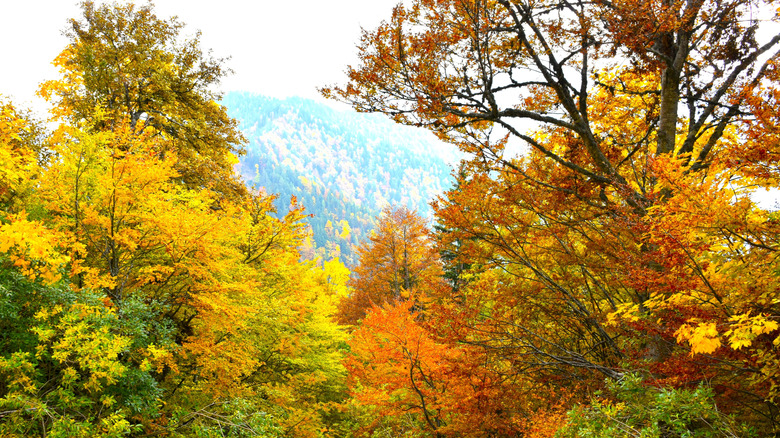
Temperate forests grow in the moderate climates of the mid-latitudes, which are areas that experience different conditions in all four seasons. A wide range of deciduous and evergreen trees and other vegetation grow in temperature forests. The combination of tree types and seasons results in views of stunning fall foliage in these wooded areas. Temperate forests are the smallest of the three categories of forest, accounting for roughly 16 percent of forested land. However, they make up the majority of U.S. forests and a bit more than half of Canadian forests. They are also home to a wide variety of wildlife, including a dozen endangered mammal species in the U.S. alone.
Tropical forests have incredible biodiversity
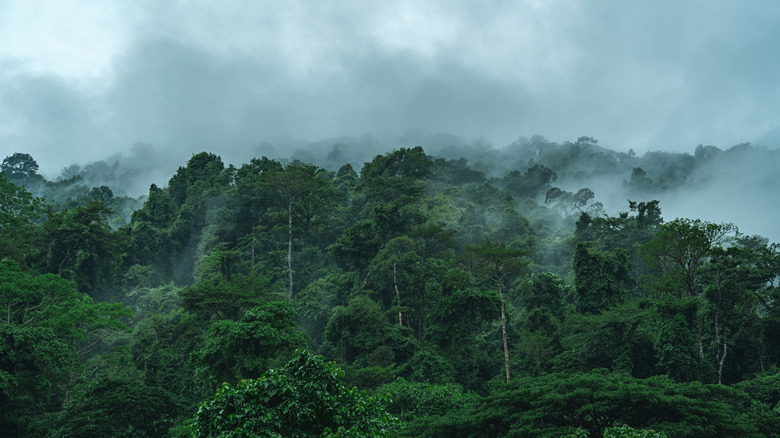
In what may come as a surprise to some, tropical forests are far and away the most common forests on the planet. In fact, tropical and subtropical forests combine to make up nearly 60 percent of all the forested lands on Earth. That comes as an even bigger surprise when you consider that of the five countries containing the most acreage of forested land — Russia, Brazil, Canada, the United States, and China — only the U.S. and Brazil have any tropical or subtropical forests.
These forests grow between the Tropic of Cancer and Tropic of Capricorn, hence the name. For the United States, that means only Hawaii and Puerto Rico — which is home to El Yunque, the only tropical rainforest in the U.S. national forest system — have true tropical forests. However, there is quite a swath of subtropical forest within the southeastern portion of the Lower 48. Although the U.S. has a relatively small amount of tropical forest, all of Brazil's forest lands are this type, including a significant portion of the whole Amazon rainforest. The Earth's belt of tropical forests extends through the mid-section of the African continent, much of South America, southern Mexico, India, Southeast Asia, and northern Australia.
These forested areas are known for their incredible array of flora and fauna. Despite covering only about 10% of the planet's land, they are home to about half of all species. The Amazon rainforest itself hosts 10% of the world's known species, making it a top destination for trending wildlife getaways. This outsized biodiversity is largely due to the fact they have the longest growing season of any type of forest and many of tropical forests receive a significant amount of rain throughout the year.
Boreal forest store vast amounts of carbon
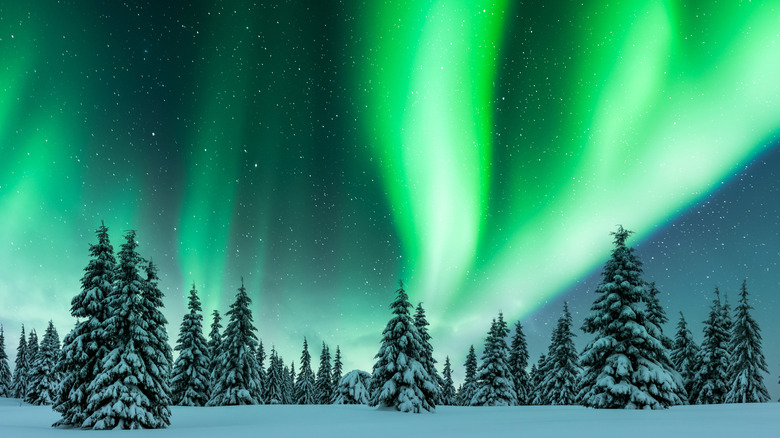
The third type of forest grows in the extreme northern latitudes. Because of the incredibly cold climates found in these regions, boreal forests have the shortest of all growing seasons (only about one-third of the year) and the least amount of biodiversity. All told, boreal forests comprise around a quarter of the world's forests. This type of forest rings the northernmost swath of three continents: Asia, Europe, and North America. In North America, Canada has a significant amount of boreal forest. By contrast, the only boreal forests found in the United States are in the state of Alaska.
Conifers, such as various varieties of firs, are the most common type of trees found in boreal forests, although there is a sprinkling of deciduous trees. While these forests may be lacking in biodiversity compared to the other types, that does not mean they are without merit. For one, the regions hosting boreal forests are among the best places to see the Northern Lights, which is an important economic activity in much of this remote region. However, given these areas are at or below freezing for three-quarters the year, plan to dress like you going on a winter hike.
Additionally, these forests provide valuable timber for lumber and paper. They also are important carbon sinks — areas which store carbon emissions. However, the vital role they play in regulating the Earth's climate has come under siege, not from deforestation, but rather from climate change. As temperatures continue to rise, the permafrost beneath the majority of boreal forests is melting. As the ground softens, the trees are dying away, and stored carbon is escaping from both the trees and the soil.