

What It Means If Mushrooms Start Growing Out Of The Trees In Your Yard
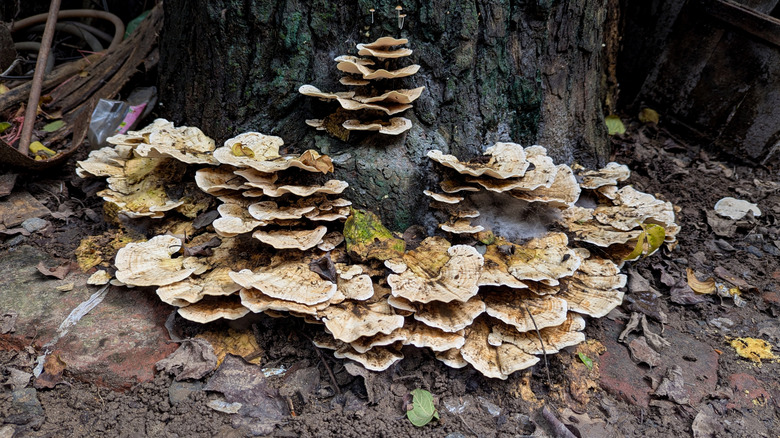
If you live in a rainy region or your area has had a bout of very rainy days, you may notice manifold mushrooms growing on the ground and around your trees. That's because mushrooms thrive in soggy and wet conditions, and will usually appear two to 10 days after heavy or excessive rainfall. While most mushrooms that sprout in your yard are generally harmless – like Turkey Tail, Reishi, Artist Conk, and other saprophytic mushrooms, which feed on already dead organic matter — you don't want to ignore all of them.
Identifying mushrooms is important in discerning whether they're deadly mushrooms you don't want in your backyard or simply benign ones. There are several phone apps, such as Picture Mushroom, Shroomify, and shroomID, that allow you to upload a picture to identify mushroom types.
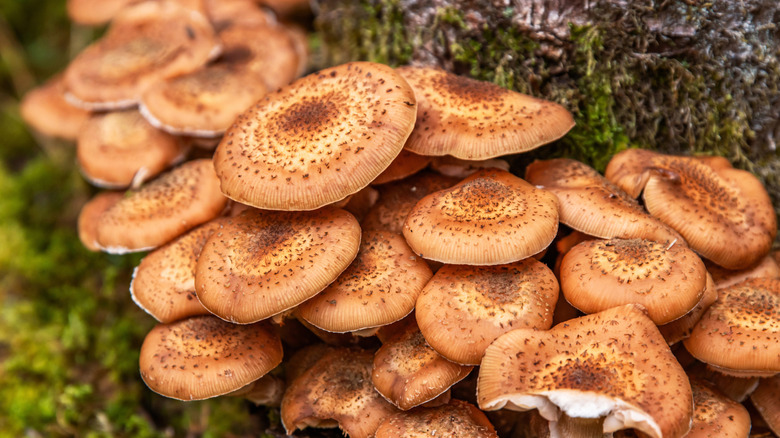
If mushrooms are growing on your trees, they may be reflective of certain issues. Some mushrooms that are growing on the base of your live trees can suggest certain issues, such as stress, disease, and internal decay. If the mushrooms are growing directly from the tree trunk or branches, the situation is much more serious and needs to be addressed if you want to save your trees. Honey fungus is a well-known variety that you don't want to see; they are usually symptomatic of armillaria root rot, which can cause growth loss, root decay, and even outright tree death. Trees commonly affected by honey fungus include oak, fruit trees, birch, and many hedge plants.
Removing mushrooms like chicken of the woods from your trees
Another mushroom known as the chicken of the woods is also problematic for your trees. These unusual-looking, rubbery fungi indicate that a tree has brown heart rot. Chicken of the woods typically gets inside your trees through wounds and dead branch stubs, and hollows out the center of the tree it is infecting. Trees that have chicken of the woods tend to be very brittle and can snap easily. The list of trees susceptible to chicken of the woods is long and includes ash, cherry, birch, eucalyptus, maple, oak, several locust trees, and many others.
If mushroom sightings on your trees are accompanied by early leaf drop, odd leaning, and a hollow sound when you knock on the trunk, a closer look is required. A certified arborist will be able to assess the damage and discern what is going on with your mushroom-infected trees, so you can take care of them and potentially prevent tree loss.
If you have other mushrooms on your tree that you wish to remove for mostly aesthetic reasons and don't believe your tree has significant underlying issues, you can simply prune infected branches, ensure that tree debris is frequently cleared, and apply a fungicide that's designed for the specific mushroom you're dealing with. Alternatively, you can rid your garden of fungus with a natural solution of baking soda, dish soap, and water. You can take preventive measures by spacing out your trees before they're planted, watering them deeply but not too regularly, and mulching around the tree's base but without piling it up against the trunk. If you follow these steps, you should be fungus-free.