

The Simple Salt Alternative That'll Make Removing Snow And Ice Easier
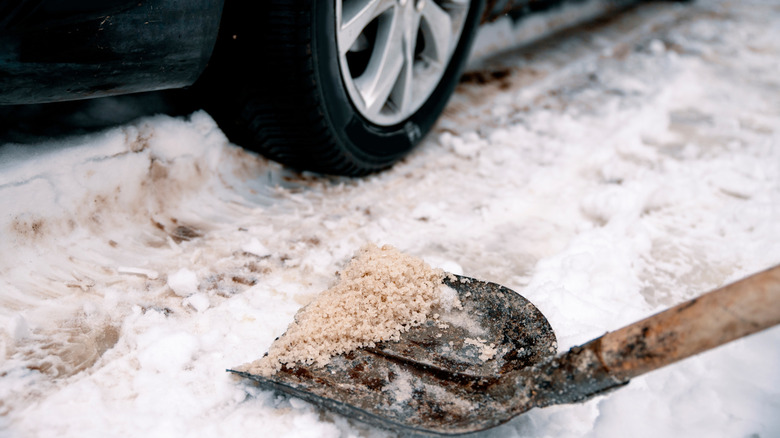
If you live in a cold climate, you're likely already bracing for another snow and ice-filled winter season. This means winterizing your garden, trading your lawn mower for a snow blower, and purchasing large quantities of sand or rock salt to melt the ice off of your driveway, steps, and walkways. If ice is a constant headache for you, and you feel that salt and sand just aren't cutting it, there might be a helpful alternative, known as calcium chloride.
Homeowners have increasingly shifted to calcium chloride pellets over sand in recent years, thanks to the former's ability to soak up moisture from the air, allowing it to dissolve ice quickly and effectively in a brief amount of time. This chemical compound is made from a combination of chloride and calcium ions, which work together to drop the freezing point of any water that they come into contact with. This causes the formula to break down ice at temps as low as -25 degrees Fahrenheit.
The compound is similar to rock salt, AKA sodium chloride, but much more effective at making snow removal easier in sub-zero temps. Furthermore, calcium chloride is sold in a smooth, spherical pellet form, which is capable of activating upon contact with moisture and generating its own heat. To utilize this miracle solution, simply disperse a few hefty shakes or shovels-full of calcium chloride pellets across patches of ice, and watch as they break down thick sheets like tissue paper.
Are calcium chloride pellets right for you?
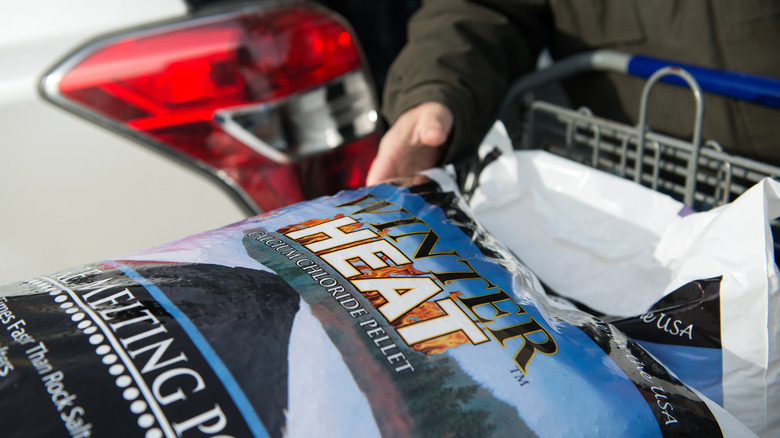
While it may sound like a perfect winter substance, calcium chloride pellets aren't necessarily for everyone. There are several factors that might influence your decision to pick up a few bags, including your expected weather patterns, desired price point, and the material you're attempting to de-ice.
Calcium chloride pellets tend to cost significantly more than regular rock salt. 50-pound bags of sodium chloride salt can frequently be found in hardware stores for under $10, while 20-pound bags of calcium chloride pellets will run you upwards of $20. Calcium chloride is also much more corrosive than its bog-standard counterpart. This can be a good thing if you're looking to melt through thick sheets of ice, but causes problems if you're using it around metal stairs, gutters, or parked vehicles. The chemical compounds found in calcium chloride pellets tend to eat through metal and may cause rust to form on garden items such as birdbaths, but they're generally more gentle on plants than rock salt.
So, if you're not looking to overspend, de-icing a driveway where you plan to park your car, and living in a cold climate, but not below 0 degrees, your best bet is to stick with regular rock salt. If you're trying to de-ice a garden area, and money isn't an object, feel free to spring for the calcium chloride instead. Some also suggest buying both and combining them into a mixture, in order to get the best of both worlds. Calcium chloride should keep for years as long as it's stored in a dry, airtight container, so it may be worthwhile to employ it in smaller doses when you feel that rock salt and sand aren't getting the job done.