

The Strangest Things Ever Found Deep In The Woods

For most people, it's fair to expect a walk in the woods to be a largely peaceful experience. When they plan a hiking route, they expect the dirt paths and the underbrush, scattered pine needles, mosquitoes, and maybe what remains of an old fence line. But even as it feels alive with both flora and fauna, it can also seem uneventful, mundane, and empty. Everything worth discovering has already been discovered. And while it's worth knowing about dangerous hiking spots to avoid, most hikes come without surprises beyond a beautiful waterfall. But every so often, someone stumbles on something that doesn't quite fit in like everything else. Perhaps it's an artifact from long ago. Or maybe it's an eerie passageway leading to someplace unexpected. Still others are modern leftovers with surprising backstories.
These discoveries rarely jump out at you from a distance. Instead, they can be small, subtle, or appear entirely out of the blue. And yet they disrupt the quiet in a way that's truly unforgettable. They remind us that the wilderness really isn't as empty as it appears at first blush. It's layered with history, myth, and memory. And when the light hits at exactly the right time and place, it can sometimes even give something back.
The stripped Honda Civic hidden in the pines

Miles away from any paved road, deep in the tangled woods straddling Nevada and California, one lone hiker stumbled onto something wildly out of place: A mangled 1999 Honda Civic. The vehicle sat neatly in a quiet clearing, oddly intact despite its remote location. The plates were missing, the lights and radio were gone, and both rear tires had been removed. On the inside? A haunting mix of toys and scattered clothing, almost as though the past had been frozen mid-exit.
The internet jumped on the mystery, quickly turning Redditors around the world into a makeshift detective squad. Using the VIN and a paycheck envelope they'd found in the trunk, they traced the car's original owner, who confirmed it had recently been stolen. She and her child were safe, but the eerie scene initially sparked concern, particularly with the discarded baby items. And no one had known where the car ended up until this hiker stumbled upon it.
Believe it or not, though, finding belongings abandoned deep in the wilderness is not as uncommon as you might think. In fact, dumping in the forest has been flagged as a huge problem in recent years. In fact, abandoned cars can be found in forests all over the world, like the 1957 Porsche found deep in the woods in Ohio or a 1959 Volvo abandoned in the woods for 30 years in Sweden before being started up once again.
The Shoe Grove deep in Oregon's backcountry
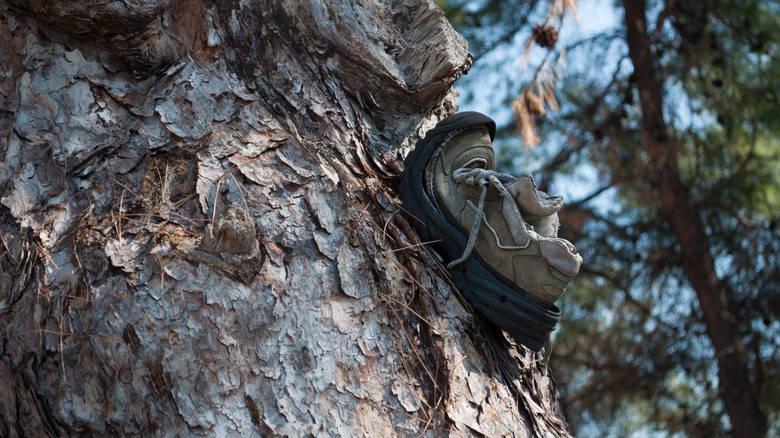
Tucked within a dense grove in rural Oregon, hikers occasionally stumble onto something that feels ripped straight out of Wonderland: Dozens of frayed hiking shoes, worn boots, and muddy sneakers hung on branches or nailed high into tree trunks, some high in the very treetops. What you won't find nearby is any sign of trail markers or clearings to even suggest a gathering spot. And it's not just one or two trees, either. The shoes spread across multiple trunks, almost as though someone spent years assembling this off-the-grid gallery, randomly, one nail or knotted shoelace at a time.
One of the more well-known shoe trees is found near Alfalfa, Oregon, nestled among a landscape of caves and ancient rock art. Some are occasionally vandalized by fire, and one popular tree near Crooked River Ranch was discovered stripped of all its shoes overnight by an unknown assailant (or perhaps someone tired of seeing the Bureau of Land Management-protected tree so adorned, though the local BLM officials claim innocence).
It's the lack of explanation that entrances locals the most. These living shoe racks generally offer no context: No signs, no signatures, no patterns, and no obvious reasons for why they exist (some actually mark local high school graduations or other celebrations). It's that negative space of not knowing that fuels the folklore, with some thinking it's a warning, others seeing it as a memorial, and more than a few simply quipping that it's the forest's version of abstract art.
The colossal fungus beneath Oregon's forest floor

In the beating heart of Oregon's Malheur National Forest lies one of the strangest living things ever found — but you'd be hard-pressed to spot more than a little bit of it at a time. It's not just a few mushrooms poking through the moss, but rather an organism so massive, yet so subtle, it escaped notice for thousands of years. Stretching beneath some 2,300 acres of forest floor, a single honey mushroom colony lies silently underneath more than three square miles of trees and trails. And the wildest part? You can hike across its entire length without ever knowing that the Earth's largest living organism is right under your boots.
Known as Armillaria ostoyae, this underground network is believed to be between 2,600 and 8,600 years old, meaning it's been slowly consuming conifer roots since before the Roman Empire arose. It expands undetected, invading tree systems from below, spreading the deadly Armillaria root disease and reshaping entire ecosystems in the process. Although parts of this beast will break through the surface in the form of small mushrooms each fall, the real creature remains unseen; an ancient, fungal labyrinth slowly feeding and growing with every passing century. And what's wild is, there are four other distinct colonies just in the Malheur Forest boundaries, the smallest covering about 50 acres.
Even though this fungal network was discovered when scientists were investigating how thousands of trees could die so quickly, it's still considered largely beneficial because it serves as the ecosystem's primary recycler. As a saprotoph, it feeds on dead organic matter and recycles vital nutrients like carbon back into the soil, which is why it can be helpful to spot mushrooms in your yard. It all just goes to show that the wilderness is still full of all sorts of monsters. Just not the kind most people expect.
The staircases that lead to nowhere

Every now and then, hikers deep within the forests from New England to the Pacific Northwest stumble across something that stops them cold: A staircase that's just...there. It's neither attached to a house nor part of any trail system. Stone steps, often weathered but surprisingly intact — climbing skyward into thick brush or ending abruptly in mid-air — with neither walls, roofs, nor any signs of what came before.
Some have been explained as the remains of long-lost estates, burned hunting lodges, or fire towers being slowly erased. For example, stairs are all that remain of the Madame Sherri residence in New Hampshire, an eccentric socialite's summer castle, which burned to the ground in 1962. But even when accompanied by logical explanations, it never quite kills that eerie feeling these remnant risers inspire.
It's the pristine condition of some of these staircases, especially those in out-of-the-way areas, that has sparked more than a few unsettling legends. Some believe them to be markers or relics left behind by something ancient. Others whisper that climbing them alone at dusk might transport you into another world entirely, like one veteran search and rescue officer described on Reddit, who encountered a number of "stairs to nowhere" deep in the wilderness throughout his career. He reports that many were almost 40 miles away from any main road. Whether rooted in imagination or truth, they're seen as portals — if not literally, then emotionally — with every moss-covered step.
The abandoned Bigfoot trap of Southern Oregon
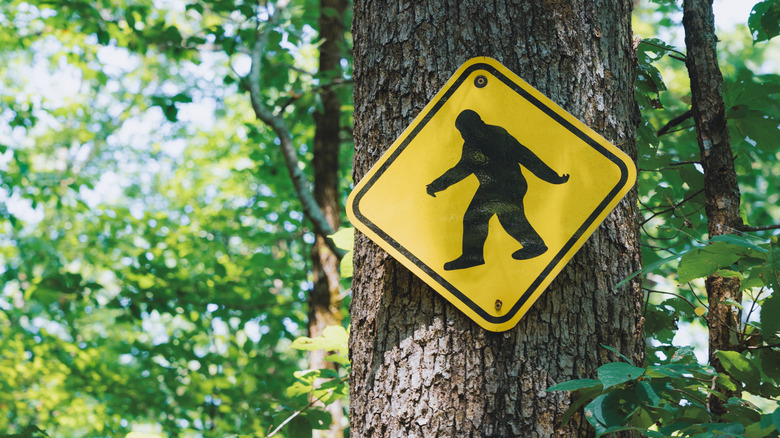
Not far from the border of the Rogue River-Siskiyou National Forest in southwestern Oregon sits one of the most bizarre pieces of wilderness history you're likely to find: A massive wooden box built with heavy beams and iron reinforcements. You'd be forgiven if you assumed it was an old mining relic or backwoods shelter. But the truth? It's a trap for one of mankind's most enduring cryptids: the one and only Bigfoot. Constructed in 1974, this hulking cage was the brainchild of the North American Wildlife Research Team, a group of dedicated Sasquatch hunters who were thoroughly convinced the legendary creature was roaming these woods. For six years, they baited the structure with roadkill, and waited for the impossible. So if you'd taken the 7-mile hike it takes to reach the trap during the mid-70s, the scene would have been even more disturbing.
While the group didn't catch Bigfoot, their trap reportedly did catch a couple bears and possibly one hunter. After half a decade of stakeouts and zero cryptids, the team finally threw in the towel. In 1980, the trap was welded shut and left, surrendered to the elements (though the Forest Service did some upkeep in 2006). Today, it stands like an abandoned stage set for a monster movie that never quite wraps up.
While it's easy to laugh now, it's not so easy when you're standing in front of the thing, deep in the forest with no one around. It's a physical reminder of how powerful belief can be when it's set loose in the wild. Because really, what if those hunter-researchers weren't entirely wrong?
A 2,800-year-old scarab amulet found in Israel
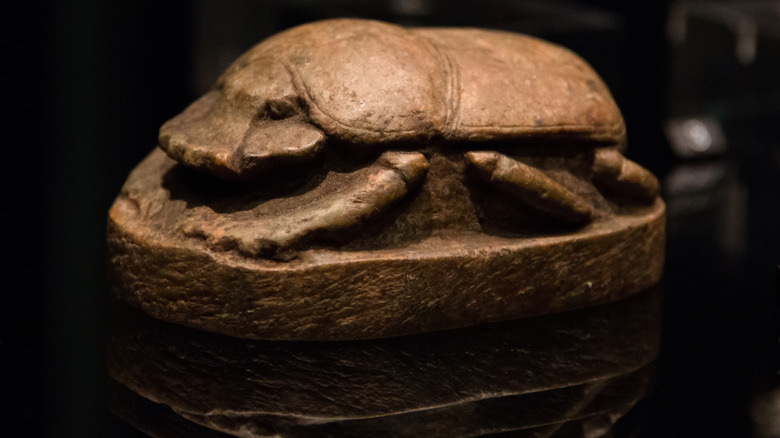
Erez Avrahamov wasn't searching for treasure. The 45-year-old reservist in the Israeli Defense Forces was simply hiking through the Tabor Stream Nature Reserve in Lower Galilee when something caught his eye — a glint of orange-red, half-buried in the dirt. Curious, he stooped down and picked the object up. It was a small, smooth stone no bigger than a penny. But this wasn't a coin or even a lucky rock. Rather, it was a finely carved scarab amulet shaped from carnelian (a type of chalcedony quartz), dating back nearly 2,800 years. On one side, it was domed like a beetle's back. On the other, flat and etched with an image of a mythical creature, looking vaguely like a dragon, griffin, or winged horse.
Experts wasted no time in confirming the find as a rare seal amulet from the Iron Age, most likely used as a signet or personal charm by someone of status. To hold it today is to bridge a quick but powerful gap between past and present, with a single artifact that's survived — in pristine condition — empires, wars, and centuries of silence, only to be rediscovered by a guy out for a walk. Unlike the usual museum pieces pulled from long-sealed tombs, this priceless artifact was just lying there, waiting to be found.
Reese Witherspoon's lost hiking boot on the Pacific Crest Trail

Perhaps you remember this iconic scene from the 2014 film "Wild": Blistered and broken, Cheryl Strayed (Reese Witherspoon) screams in frustration before hurling a poorly fitted hiking boot off a cliff. The scene itself is a good reminder that there are important safety steps to take when solo hiking. What many fans don't know, however, is that during filming on Oregon's Mount Hood, Witherspoon actually did toss a real, custom-made Danner boot down into the wilderness. The red-laced prop was never retrieved (though the production crew did try). It simply vanished into the thick trees and rocky slopes, as in Strayed's retelling of her real-life story.
Nearly two years later, hiker Chris Kesting — retracing Strayed's route — stumbled upon something surreal. Camouflaged by dirt, save for its red laces, was the boot. Although it was weathered by time, it was unmistakable. For Kesting, a fan of the book and film, it was like finding a piece of myth come to life. The prop had left the realm of cinema and become a real artifact of the Pacific Crest Trail (part of America's Triple Crown of hiking trails). By then, it was no longer just a symbol of a screenplay, but a physical piece of storytelling, claimed and preserved by the wild itself.
The haunted tunnel of Moonville, Ohio
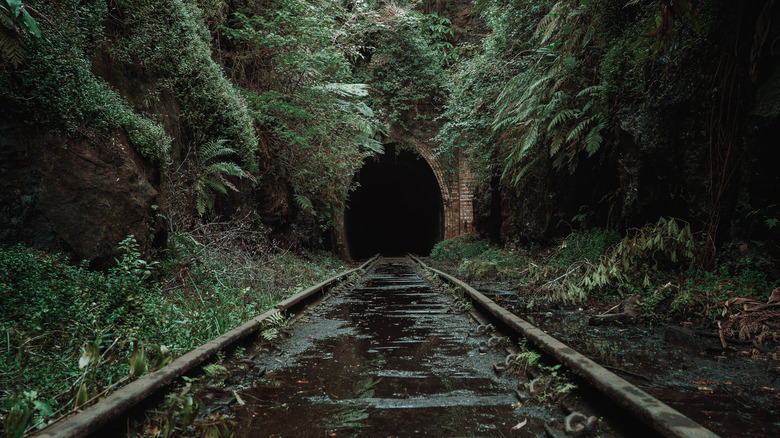
In the Zaleski State Forest, far from any main road, you can find the last whispers of a forgotten town. Once a rail line community in 19th-century Ohio tied into local coal mining, Moonville was officially abandoned by 1947, and the forest wasted no time in swallowing everything up. If you visit today, you'll see only fragments of what remains: A few cracked foundations buried in the brush and a lonely, overgrown cemetery. But what still stands is the ominous Moonville Tunnel, carved directly into the hillside. These days, you wouldn't want to travel by train through it even if it were still running.
Built in 1856 to ferry coal trains through Ohio's rugged hills, the tunnel is now the town's most iconic, and unsettling, survivor. It's a brief, stone-lined passage, and now part of a scenic trail, much like New Jersey's latest rail trail. But its reputation has less to do with hiking and more to do with spirits. That's because locals swear it's haunted. Ghost stories have clung to this tunnel for generations, with the most famous of them involving phantom railroad workers seen waving lanterns in the middle of the night. Some claim to hear distant whistles, while others swear they've seen a man in outdated work clothes vanish into thin air, right where the tracks once ran. That last ghost may have been inspired by a sleeping brakeman and a mistimed crossing. The stories, like the ghosts, haven't faded.
A Bronze Age sword just eight inches underground

In a quiet Dorset field, a metal detectorist wandered away from the group rally, chasing a faint blip on his machine and seeking higher ground for a good view of his surroundings. The signal he got was much like a hundred others before, but this one stopped him in his tracks. Digging down barely eight inches into the clay, he uncovered the hilt of a sword. And not just any sword: This was a Bronze Age rapier, over 3,000 years old. Although it was broken into three pieces (probably deliberately), it was buried beside a matching axe head and a bracelet. Since the weapon was part of what's known as the Stalbridge Hoard, it became one of the most exciting archaeological finds in modern British history.
What made this discovery so incredible wasn't just the age, it was the rarity. The rapier belongs to an exceptionally uncommon style, with only two others like it ever found across all of Britain. Experts went as far as declaring it "nationally important." And all this was discovered by one man with one machine on one, otherwise unremarkable day.
A massive wooden statue buried in the mud

In the misty depths of the Ural Mountains in 1890, gold miners rewrote history after discovering a massive, weathered sculpture carved from a single piece of larch wood buried in a peat bog. Well-preserved in the acidic, oxygen-free mire, it would come to be known as the Shigir Idol. What looked at first like a curious wooden relic turned out (based on radiocarbon and accelerator mass spectrometry dating and additional research) to be the oldest known wooden statue ever unearthed. Against all odds and buried beneath layers of swamp, it had survived over 12,000 years — quite literally longer than any temple, tomb, or monument still standing today.
At its full height, the Shigir Idol stood nearly 17½ feet tall, carved from a single tree that was itself already 160 years old when the artist or artists began their work. The pole's surface is etched in mysterious geometric patterns and lined with eight haunting faces stacked along its length. Considering that it was carved at the beginning of the Mesolithic Era, when woolly mammoths still roamed Siberia, its purpose was likely more than decorative. Researchers think it may be a coded message from an Ice Age society, depicting creation myths, gods, and the relationship between the human and the divine. And considering its carvings represent a complex symbolic language that hasn't been cracked, there's still plenty to learn from this incredible relic. These days, rather than stomping through the woods and digging in the mud, all you have to do to see this remarkable statue is to head to the Sverdlovsk Regional Local Lore Museum in Yekaterinburg, Russia.
A Nordic rune stone hidden in the Canadian wilderness
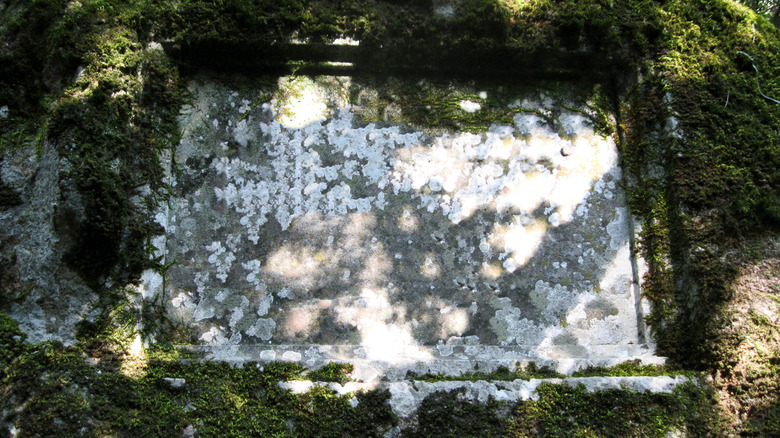
A tree's fall in northern Ontario led to a discovery that stunned archaeologists and storytellers alike. As the roots tore through the earth, they exposed a smooth slab of bedrock, along with a mystery carved into it. Etched with careful, deliberate strokes were 255 characters in Futhark, an ancient Nordic runic alphabet. Incredibly well-preserved, the engraving wasn't some cryptic curse or battle record, but rather the Lord's Prayer, written entirely in Swedish. After cautious research done by flashlight — before anything was publicly announced — historians had uncovered a message sent across time by a European soul lost to the Canadian frontier in the 1800s (even the scientists were a little disappointed it wasn't crafted by ancient Vikings prodding into North America).
Experts believe the carving was done by a Swedish worker (or possibly a few) tied to the Hudson's Bay Company — one of the many traders or fur trappers who ventured deep into the untamed wilds. And yet questions linger. Why carve something so long and so personal, into a remote slab of rock, only to bury it (researchers think the several-inch-deep soil cover was deliberate)? Given the tools at the artist's (or artists') disposal, it could have taken days or weeks to chisel each symbol into the bedrock. And given the message, it's unlikely it was idle work. It was a spiritual act, one meant to last even if no one else ever saw or found it.