

The Wet/Dry Vacuum Hack That'll Ease The Stress Of Snow Removal
We may receive a commission on purchases made from links.
If you're in a region where you're forced to contend with snow each year, you're likely already bracing for the work required to clear off driveways, walkways, porches, and more. Many homeowners will find themselves hunched over, digging into snowbanks with flimsy shovels, incurring untold amounts of lower back pain. Plenty of people are left to search for clever snow shoveling hacks, while others are willing to shell out big bucks to hire someone to handle the snow-clearing. Luckily, there's a quick, easy, and relatively inexpensive option available, which utilizes something many homeowners already have on hand: a basic wet/dry vacuum.
Any decent wet/dry vacuum or shop vac has the capability to suck up snow (just as it does water), allowing you to effortlessly clear small areas with ease. Once you're finished, you can swap your vacuum to the blow setting, disgorging the collected snow where you want it, or clearing what's left on the walkway, using the machine like a hand-held snow blower. They're also much cheaper and more compact than your average snow blower, which might not be the right choice. Of course, there are downsides to employing your wet/dry vac outside the shop during winter, so it's worth knowing exactly when and how to use your wet/dry vac as a makeshift snowblower.
Wet / dry vacs snow cleanup is limited by hoses and cords
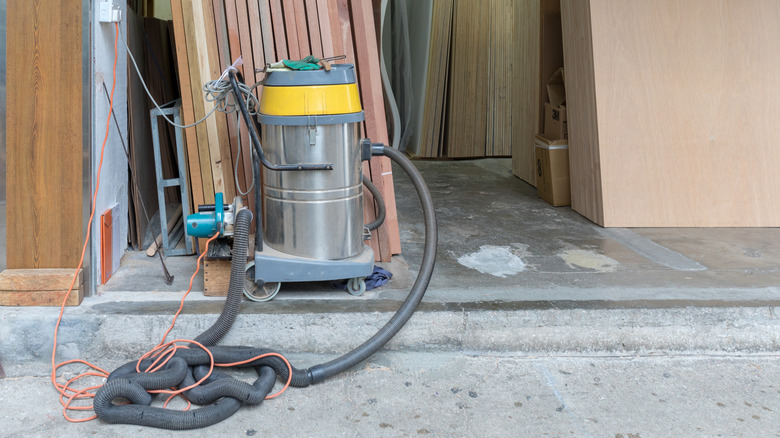
Wet/dry vacuums come in a range of shapes, sizes, and functionality. If you're looking for a compact model to safely remove snow from your deck, consider a machine like the Craftsman 2 ½ gallon peak HP wet/dry vacuum. With its handle, it's quite portable, as long as you don't mind making a few trips to empty snow as the bucket fills up. You can always spring for a larger-capacity vacuum, but it's unlikely you'll need that for regular shop applications. Most models tout blower ports, and hoses ranging from 5 to 7 feet. Simply move the hose from the vacuum port to the exhaust port to empty a full bucket, and to blow away powder snow (it won't work on wet, compact snow).
There are downsides: You'll be vacuuming tiny strips of snow using just the hose, so it's best for small spaces, like porch steps. The blower works more or less like a leaf blower, so it's a little more effective, but it won't work on ice or compacted snow. And remember that a wet/dry vac filled with frozen water is going to be very heavy, so keep that in mind when it comes to capacity.
Check your machine's cord length as well, since that will limit how far out you can use the machine (extension cords are generally not recommended for vacuums of any kind, especially where water is involved). Lastly, don't forget to empty out your bucket once you're done clearing your walkway. The last thing you'll want to deal next spring is a bucket full of melted snow, which could damage your machine if left to sit. Also grab a few extra filters: Snow can sometimes carry harmful particulates or bacteria.