

Tree Of Heaven Or Black Walnut: How To Tell The Difference Between These Lookalikes
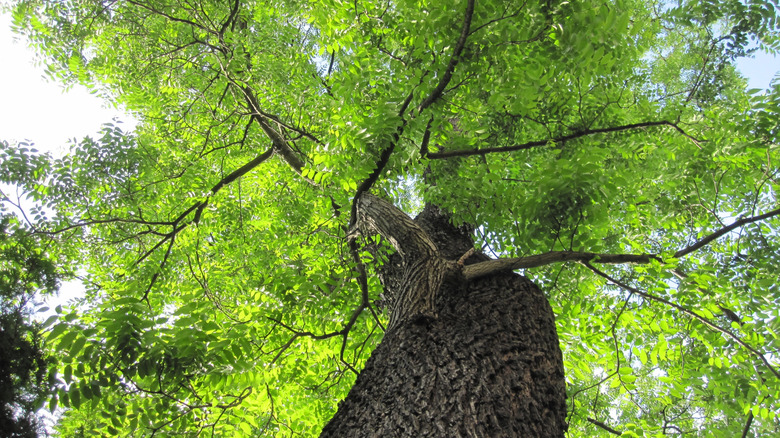
Despite its celestial name, tree of heaven (Ailanthus altissima) is known for its infernal behavior. Tree of heaven threatens other plants by forming crowded thickets that suffocate nearly any competitors, especially native species. It also grows and spreads rapidly, quickly taking over disturbed areas and sometimes damaging buildings. These aggressive traits have earned it invasive status in 30 states, including Hawaii. Making matters worse, tree of heaven is tough to eradicate once it sinks its roots into your lawn or flower bed. Pulling its seedlings before they establish themselves is key. To do this, you must know how to identify it and distinguish it from lookalikes. Black walnut (Juglans nigra) is often mistaken for the tree of heaven since both grow in similar habitats, but a few key differences can help you tell them apart.
Though tree of heaven can help you get rid of spotted lanternflies, removing it is typically best because it causes more problems than it solves. Even if it's not causing any immediate problems, it's generally eager to grow a big, unruly family. A single tree can produce more than 300,000 seeds in a year, and at least a few of them are likely to germinate. The seeds can also travel long distances on the wind, spreading into neighboring yards, parks, and nature preserves. Black walnut can also be a pain, but to a lesser degree. Like tree of heaven, it releases substances that discourage other plants from growing nearby. Unlike tree of heaven, it's native to North America, valued for its wood in furniture making, and known for producing nuts that squirrels love.
How to identify tree of heaven
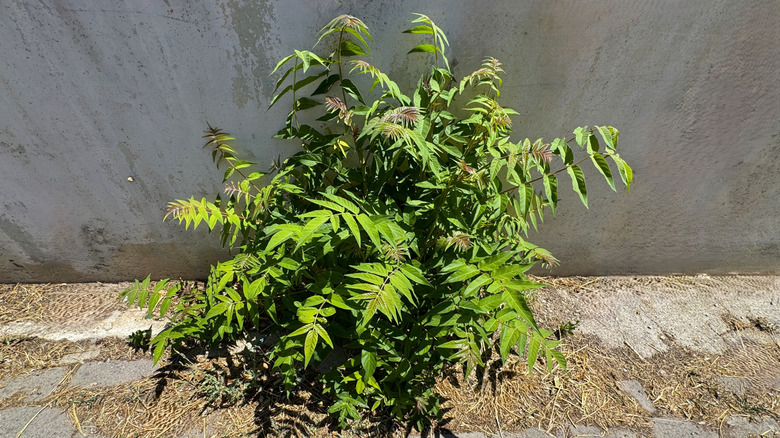
Tree of heaven is known for its green leaflets, which sprout from nodes on reddish-brown stems. On many plants, each node grows a pair of leaflets positioned directly opposite each other. This isn't the case with tree of heaven. Instead, each node produces a single leaflet. The leaflets form an alternating pattern on the stem. In other words, if the first node grows a leaflet on the left side of the stem, the second node will grow one on the right, the third node will grow one on the left, and so forth. Each stem supports 10 to 41 of these leaflets. Black walnut is often mistaken for the tree of heaven because its leaflets also alternate along the stem.
The two trees are easiest to distinguish once mature, since their seed-bearing fruits look quite different. Don't wait that long to remove tree of heaven from your yard, though. It's incredibly resilient once it develops its sprawling root system. If cut down, the tree often responds with a profusion of new shoots. Mature female specimens also produce bunches of red or brown samaras, which are seeds with wing-like protrusions. Tree of heaven may also emit a nasty scent when it's full-grown. Sometimes, this stench wafts out of its greenish-yellow flowers in the late spring or summer. The scent can transfer to your hands if you crush its twigs or leaves.
How black walnut differs from tree of heaven
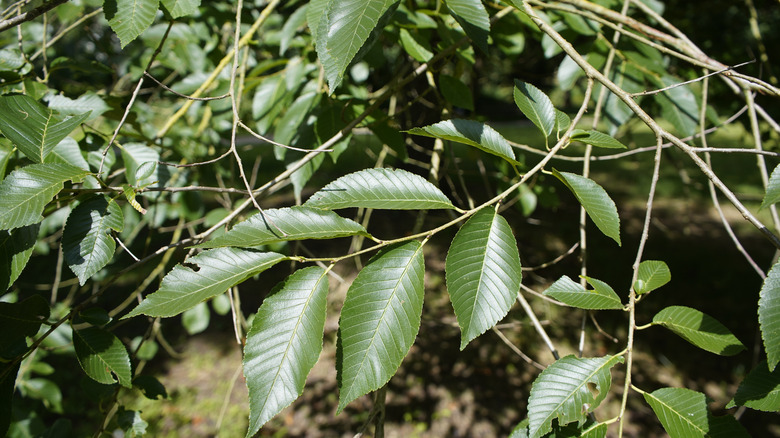
Black walnut is easiest to distinguish from tree of heaven when it's producing or dropping fruit. The fruits are nuts surrounded by husks that look like tennis balls from a distance. They often split open when they hit the ground, creating a mess that may make you regret planting this fast-growing tree. When a black walnut is too young to bear fruit or out of season, its leaf margins should reveal its identity. Black walnut leaflets have serrated edges. Inspect them closely and you'll see that they resemble little bread knives. Tree of heaven has a few teeth on each leaflet, but not as many as black walnut.
A bark-and-stem inspection can also help you determine if the tree in front of you is a black walnut or a tree of heaven. Black walnut bark is dark brown and becomes deeply ridged with age. If you pluck a leaf from the stem of a black walnut, the scar left behind will have three sections. It may also remind you of a monkey's face. The scar will be heart-shaped on a tree of heaven stem. A black walnut will also have a bud on the tip of each stem, unlike tree of heaven.
Though both species often sprout in inconvenient spots, tree of heaven is far more notorious for doing so. Tree of heaven is often found in sidewalk cracks and other spots with low-quality soil. In contrast, black walnut prefers soil with lots of nutritious organic material.