

Are Snow Melting Mats Worth Investing In Before The Winter Snow Hits? Here's What Users Say

We may receive a commission on purchases made from links.
The Old Farmer's Almanac predicts a cold, wet winter for some regions this coming season, and even if you enjoy watching snow fall gently, covering the ground, its potential to surprise isn't always so pleasant. If the overnight forecast predicts flurries and you wake up the next morning to huge drifts of snow throughout your driveway and yard, that could be a major setback if you were planning to leave anytime soon.
One way to avoid those unpleasant surprises is by investing in a few snow-melting mats. These electric heating mats help ensure you aren't snowed in, and let you swap a back-breaking snow shovel for hot chocolate and a warm fire. With such mats in place, when you go outside you can actually enjoy the snow, making forts or snow angels, or giving those cross-country skis a go. Essentially they're electric blankets for your sidewalk, porch, or deck. And while there are a few different brands, HeatTrack seems to dominate the conversation. Regardless of the brand, the mats are rubber mats with heating elements inside that emit enough heat to melt snow and ice. Most mats can be connected together end-to-end (like a holiday light string) to cover a long walkway, and you'll need at least one mat with a power unit to plug in to an electrical outlet.
These mats definitely one of those clever hacks that make snow-removal easier than ever. Most users say they work well and are worth the money, though the mats melts just the area they immediately touch, and can take a couple of hours to get the job done. We'll dive into the details about what it takes to use and maintain these mats, as well as what users like and dislike about them. Go ahead and enjoy that cuppa.
The hot and not-so-hot details about snow-melting mats
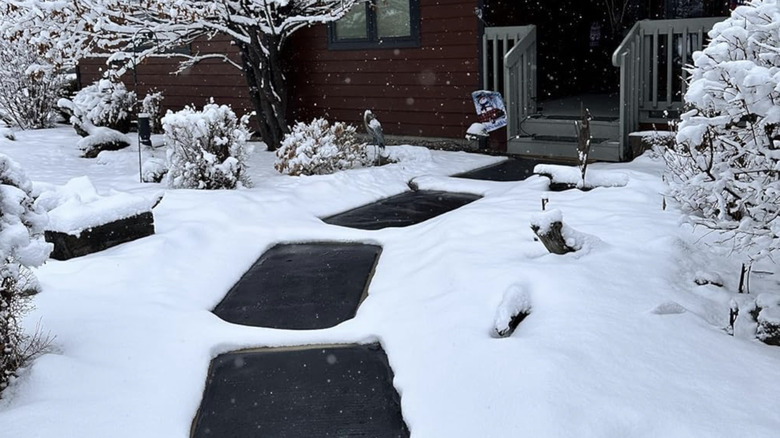
The mats are a bit of an investment: A HeatTrak 30-inch-by-60-inch mat with a power unit costs about $350. The same mat without a power unit costs about $50 less. There are stair-molded options and driveway-specific and commercial mats for heavy traffic. HeatTrak estimates electricity costs at 15 cents per hour to run one mat, the equivalent of running about four light bulbs for the same time. Even if you had 10 mats running, that's just $1.50 per hour, which is less than you'd pay the kid down the street. These mats are also an alternative to salt or other ice-melting chemicals that could damage your driveway.
Reviewers on Amazon give this a cumulative 4.4 out of 5 stars from about 1,600 total reviews. Many reviewers noted the convenience and how well these mats work. "Since I only use 2 mats and 1 step mat, it is easy to store them in my garage until before the next ice or snow event," Maryland-based Avidconsumer writes. "At my age the peace of mind of not having to shovel and chip away at this area is worth every penny."
There are a couple caveats: Some users needed to buy specific connectors or extension cords to fit their setups, an additional expense. The mats only melt the space where they sit, at about 2 inches per hour. If you're catching the snow as it falls and it's an average storm, the snow will melt as it falls. But if it's accumulated before you turn the mats on, expect to wait a couple hours for the all-clear. If the cost is a deterrent, you could always skip the mats for now and use this unexpected kitchen ingredient to melt sidewalk snow and ice instead.