

A Plant With Brilliant Autumn Colors You'll End Up Regretting Adding To Your Garden

If you're looking for an easy way to decorate your fence with vines, ivy plants are likely what come to mind. Many popular species of ivy are invasive in the U.S., but there is a native alternative. Virginia creeper (Parthenocissus quinquefolia) is a vine that resembles poison ivy, but is generally more colorful. New leaves are green with a bronze or purple tint; they fade to a duller green as they grow before turning strikingly red in fall. In late summer to early fall, the vines produce small berries that look like grapes. These are perfect for attracting a variety of birds, but you shouldn't eat them yourself, as Virginia creeper berries are toxic to humans.
Virginia creeper seems to have many benefits, and it's native to the eastern U.S. — so why do some gardeners warn against growing it? While Virginia creeper isn't technically invasive, it does have many of the same qualities as an invasive plant. It grows quickly and spreads aggressively, sometimes overwhelming other nearby plants. In a healthy ecosystem, seasonal wildfires keep it in check, but fires in developed areas are typically suppressed. This lets the plant spread further than it naturally would. Additionally, Virginia creeper is quite flammable, making it a poor choice for wooden fences or houses.
How to control and remove Virginia creeper
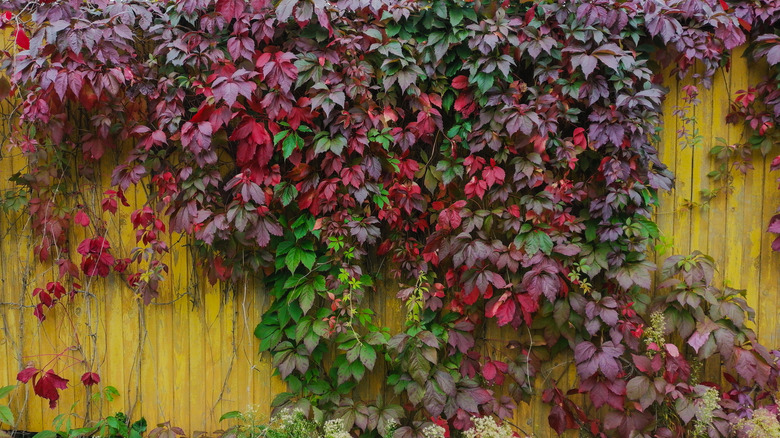
It might be tempting to replace your Virginia creeper with English ivy — but English ivy is also invasive, so it isn't a great alternative. Instead, try another native plant that's easier to control. Virgin's bower, American bittersweet, and Dutchman's pipevine are all good options if you want a native vine that won't take over your whole yard. If you still want to grow Virginia creeper, you can try to control the spread through careful pruning while removing plants that grow outside of where you want them.
If you already have Virginia creeper spreading across your garden, you can use a combination of physical and chemical control to get rid of it. Cut the plant back during the growing season, rather than while it is dormant. Make sure to cut it as far back as possible, removing the vines to prevent them from regrowing. From there, you can dig up as many of the roots as possible, or treat the remaining plant matter with an herbicide that contains glyphosate. If the Virginia creeper is growing over wooden surfaces, you may see some damage after removing the vine. This is because the holdfasts, which are tiny, sticky vines that keep the plant attached to vertical surfaces, are quite strong. Your fence or wall may need another coat of paint after the plants are gone.