

Tricks To Help Identify What Animal Is Digging Holes In Your Yard
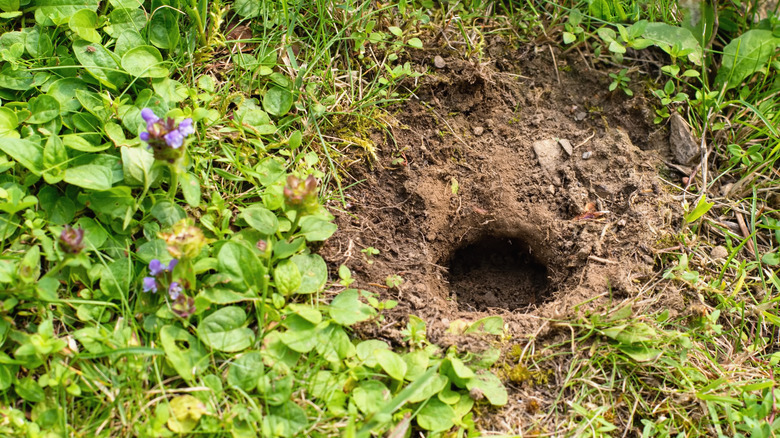
There's nothing more annoying than finding your yard full of freshly-dug holes, especially when you don't have the first clue as to what's causing the damage. While you can quite safely assume that it's an animal behind the burrowing, that doesn't really narrow down the list. And since identifying the culprit critter is key to getting on top — and ideally ahead — of the problem, this head-scratching mystery becomes all the more frustrating.
Fortunately, there are some tell-tale signs you can look out for that, in many cases, will quickly give the diggers away. The Internet Center for Wildlife Damage Management is a fantastic resource for this, offering creature-specific clues that will quickly help you get to the root of your problem.
At first glance, a hole in your garden looks like just a hole, but by identifying its unique characteristics, you'll be surprised at how easy it is to narrow down the list of potential critters. Depth, diameter, soil pile size, and the time at which the damage occurred can all help reveal the creature's identity.
Prairie dogs surround their holes with raised soil
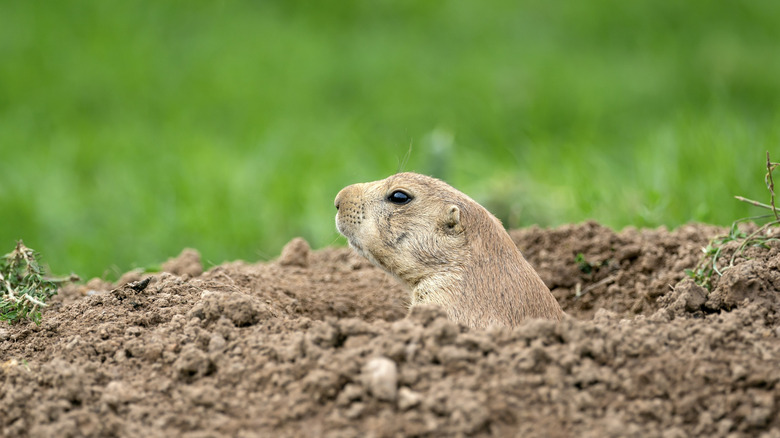
There are different species of prairie dog living across North America. In the United States, the Utah prairie dog can be found within an area of just 10.81 square miles of their namesake state. Gunnison's prairie dogs are more widespread, found in Arizona, Colorado, New Mexico, and Utah, while white-tailed prairie dogs are typically found in eastern Wyoming and in the valleys of the Rocky Mountains. The most common type is the black-tailed prairie dog, residing in areas across the north of the continent, from Saskatchewan in Canada to the north of Mexico.
If any of the above species are wreaking havoc in your yard, their holes should be fairly easy to spot. Surrounded by raised soil (higher than the level of the rest of your yard) and with a hole diameter of between 3 and 6 inches, prairie dog holes are quite distinctive. The problem is that prairie dogs typically live in colonies, which means that one hole will often mean more than one prairie dog. As for their preferred habitat, they typically occupy grassland or short shrubland, favoring those within easy reach of water.
Even if you're still unsure of whether or not the holes in your yard are caused by prairie dogs, there's a chance you can identify them another way. Since they're diurnal (meaning that they're mostly active during the day), their holes will usually be dug during hours of sunlight. So you never know — you may just catch them in the act.
Groundhogs often dig in the spring
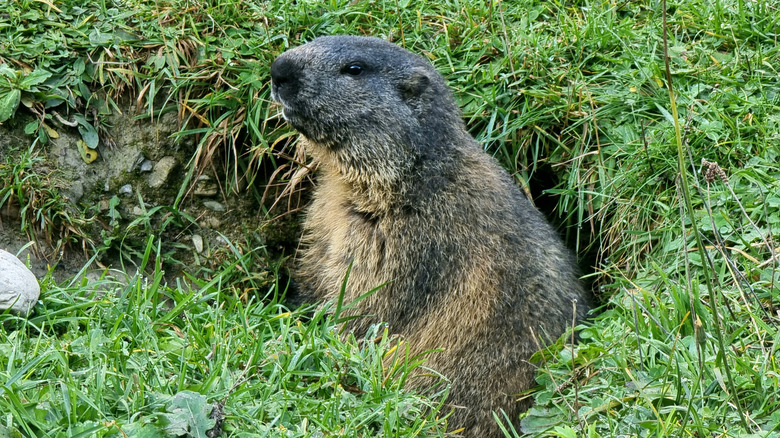
Groundhogs, otherwise known as woodchucks, are another diurnal digger. This means that the damage you find will usually occur during the day, and again, you may be able to spot them in the act of excavation. In fact, did you know that their scientific name is "Marmota monax," and that "monax" is actually a Native American term for "digger"?
If fresh holes are appearing in your garden during the spring, there's a good chance that they're the work of groundhogs. After waking from hibernation, they dig to extend their burrows in preparation to breed, as well as to find new sources of food. Look out for holes around 12 inches in diameter, with a large mound of excavated earth alongside. You might even find secondary openings, however, these usually won't be accompanied by the same pile of earth as the primary hole, since they're dug from underground.
If groundhogs have already established themselves, you may be able to identify them in the flesh. They spend much of their time standing upright, their heads and bodies popping out of their burrows as they look for danger. If they spot you, they may hide too quickly for you to see them. But if you listen out, you'll likely hear a sharp shrill — a warning call to their young that danger is coming and that they should hide, immediately.
Groundhogs appear across eastern and central North America, and typically favor areas of pasture, open woods, and areas alongside roads and streams.
Moles can dig at any time of day
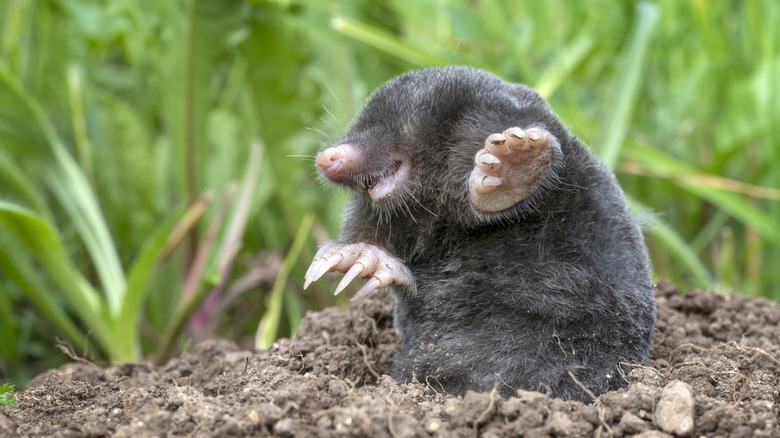
Anybody who has experienced moles in their garden will tell you that the classic arcade game is based on a very real feeling of frustration. This is for a few reasons. Not only do moles create messy mounds of earth (and lots of them) as they breach your soil, but they also create what are known as "furrows." Furrows are straight, elevated strips of grass or soil, and are usually a surefire sign of moles. They're also annoying, and without heavy machinery, you'll need to employ some creative tricks to level your bumpy lawn.
To clarify if a mole has damaged your lawn, check for holes that are around 2 inches in diameter. These will almost always be surrounded by piles of excavated soil, measuring between 6 and 8 inches across.
Common mistakes that attract moles to your garden include overwatering and forgetting to pest-proof it. Moles favor damp soil for easy tunnelling, and they seek areas with plenty of natural food. They are most commonly found in the eastern states and near the southern Great Plains, so if you live in these areas, these mistakes are definitely worth avoiding.
Voles make highways in grassy areas
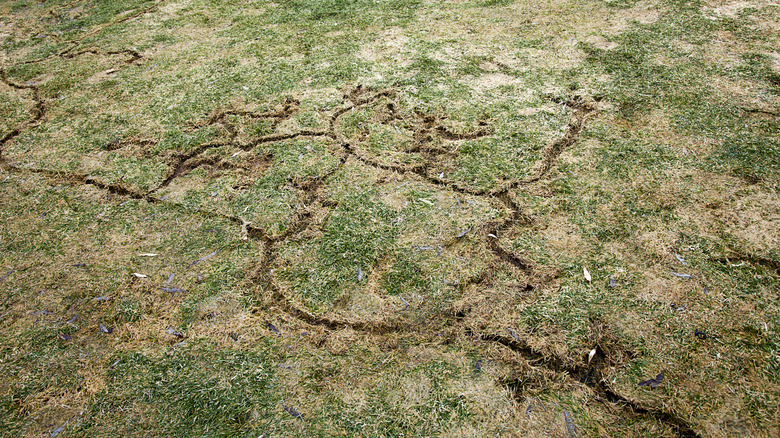
If you're starting to find "highways" of damage on your lawn, then voles could be your problem. Unlike moles, which tunnel underground and push the soil upwards to create furrows, voles tend to travel overground. And since they usually follow the same routes over and over again, vole traffic tends to trample down the grass, which is a handy giveaway if you're trying to identify which animal is damaging your lawn.
Otherwise known as "runways," these damaged strips of grass usually connect vole burrows to areas where plants and bulbs (usually grasses and forbs) are present, since this is what they usually eat. They also sometimes eat tree bark, so if you notice irregularly-patterned gnaw marks on nearby trees — and you find these at the end of trampled strips of grass — there's a good chance that voles are responsible.
Now, several species of vole could be damaging your lawn, since various species are present across the United States. The aforementioned highways are usually the work of meadow or prairie voles. Woodland voles create surface runways, too, but they tend to do so beneath the leaf litter that's present in their natural habitat, making them harder to spot.
As for their holes, they'll usually be golf ball-sized and concealed beneath grass and shrubs. To help you find them, look out for the runways, keep an eye out for gnawed trees, and check for pellet-shaped droppings, as these are all sneaky signs that your yard has a pest problem with voles.
Armadillos may dig several holes
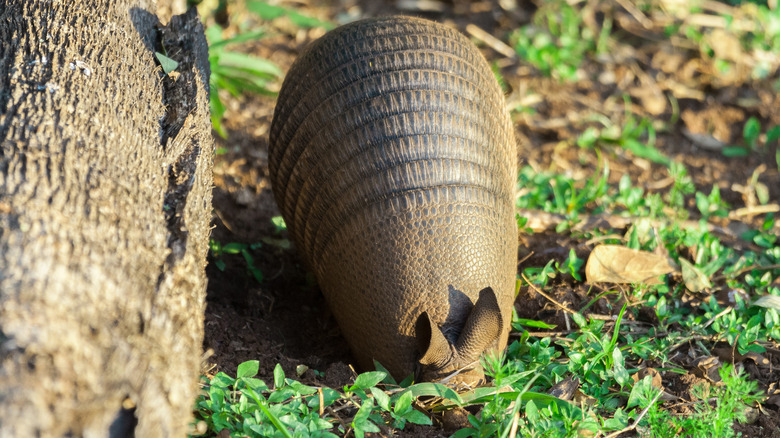
Although typically found in Central and South America, Armadillos are also present across an impressive 21 U.S. states, typically those in the southeast and south-central areas. This is largely because, as invertebrates without fur, they are better adapted to survive in warmer climates.
If you live in one of these areas and you suspect that the holes in your garden are the work of an armadillo, then there are a few things to look out for. Firstly, the entrance to an armadillo burrow is typically between 7 and 8 inches in diameter. The damage below ground is usually far more extensive, often extending as far as 15 feet. What's more, armadillos have been known to dig several dens in a single area, which they can later use to escape danger.
Despite their comparatively large size, the burrowing tendencies of armadillos tend to cause less damage to yards than moles and other, smaller creatures. Unfortunately, the armadillo doesn't just dig for shelter; most lawn damage actually occurs as armadillos dig for food. Multiple shallow holes of up to 3 inches deep and 5 inches wide are a tell-tale sign of an armadillo "rooting" for food, which, being nocturnal, they usually do at night.
Chipmunks dig holes in covered, sheltered areas
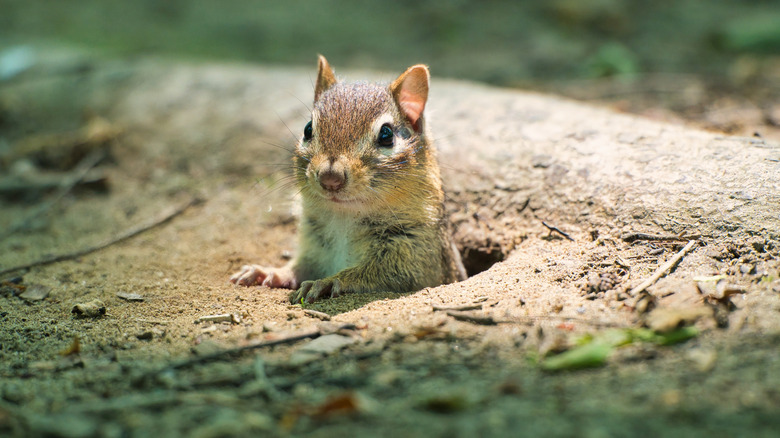
With 15 types of native chipmunks living across the United States, including the common eastern and least chipmunks, garden damage from chipmunks is widespread. So, too, is squirrel damage, and in areas where both animals are present, it can be hard to determine whether a squirrel or chipmunk is damaging your lawn.
Chipmunk burrows are typically quite small, usually between 2 and 3 inches in diameter. Below the ground, however, they can form extensive tunnel networks, which present something of a problem. If allowed to settle near your home, they can eventually cause structural damage. They do this by gnawing away at your foundations, which helps to keep their incisor teeth from over-growing. Since chipmunks often burrow beneath natural shelters like shrubs and ground-cover plants, you may want to avoid planting these close to your home.
Norway rats tend to nest near structures
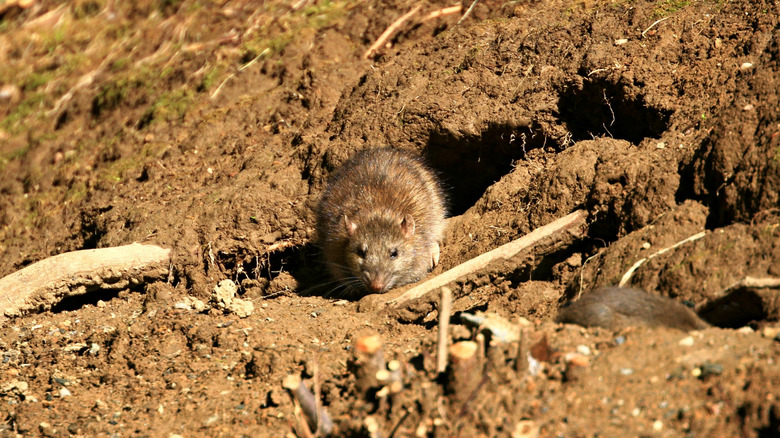
Despite Pixar's best efforts, few rodents are as strongly vilified as rats. And perhaps none more so than Norway rats. Otherwise known as brown rats, this species is prevalent across the country, favoring any area in which food, water, and shelter are abundant. Since they consider almost any type of food fair game, they look especially favorably on yards where garbage isn't properly covered and protected, or where there is easy access to food stores inside.
Norway rats usually burrow in the ground. The entrance to their burrows is usually between 2 and 4 inches in diameter, with edges that are smooth from the rats' frequent comings and goings. As for where they're likely to burrow, they prefer areas with sandy soil, especially those that lie within easy reach of food and water. And, similarly to chipmunks, if allowed to burrow beneath your house, they risk causing damage by gnawing your foundations, pipework, and even your electric cables.
Aside from their holes, Norway rats can also give themselves away by leaving grease marks along fences and foundation walls. Because they prefer to remain unseen, Norway rats — like many other rodents — tend to hug the shelter that these structures provide. And while they tend to avoid open spaces, you may also spot regularly-trampled pathways through it, since rats tend to follow the same routes whenever they venture from their burrows.
Skunks dig two types of holes
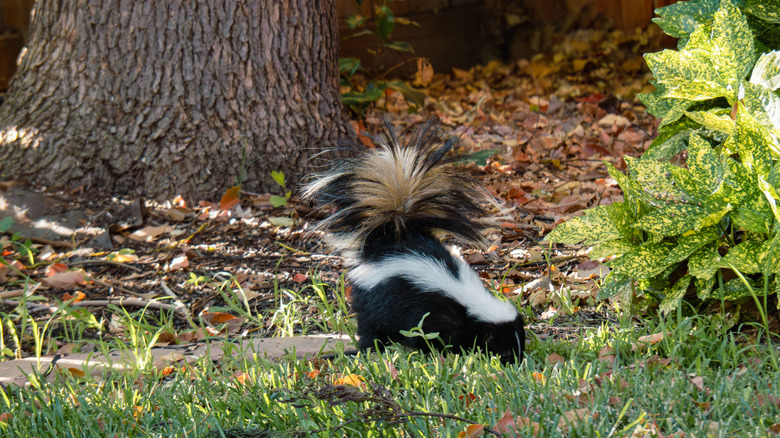
With a flash of white marking its otherwise black fur, it's hard to miss a skunk forging a path across your yard. At least, it is in the daytime, but since skunks are generally nocturnal, your chances of spying this smelly intruder are slim. Fortunately, they give themselves away in two distinct ways.
If you have a skunk residing in your yard, then you've probably started to find two different types of holes. One is much more ubiquitous than the other, and that's the type that skunks dig for food. These tend to appear in patches, are around 2 inches in diameter, and are usually just a few inches deep.
Burrows, on the other hand, are much deeper — so deep that you often can't see the bottom. What's more, since skunks like to dig beneath objects that provide protection and concealment, they're likely to have domestic designs on your shed or patio. They might even consider digging beneath the foundations of your home. So, if you suspect that you have a skunk lurking somewhere beneath your yard, try inspecting these obvious places first. And if you do happen upon a hole, look out for sparse hairs left behind by the skunk at the entrance.
Cottontail rabbits don't dig their own burrows
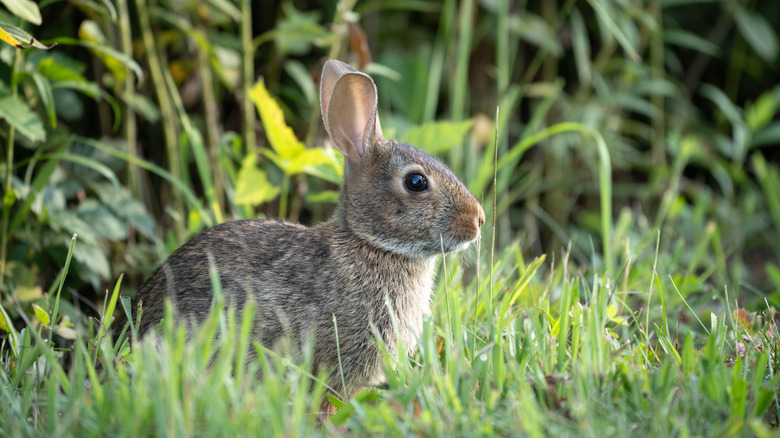
If you've found what you're almost certain is a groundhog hole only to see a cottontail rabbit spring forth from it, don't worry — there's a good reason for it. Contrary to popular belief, cottontail rabbits don't actually dig their own burrows. In fact, this particular rabbit doesn't often need a burrow at all. Only during especially poor weather do cottontails need such shelter, at which point they usually find cavities that already exist in the ground, including those dug by other animals.
What this means is that, if you see a rabbit venturing forth from a den in your garden, it's unlikely to use it for long. It also means that the critter that originally dug it has probably already moved on from your yard. Good news, right? Well, yes. But it's still worth noting the den's existence. If an animal deemed your garden worthy as a home once, there's a good chance that it could happen again.
Ground squirrels conceal their burrows in vegetation
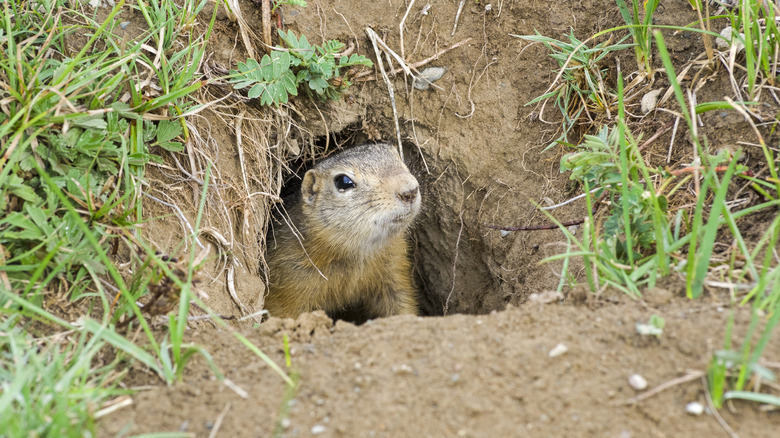
Ground squirrels, as their name suggests, prefer to burrow in the ground rather than seek shelter in trees. What's more, with various species suited to habitats across the United States — from North Dakota to Texas — they are a likely culprit for holes in gardens across the country.
They tend to burrow near obvious sources of food and can cause significant horticultural headaches in gardens with an abundance of home-grown produce. Fortunately, there are a few tell-tale signs that squirrels are feeding on your fruit. One is that you're likely to find their burrow entrances in areas that are protected by vegetation, so if you have an especially verdant vegetable patch, that's where you should start your search.
The entrances to ground squirrel burrows are usually quite small — around 2 inches in diameter. This can make them hard to spot, especially since they are mostly clean and devoid of excavated soil. To make your search easier, try looking for trampled plants in and around your patch, especially low-lying ones like grass. These often become worn from the squirrels' frequent comings and goings, and if found, can help lead you to those inconspicuous holes.
Pocket gophers leave a tear drop-shaped mound
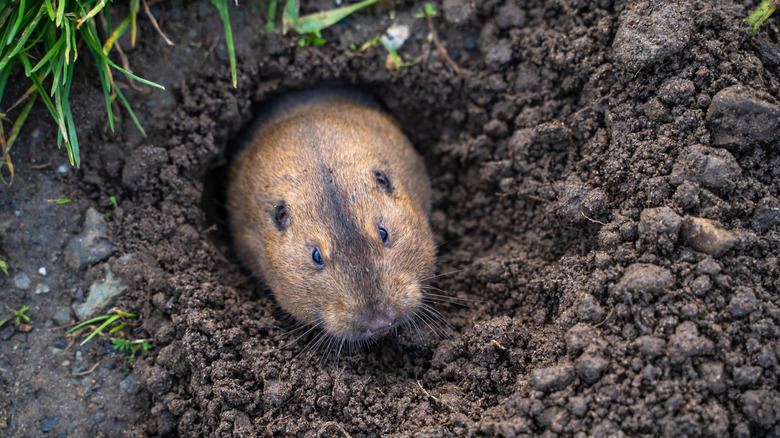
Typically found around the Great Plains region, as well as in the west and southeast United States, pocket gophers serve several important environmental functions. They help to aerate the soil, dig natural drainage for snowmelt (helping to minimize soil erosion), and their tunnels provide ready-dug shelters for several other species. This is all well and good until they begin to turf up your lawn.
If you think you might have pocket gophers tunneling beneath your yard, just take a close look at the holes. If they're shaped like a teardrop, then pocket gophers are a likely culprit. The shape of the hole is largely a result of the way these animals dig. Unlike moles, which burrow directly upwards and therefore disperse the excavated soil evenly around the hole, pocket gophers approach the topsoil from a 45° angle, which results in an uneven, teardrop-shaped mound.
In terms of the hole size, they're usually between 2 and 4 inches in diameter. And like other tunnelers, pocket gophers are unafraid to push through loose surface coverings, which is one of several things you should know before using gravel and other similar materials in your landscaping project.
Raccoons dig messy holes in search of food
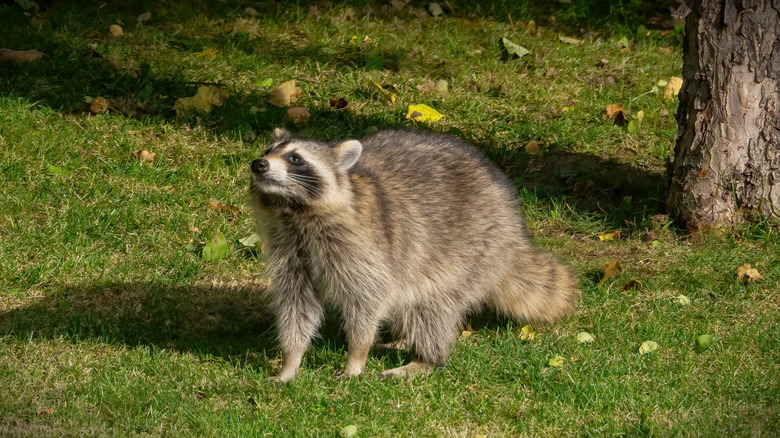
Raccoons are immensely resourceful and adaptable creatures, and can be found in an array of habitats, from built-up urban areas and woodland to swamps, prairies, and even savannahs. Now, the good news is that, if they're present in your area, they probably aren't digging burrows in your yard. This is because they don't usually dig their own, instead preferring to seek shelter in tree hollows. They will also, quite happily, commandeer burrows that have been dug and abandoned by other creatures.
However, that's not to say that raccoons won't still damage your lawn. In fact, if you've started to find big, messy, torn-up patches of turf in your garden, they were probably the work of a raccoon in its perpetual search for food. Thanks to their size (approximately the same as a house cat), their dextrous paws, and sharp claws, raccoons can make light work of your lawn. And they will, especially if they sense a tasty morsel.