

How To Manage Phone Battery Life While Hiking In Areas With Poor Or No Reception

We may receive a commission on purchases made from links.
One of the most peaceful and fulfilling aspects of hiking is that it offers an escape from the fast-paced world of social media and screens. It's the remote nature of many hikes is what makes them so extraordinary. With a great variety of long trails across the country, Americans have many options for amazing thru-hikes and backpacking trips. Whether taking on a multi-day trek or just a day hike, managing your phone's battery life is an essential safety precaution, as your can call for help even where there's no service. It's arguably the best tool in the event of an emergency.
Even with weak or no service at all, many modern phones can contact local EMS and law enforcement using satellite connections rather than cell tower connections. The usefulness of your phone as a safety device is greatly compromised if the battery dies while you hiking. Despite seeming the obvious option, it is not the best course of action to toss your phone into airplane mode in hopes of saving the battery. While this setting does conserve power, it also isolates: You are unable to receive texts or calls, and your location is not visible to others.
Instead, there are several clever tricks to optimize battery life. These boil down to simply decluttering and limiting the energy output of your phone. Running your screen brightness as low as possible and closing all unnecessary apps can help improve the lifespan of your phone while still allowing for emergency calls. Additionally, using Low Power Mode, if it's available on your phone and operating system, will automatically adjust your phone's settings to run at their most efficient levels.
External solutions to increasing battery life and accessibility
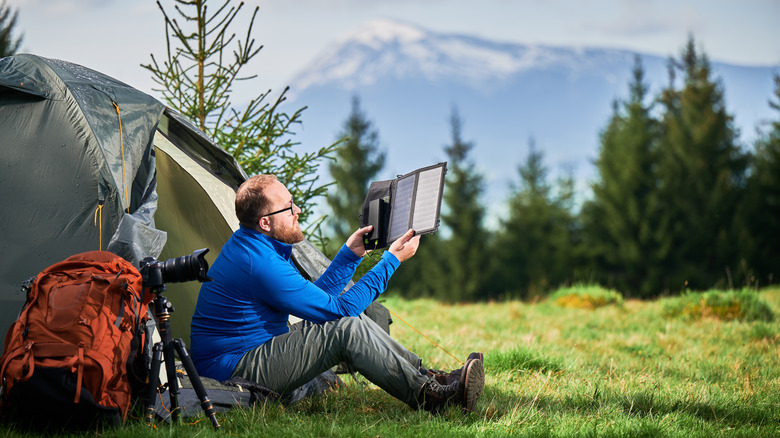
While using low power mode and ensuring your phone is not consuming too much energy is helpful in the short term, for longer hikes, external solutions have the most lasting effect.
For those going on very long hikes, investing in a dedicated device that utilizes satellite technology could take the place of a phone. Products like the Garmin inReach and the InReach Mini offer live tracking, text messaging, and navigation, with the most affordable model costing around $400.
While the InReach is one of the more expensive forms of satellite communication, opting for a portable charger can also help boost your phone's longevity. Many chargers are available, including models that also serve as portable lanterns. Portable chargers are a more cost-effective option, with high-performance chargers ranging in price from $40 to $100. Additionally, there are options for those who want to harness the power of the sun. Chargers like the Blavo 10-watt solar panel for phones are ideal for isolated hikes through national parks or along the Pacific Crest Trail. For a comprehensive system, one could also opt for a portable charger, using solar panels on sunny days to recharge the bank for use during rainy days.
Ultimately, the risk of hiking in remote, low cell service areas is well worth the reward (after all, people hiked these trails long before they could carry phones with them). However, ensuring your phone is charged and in low-power mode is key. Limiting the use of airplane mode and opting for a portable charger or InReach is the safest way to ensure that, if something bad happens away from civilization, help is on the way.